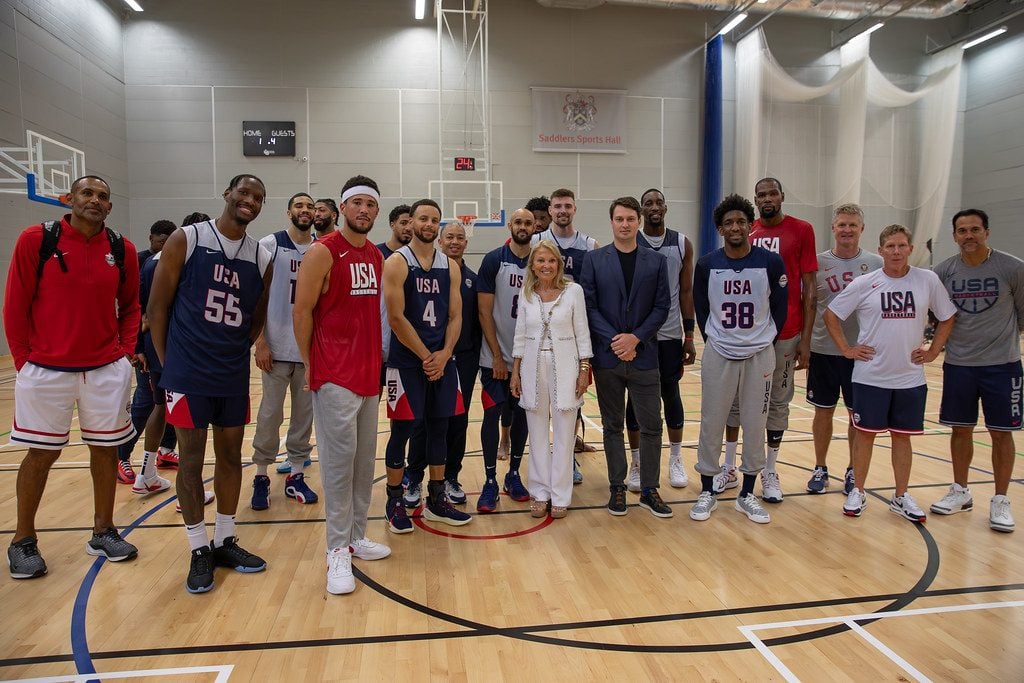

Predicting Team USA an Olympic roster more than two years out presents a unique statistical challenge, especially for a talent-rich nation like the United States. With Kevin Durant declaring his intent to pursue a historic fifth gold medal at the 2028 Los Angeles Games, the analytical lens shifts from “if” he plays to “who” complements his veteran presence.
This isn’t merely about assembling the 11 next-best players; it’s about optimizing for FIBA play, where statistical profiles often diverge from NBA norms due to rule variations and stylistic differences. The 2024 Olympic roster demonstrated this, with Derrick White, a role player statistically, out-impacting Jayson Tatum, an NBA superstar, in certain crucial moments.
Predicting Team USA
Durant, despite turning 39 by the 2028 Games, remains an elite offensive force. His efficiency metrics, particularly his true shooting percentage (TS%) and effective field goal percentage (eFG%), consistently place him among the league’s top scorers. For instance, in his age-35 season, Durant maintained a TS% well above 60%, a testament to his adaptable scoring arsenal. This efficiency, combined with his length and shooting prowess, translates seamlessly to FIBA’s shorter three-point line and more physical defense, where spacing and individual scoring ability are at a premium. His statistical longevity suggests that even in a reduced role, perhaps off the bench, his impact per minute will remain significant.
Optimizing for FIBA’s Statistical Nuances
FIBA rules, lacking a defensive three-second violation and goaltending, foster a more congested paint and emphasize perimeter shooting and defensive versatility. This means players with high usage rates coupled with strong assist-to-turnover ratios, and those who can defend multiple positions without fouling excessively, gain significant value. Consider the statistical profiles of guards. A player like Tyrese Haliburton, whose assist percentage often ranks among the league leaders and who maintains a low turnover rate, becomes particularly attractive for Team USA. His ability to facilitate offense and minimize mistakes under pressure is a crucial FIBA attribute. Similarly, guards who can credibly shoot from long range, even from the shorter FIBA arc, open up driving lanes and alleviate defensive pressure.
For wings and forwards, two-way versatility is paramount. Players who can switch defensively, contest shots, and rebound effectively while also contributing efficiently on offense are invaluable. Jayson Tatum, for example, despite his bench role in 2024, possesses the statistical breadth in scoring, rebounding, and playmaking that makes him a strong candidate Team USA. However, his defensive focus and ability to adapt to a more physical, less whistle-happy game will be critical.
The statistical advantage goes to players who excel in defensive win shares and defensive box plus/minus (DBPM), indicating their consistent impact on limiting opponent scoring. Furthermore, the absence of goaltending means rim protection becomes more about verticality and deterrence than shot-blocking after the peak. Players who influence shot selection and funnel opponents into tough looks, rather than just blocking shots, will be key.
The Next Generation: Statistical Rise Team USA
The “talent boom” referenced means a new wave of American prospects will be entering their prime by 2028. Players like Victor Wembanyama, though French, highlights the global nature of this talent. For Team USA, this means evaluating players like Paolo Banchero and Chet Holmgren who, by 2028, will have several NBA seasons under their belt. Banchero’s statistical versatility in scoring, rebounding, and playmaking, coupled with his improving efficiency, makes him a strong candidate for a forward spot. Holmgren’s elite shot-blocking and three-point shooting, a rare combination for a big man, align perfectly with FIBA demands for spacing and rim protection. His block percentage and three-point efficiency would be highly valued.
The statistical selection process for the 2028 Team USA roster will be less about individual scoring titles and more about complementary skill sets and efficiency within a team context. While Durant’s seniority and proven FIBA success grant him a spot, the remaining 11 will be meticulously chosen based on their ability to thrive under FIBA rules, their defensive impact, and their offensive efficiency. The goal is a statistically balanced roster, capable of dominating both ends of the floor, not just a collection of star power.
Source: Editorial Use | Image: Editorial Use