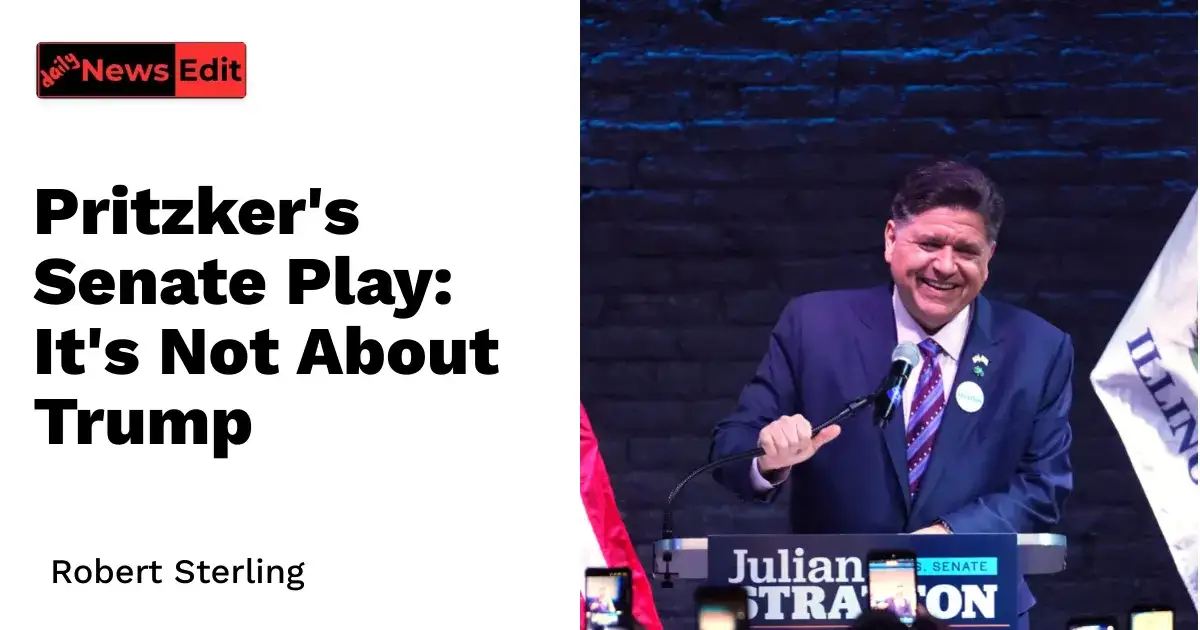

The political landscape is littered with the carcasses of ambitious men who believed their money could buy them a crown. Now, J.B. Pritzker, the billionaire governor of Illinois, is making his audacious play, attempting to sculpt the 2026 U.S. Senate map in his image. This isn’t merely about ideological purity; it’s about raw power, unbridled ambition, and a cynical rebranding of political patronage for the modern age.
The mainstream press, ever eager for a neat narrative, seems to miss the real story. Pritzker isn’t just targeting Trump-backed candidates; he’s targeting the very soul of democratic representation, attempting to buy influence with a checkbook rather than earn it through genuine grassroots engagement. Does anyone actually believe his sudden, aggressive foray into national Senate races is purely altruistic? The emperor, in this case, is wearing a very expensive suit, and his motives are as transparent as his immense wealth. This isn’t charity; it’s a calculated investment in his own political future, disguised as a fight for the republic.
The Billionaire’s Gambit: A Play for National Power and Personal Legacy
Pritzker’s latest maneuvers – a flurry of high-profile endorsements, multi-million dollar commitments channeled through PACs, and virtual town halls – are not the actions of a humble governor focused solely on Illinois. These are the calculated moves of a man with national aspirations, a billionaire attempting to fashion himself into a Democratic kingmaker, or perhaps, even a future presidential contender. As CNN reported on March 17, 2026, Pritzker declared:
“We cannot afford to let the extremism championed by Donald Trump take root in our Senate. These races are about protecting our democracy and ensuring a future where common sense prevails over conspiracy.”
A noble sentiment, perhaps, but one that conveniently aligns with his own ascent up the political ladder. Is it truly about “common sense” prevailing, or about J.B. Pritzker’s brand of common sense prevailing, funded by his vast personal fortune?
But let’s peel back the layers of this carefully constructed narrative. The public isn’t buying the fairy tale. Online discourse, particularly on platforms like Reddit’s r/illinois and r/politics, paints a far more cynical picture. Users are openly questioning Pritzker’s motivations, pointing to his past financial interventions in Illinois politics, such as the reported $5 million super PAC dump that aided Juliana Stratton’s win, effectively sidelining Black rivals like Robin Kelly and Raja Krishnamoorthi. One Reddit user didn’t mince words, calling it “buying a Senate seat with daddy’s casino cash” while Illinois grapples with “sky-high taxes and crime.” This isn’t just about partisan bickering; it’s a deep-seated distrust of money’s outsized role in shaping our political outcomes. It’s the uncomfortable truth that for many, Pritzker’s political machine feels like a perpetuation of the very corruption he claims to fight.
The Illusion of Choice: When Money Drowns Out Authentic Voices
The notion that Pritzker is simply “swinging” Senate races is a polite euphemism for what many perceive as outright manipulation. When a single individual, no matter how well-intentioned, can pour millions into races outside his state, what does that say about the integrity of the democratic process? It says that access to vast personal wealth can effectively short-circuit the traditional pathways of political advancement, where candidates are supposed to rise or fall based on their connection to voters and their ability to articulate local concerns. It screams that the marketplace of ideas is rigged, and the highest bidder wins.
“Pritzker’s not kingmaker, he’s king—Stratton’s his DEI puppet to launder anti-Trump rage while he eyes 2028 White House lotto ticket,” one particularly biting Reddit comment suggested. This isn’t just idle speculation; it’s a reflection of a deeply held belief among many Americans that their votes are increasingly overshadowed by the financial might of political elites. The Congressional Black Caucus chair, Yvette Clarke, even blasted what she termed “frustrating” interference in Black representation, highlighting the very real human cost of these high-stakes financial interventions. Are we truly to believe that Pritzker’s millions are solely for the good of the party, or for the good of J.B. Pritzker? The answer, for anyone paying attention, is self-evident.
The Trump Effect 2.0: A Convenient Scapegoat for Unfettered Ambition?
Pritzker’s strategy hinges heavily on the “Trump effect,” framing the 2026 Senate races as a referendum on the former president’s continued influence. It’s a politically astute move, no doubt, given Trump’s polarizing nature. By painting all Trump-endorsed candidates as “extremists,” Pritzker attempts to simplify complex political contests into a binary choice: pro-Trump extremism or Democratic common sense. It’s a narrative designed to bypass nuance and rally the base, but at what cost to genuine democratic discourse?
But this narrative, while convenient, obscures the reality that many of these races involve genuine local issues and diverse voter concerns. As an RNC spokesperson noted, “Governor Pritzker is attempting to buy elections and impose his radical agenda on states that don’t want it. Voters will see through this blatant attempt to manipulate the democratic process.” While the RNC’s rhetoric is predictably partisan, the sentiment resonates with a public tired of nationalized politics overriding local voices. What about the nuanced challenges facing voters in these swing states? Are they merely pawns in Pritzker’s grand chess game against Trump? The constant focus on national figures and their vast resources often means that the granular, everyday struggles of ordinary people are completely ignored, if not actively trampled underfoot by the march of big money.
Consider, for a moment, the specific dynamics of a state like Ohio or Montana, where local economies, agricultural policies, or specific energy concerns might dominate voter priorities. When Pritzker’s millions flood these races, are they genuinely empowering local candidates to address these issues, or are they simply forcing a nationalized, anti-Trump agenda down the throats of voters who might have entirely different concerns? This isn’t just a theoretical question; it’s a fundamental challenge to the principle of representative democracy, where local voices are supposed to matter most. Pritzker’s deep pockets risk turning these crucial local battles into mere proxies for his own national ambitions, leaving the actual needs of the electorate unaddressed and unheard.
The Erosion of Localism and the Rise of the Oligarch
The consequences of this kind of top-down, money-driven politics are far-reaching. It fosters an environment where grassroots organizing, genuine community engagement, and the development of local political talent are increasingly marginalized. Why bother knocking on doors and holding town halls when a billionaire can just write a check and parachute in a preferred candidate? This isn’t just about Pritzker; it’s a broader, insidious trend that threatens to hollow out the democratic process, replacing authentic representation with a system where influence is directly proportional to wealth. We are witnessing the slow, deliberate transformation of our republic into an oligarchy, where the rich dictate the terms of engagement.
Fox Chicago’s Paris Schutz, while acknowledging Pritzker as the “biggest special interest winner,” inadvertently highlighted the public’s deeper unease. Commenters quickly turned the praise into scorn, likening Illinois Democrats to a “Pritzker crime family” succeeding Mike Madigan’s alleged corruption. The implication is clear: whether it’s old-school political machines or new-school billionaire benefactors, the end result is the same—voters feel their voices are being drowned out by powerful interests. Is this the democracy we fought for, or merely a more polished version of the same old power grab?
The “King of Illinois” narrative, then, is not a reflection of Pritzker’s political acumen, but rather a chilling reminder of how easily our democratic institutions can be influenced, if not outright controlled, by those with the deepest pockets. This isn’t strengthening democracy; it’s buying it, piece by piece, and the price is paid by the very voters whose interests are supposedly being served. The question for every American isn’t whether Pritzker will succeed in his gambit, but whether we, the people, will allow our democracy to be auctioned off to the highest bidder.
Source: Google News