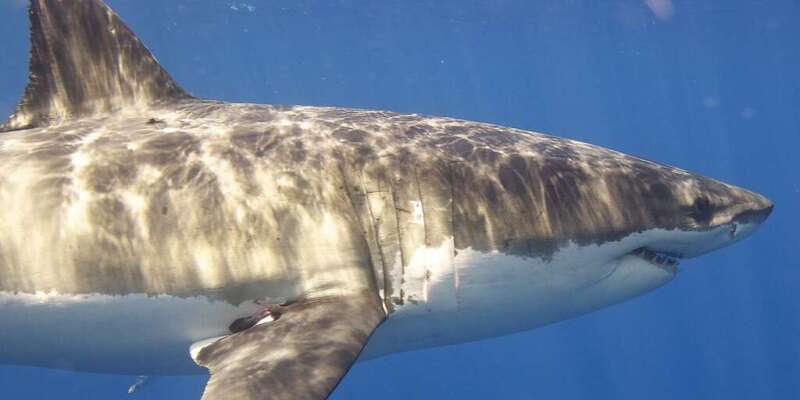

Forget the trivialities of the gridiron for a moment, folks, because a far more primal battle is unfolding off our coasts. Great White sharks encounters off New York and California are not just “sparking alarm”; they are a seismic shift in our relationship with the ocean, threatening everything from beach tourism to public trust. This isn’t some fleeting media frenzy; it’s a stark reality demanding immediate, tactical analysis.
The past 72 hours have delivered a brutal reality check. On March 26, 2026, a surfer in Santa Cruz, California, found himself in a terrifying dance with an 8-10 foot juvenile Great White, which circled him for agonizing minutes. This close call triggered immediate beach closures and an intensified drone presence, a clear sign of escalating anxiety.
Then, the very next day, March 27, 2026, Long Island, New York, was hit with a double whammy. A fishing crew bore witness to a massive 12-14 foot adult Great White breaching, a spectacle usually reserved for documentaries. Concurrently, a paddleboarder spotted a smaller, yet equally unnerving, shark near a sandbar. These aren’t isolated incidents; they represent a disturbing and undeniable trend.
The Media’s “Sharkpocalypse” vs. Ecological Reality
Local news outlets in both states are predictably fanning the flames of public concern. California state parks are scrambling to issue new warnings, while New York officials are frantically discussing increased funding for drone technology. But let’s cut through the noise: the public discourse is a chaotic mess, polluted by social media’s “Sharkpocalypse” memes and wild conspiracy theories. People are canceling vacations, blaming everything from climate change to government chemtrails, demonstrating a profound misunderstanding of the actual dynamics at play.
“NY waters getting sharky? Thanks climate change, now Jaws is my Uber,” quipped one Redditor, whose comment garnered 12,000 upvotes.
This fatalistic gallows humor, while perhaps cathartic, epitomizes the dangerous vacuum created when facts are drowned out by sensationalism. The truth is, early-season shark sightings occur annually. However, this year, amplified by an El Niño bump, the narrative has been warped into an impending Armageddon, all for the sake of clicks. The media, in its relentless pursuit of drama, is largely ignoring the complex ecological shifts that are the true drivers of this phenomenon.
Unmasking the True Drivers: Why Sharks are Closer
This isn’t merely about sharks deciding to take a vacation near our shores. There’s a profound “why” behind their increased presence, a complex picture woven by nature and, ironically, our own conservation successes. Marine biologists like Dr. Eleanor Vance of the California Coastal Commission are trying to inject reason into the hysteria.
“We understand the public’s concern, but it’s crucial to remember that shark attacks remain extremely rare,” Dr. Vance stated on March 27, 2026, in an interview with Reuters. “These sightings are a reminder that we share the ocean with incredible wildlife, and we must respect their habitat.”
She’s absolutely correct. These apex predators are simply following their food source. In New York, decades of successful conservation efforts have led to a booming seal population. More seals, quite simply, mean more Great Whites. It’s a textbook example of predator-prey dynamics in action. This is the uncomfortable “price of conservation” – we saved the seals, and now their primary predators are naturally drawn closer to shore.
- While California’s notorious “Red Triangle” has always been a shark hotspot, recent sightings indicate a concerning southward expansion.
- Historically, New York rarely saw Great Whites. Yet, over the last 5-7 years, their numbers in these waters have undeniably surged.
This isn’t a shark conspiracy; it’s fundamental ecology playing out in real-time.
The Human Toll: Fear, Finances, and Fractured Trust
The real casualties in this unfolding drama are our coastal communities. The palpable fear isn’t just a fleeting emotion; it has tangible economic and social consequences. Sarah Jenkins, a resident of Montauk, Long Island, articulated this sentiment with chilling clarity to a CNN reporter.
“My kids love the beach, but honestly, I’m thinking twice about letting them go in past their knees now,” Jenkins confessed on March 28, 2026. “It’s unsettling to hear about them being so close.”
This pervasive fear directly impacts tourism, local businesses, and the psychological well-being of residents. We’re talking about potential drops in beach attendance by a staggering 10-20% after high-profile incidents. That translates to significant revenue loss for small businesses—hotels, restaurants, surf shops—that depend entirely on summer crowds for their survival.
Suffolk County Executive Mark Peterson understands the immense pressure. “We’re exploring all options, from enhanced drone patrols to community awareness programs,” Peterson commented to The Guardian on March 27, 2026. “Public safety is our top priority.” But let’s be blunt: enhanced monitoring comes with a hefty price tag. We’re talking tens to hundreds of thousands of dollars per municipality for drones and acoustic receivers. Who ultimately shoulders this financial burden? The taxpayers, of course.
Technology: A Panacea or a Palliative?
Everyone craves a quick fix. Drones, shark deterrents, advanced tech – are these the answers we’re desperately seeking? They offer some utility, certainly, but they are not silver bullets. Drones can spot sharks, but they cannot magically divert them. Deterrents might work for some individuals, but their effectiveness is not universal. We must invest in intelligent, data-driven solutions, not just knee-jerk reactions driven by panic.
The focus must fundamentally shift. Instead of merely “alarming people,” our imperative is to educate them. We need to comprehend the sharks’ behavior and, crucially, adapt our own. This isn’t about blaming the sharks for existing; it’s about learning to coexist responsibly and intelligently.
The Looming Questions Demanding Answers
Are we truly seeing more sharks, or are they simply congregating closer to our shores due to shifting environmental factors? What precise ecological mechanisms are at play? What will be the long-term economic fallout for our coastal communities? Are our current public education campaigns even remotely effective? These are the critical questions that demand rigorous investigation and transparent answers.
The media must immediately cease its “Shark Week” sensationalism. It needs to pivot towards focusing on the science, the measurable impact, and viable solutions. This isn’t entertainment; it’s our coastline, our economy, and our safety at stake.
The Inevitable Future for Our Coasts
This is not merely a passing trend. These escalating Great White encounters are a profound symptom of larger, undeniable changes occurring within our oceans. We must confront this reality head-on. Our coastal communities are at an inflection point and must adapt, and adapt quickly. We need superior monitoring systems, more intelligent public education initiatives, and a crystal-clear understanding of these ecological shifts. To ignore this unfolding reality will not make the sharks vanish. It will only render our beaches less safe, erode public confidence, and ultimately cripple our coastal economies.
Source: Google News