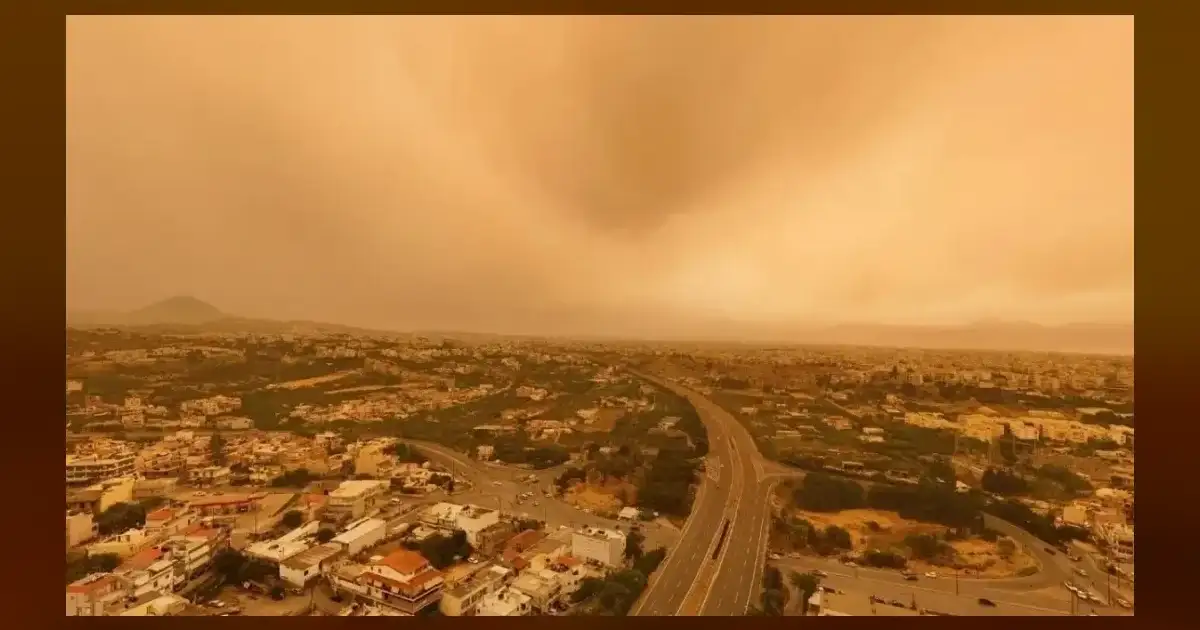

Reports of a significant dust storm and tornadoes in Greece have ignited a fervent online debate. Far from accepting dramatic headlines, a vocal segment of the internet dismisses these “apocalyptic” claims as an elaborate April Fool’s hoax, showcasing a profound distrust in mainstream reporting on extreme weather events.
Mainstream media outlets quickly disseminated a narrative of chaos, highlighting Saharan dust storms transforming Greek skies into an “eerie red and orange hue.” They detailed tornadoes striking Crete and numerous Easter flights being diverted or canceled. Yet, on platforms like Reddit’s r/Greece and X (formerly Twitter), the public’s reaction has been one of pronounced disbelief, bordering on outright rejection of the official narrative.

The Skeptic’s Lens: Deconstructing the “Apocalypse”
Official accounts painted a grim picture, with sources citing PM10 levels soaring “far exceeding” safety guidelines. They claimed approximately 20 international and domestic flights were diverted or canceled, affecting an estimated 3,000 to 5,000 passengers. The Greek Tourism Confederation (SETE) even voiced concerns over “millions of euros” in lost revenue.
However, online communities were swift to highlight perceived inconsistencies. One popular Reddit thread sarcastically labeled the coverage as “Proto Thema’s annual prank edition,” drawing parallels to past instances of perceived holiday hysteria. Photographs of “eerie red skies” were dismissed as “bad Mad Max cosplay,” with users asserting they were “not actual weather” but rather filtered or manipulated images. Flight diversions, often presented as evidence of the dust storm’s severity, were casually brushed off as “routine Heraklion fog excuses,” not a “dust Armageddon.” This represents a forceful and collective rejection of the prevailing narrative.
Why the Erosion of Trust? A Pattern of Hyperbole
This public reaction is not an isolated incident. It stems from a palpable fatigue with what many perceive as a continuous stream of “apocalyptic” weather reports. Social media users frequently recall past forecasts, such as “storm Erminio,” which were predicted to be catastrophic but ultimately “fizzled into muddy drizzle.” This perceived pattern has led many to believe that media outlets are engaging in “fearmongering for engagement,” particularly during holiday periods.
The skepticism extends to more conspiratorial corners of the internet. One viral X chain provocatively suggested a “climate change psyop,” humorously positing it was designed “to guilt-trip tourists into staying home.” On subreddits like r/conspiracy, some users even attempted to link the weather events to “HAARP weather weapon tests,” framing them as part of a “satanic ritual.” Meanwhile, r/climateskeptics dismissed “PM10 spikes” as “manipulated data,” arguing it was being used “to hype green agendas.” These extreme interpretations underscore a deep-seated suspicion and a pervasive distrust in official scientific and media pronouncements.
The Unseen Costs of Sensationalism in Communication
While the meteorological phenomena of dust storms and localized tornadoes are real, the public’s response to their reporting is critically important. It starkly illuminates a significant breakdown in trust between information providers and their audience. When nearly every weather event is framed as an “end times” scenario, people inevitably become desensitized. This desensitization can lead them to doubt even legitimate warnings, a predicament that carries considerable danger.
Dr. Eleni Mykonos, a meteorologist at the National Observatory of Athens, described the event as “highly unusual.” Yet, for a public wary of hyperbole, the term “unusual” can easily be misconstrued as “exaggerated.” This undermines serious scientific discourse and impedes the ability to effectively convey genuine risks. How can we expect the public to discern true emergencies from routine occurrences if the language used to describe both is perpetually amplified?
Geopolitical Reverberations: When Weather Becomes a Political Football
From an international affairs perspective, this widespread distrust carries broader implications. If populations are conditioned to dismiss severe weather events as mere “pranks” or media fabrications, how will they react when confronted with truly existential climate crises? What will be their response to urgent calls for international cooperation and policy changes?
The Greek Ministry of Climate Crisis and Civil Protection affirmed that they “activated emergency protocols” and prioritized “public safety.” However, if the public perceives such actions as an overreaction, it erodes institutional credibility. This erosion can impact future crisis management, potentially even affecting regional stability in a world grappling with increasingly frequent and intense weather events.
Consider the immediate economic fallout. The Rhodes Hotel Association lamented “thousands of tourists” having their “plans ruined,” characterizing it as a “significant blow to our local economy.” If potential tourists encounter conflicting or alarmist reports, they might simply choose to avoid the region altogether, regardless of the actual severity of the event. This creates real economic damage that transcends the immediate weather conditions; it is fundamentally about perception and the fragile ecosystem of trust.
The Blurring Lines: Objective Reality Versus Online Narrative
The internet has become a battleground for competing narratives. Official reports from governmental bodies and established news organizations frequently vie for attention against citizen journalism, personal anecdotes, and cynical memes. A post that garnered over 10,000 likes, for instance, sarcastically quipped, “Visibility 1km? That’s just Athens smog on a bad day.” This illustrates the potent ability of online humor and collective cynicism to deflate even serious claims, highlighting the pervasive influence of user-generated content.
The fundamental issue at play is a glaring lack of clear, consistent, and measured communication. When official reports are perceived as alarmist or overly dramatic, they inevitably lose their intended impact. When the media consistently employs words like “apocalyptic” to describe a range of phenomena, it triggers an immediate and often visceral backlash. The public, particularly a discerning and digitally native public, seeks facts, nuanced context, and credible analysis, not a relentless diet of fear.
Rebuilding Trust in a Skeptical Age
The challenge confronting international organizations, national governments, and credible media outlets is starkly clear. How does one effectively communicate genuine threats in an age characterized by widespread skepticism and an inherent distrust of authority? How can the critical distinction be drawn between a rare, but ultimately manageable, weather event and an existential crisis demanding immediate, global action?
The Greek dust storm and tornado incident serves as a potent reminder. The credibility of the media, and indeed of all information purveyors, is under constant scrutiny and subject to rapid erosion. Exaggeration, even when stemming from a desire to inform or warn, can spectacularly backfire. It leaves populations not only vulnerable to misinformation but also significantly less likely to heed legitimate official warnings when they are most crucial.
We must advocate for a return to objective, fact-based reporting, meticulously avoiding the siren call of sensationalism. Without this fundamental shift, the next truly catastrophic crisis, whether environmental, geopolitical, or public health-related, risks being dismissed by a jaded public as nothing more than another elaborate April Fool’s joke.
Source: Google News