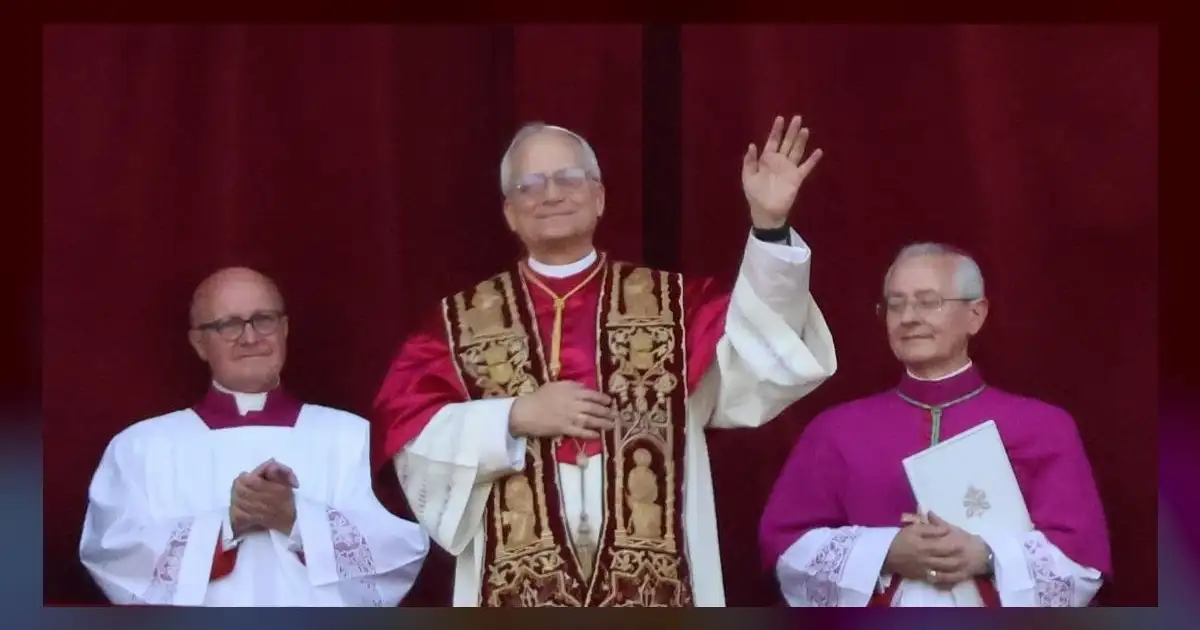

The Easter blessing delivered by Pope Leo XIV has ignited a global firestorm, casting a harsh spotlight on the Vatican’s precarious position in a hyper-skeptical world. Far from offering solace, his inaugural “Urbi et Orbi” address has been widely lambasted as a “deepfake psyop” and a “staged spectacle,” plunging the Holy See into an unprecedented crisis of credibility.
On Sunday, April 5, 2026, Pope Leo XIV made his highly anticipated debut, delivering his first Easter “Urbi et Orbi” blessing from the central balcony of St. Peter’s Basilica. The message, centered on themes of peace and God’s triumph over hatred and death, was intended to resonate with the faithful and offer hope amidst global turmoil. However, the reception was anything but reverent; it triggered an immediate and intense backlash, with many dismissing it as profoundly disconnected from the harsh realities of global suffering.

The Digital Inferno: Vatican AI Experiment or Unforeseen Backlash?
The fury directed at Pope Leo XIV is not merely intense; it is pervasive, amplified across every major social media platform. From the sprawling forums of Reddit to the rapid-fire conversations on X and the visually driven narratives of TikTok, a collective roar of cynicism has erupted, questioning not just the Pope’s message, but his very existence. Is this a crisis of faith, or a crisis of perception?
Conspiracy theories have proliferated at an astonishing rate, with many users vociferously claiming a “Vatican AI experiment.” The evidence cited, though anecdotal, has proven compelling to millions: “glitchy live streams” and viral clips showing the Pope’s face “morphing” mid-blessing have garnered over 5 million views. One particularly popular X thread, questioning “Why skip XIII? Illuminati numerology,” amassed 20,000 likes, fueling widespread speculation that the Vatican deployed advanced AI to generate a deepfake of a new Pope.
The discourse on Reddit has been equally scathing. On r/Catholicism, users decried the event as “disrespectful fanfic,” accusing the Church of a “Hollywood rebranding” in a desperate attempt to stem declining attendance—a move that, if true, has spectacularly backfired. On r/conspiracy, users dubbed him “Pope Leo the Fourteenth Error” and postulating that he is a “hologram replacement” for a “real” Pope supposedly kidnapped by shadowy globalist forces, a narrative disturbingly echoing familiar QAnon tropes involving “Vatican pedo rings.” Such extreme reactions underscore a profound erosion of trust.
A Message Lost in Translation: Tone-Deaf Amidst Global Agony
The Pope’s message, designed to be a beacon of hope, spoke of God driving out hatred and death. Yet, for countless observers, it came across as profoundly “tone-deaf PR fluff.” How could such platitudes resonate when the world grapples with the brutal realities of ongoing conflicts in Ukraine and Gaza?
The disconnect was stark. As one TikTok user ranted in a viral skit with 2 million views, “Transcends death? Tell that to the 40,000 dead kids.” The Pope’s words, intended to uplift, instead rang hollow, igniting outrage rather than inspiration. While Pope Leo XIV did specifically lament the conflicts in Ukraine and the Middle East, explicitly mentioning the Israeli-Palestinian conflict and highlighting the humanitarian crisis in Gaza, alongside crises in Sudan and the Democratic Republic of Congo, his calls for an immediate end to fighting and diplomatic solutions felt like a recitation of standard papal rhetoric, rather than a powerful, resonant plea.
His appeal to the international community to welcome refugees, while a consistent message from the Holy See, was similarly overshadowed by the broader controversy. The delivery and timing, rather than the content itself, fueled much of the anger. Many had anticipated a fresh perspective from a “new” Pope, a break from tradition that might offer genuine insight or a renewed sense of purpose. Instead, they perceived a performance.
The Illusion of Grandeur: A Staged Spectacle?
The prevailing sentiment across digital platforms is unequivocal: this Easter blessing was a meticulously “staged spectacle,” an overt attempt to inflate “flagging faith metrics.” The Vatican, it seems, is perceived as being under immense pressure, and this event is seen as a desperate, if clumsy, public relations maneuver.
Users on X claimed to have “proven” this staging, citing “crowd size discrepancies” and suggesting the use of “pre-edited footage.” The Pope’s “smooth, perfect delivery” also raised significant eyebrows; it felt too polished, too flawless, almost artificial. While the Vatican reported an impressive 150,000 pilgrims gathered in St. Peter’s Square—a notable increase from pandemic years—skeptics were quick to question these figures, seeing them as part of the broader narrative manipulation. The perceived perfection of Pope Leo’s appearance, dispelling rumors of poor health, only deepened the suspicion rather than alleviating it. Was it too perfect to be true?
This event, more than any in recent memory, starkly highlights the ongoing decline in the Church’s moral authority. The public, weary of generic pronouncements, demands action and accountability. The grand spectacle, rather than reaffirming faith, has inadvertently exposed a profound chasm between the institutional Church and a disillusioned global populace.
A Crisis of Credibility: The “So What” Factor
Traditionally, the Pope’s Easter message serves as a global moral compass, offering solace, encouraging charity, and promoting peace. This year, however, it achieved precisely the opposite, igniting outrage and deepening skepticism. For millions suffering across the globe, this address was meant to offer hope, to signal that their pain was seen and acknowledged. Instead, the swirling controversy utterly overshadowed any potential comfort, rendering the Vatican’s message effectively lost.
The international community desperately requires moral leadership, particularly when confronted with immense suffering:
- An estimated 300 million people will require humanitarian aid in 2026.
- A staggering 120 million people are currently displaced globally, marking a record high.
- Trillions of dollars are forfeited annually due to ongoing conflicts and instability.
The Pope’s words are meant to directly address these monumental challenges. Yet, the focus has entirely shifted away from these critical issues, centering instead on his legitimacy and the Vatican’s perceived manipulative tactics. This represents a catastrophic failure of communication and moral leadership, at a time when it is most acutely needed.
Echoes of the Past, Disconnect from the Present
The “Urbi et Orbi” blessing boasts a rich and venerable history, spanning centuries, during which Popes have consistently addressed pressing global issues of peace and justice. Popes such as John Paul II and Benedict XVI utilized this platform to condemn wars, advocate for human rights, and call for international cooperation, underscoring the enduring nature of humanity’s challenges.
Pope Francis, in his pontificate, has emphasized “fraternity” and “encounter,” reflecting a commitment to dialogue and bridging divides. The contemporary landscape is vastly different. We live in an era of unprecedented cynicism, where information spreads instantaneously, and dissent can be voiced globally within seconds. The Vatican, it is now clear, can no longer unilaterally control its narrative in the face of such pervasive digital scrutiny.
The Uncertain Future of Papal Authority
The Vatican now confronts an existential challenge: how will it recover from this profound crisis of credibility? Can Pope Leo XIV, whose debut has been nothing short of disastrous, ever truly regain the trust and respect of a deeply skeptical global audience? The depth of this skepticism is not to be underestimated.
Should the Pope’s legitimacy continue to be questioned, his moral and diplomatic influence on world leaders will inevitably wane. This Easter blessing, rather than serving as a moment of unity and reflection, proved to be a profoundly missed opportunity. Instead of bringing people together, it has, paradoxically, driven them further apart.
The Church must adapt, and rapidly so. It must embrace transparency, directly addressing modern concerns with authenticity and candor. Generic calls for peace, however well-intentioned, are simply insufficient when large segments of the population suspect a “deepfake” at the heart of the institution. This Easter was a defining moment, vividly illustrating the vast and growing chasm between the Vatican’s traditional approach and the expectations of a contemporary, digitally-empowered world. The Church must bridge this gap, and do so convincingly, or risk an irreversible slide into irrelevance.
Photo: Photo by Edgar Beltrán / The Pillar on Openverse (wikimedia) (https://commons.wikimedia.org/w/index.php?curid=164971427)
Source: Google News