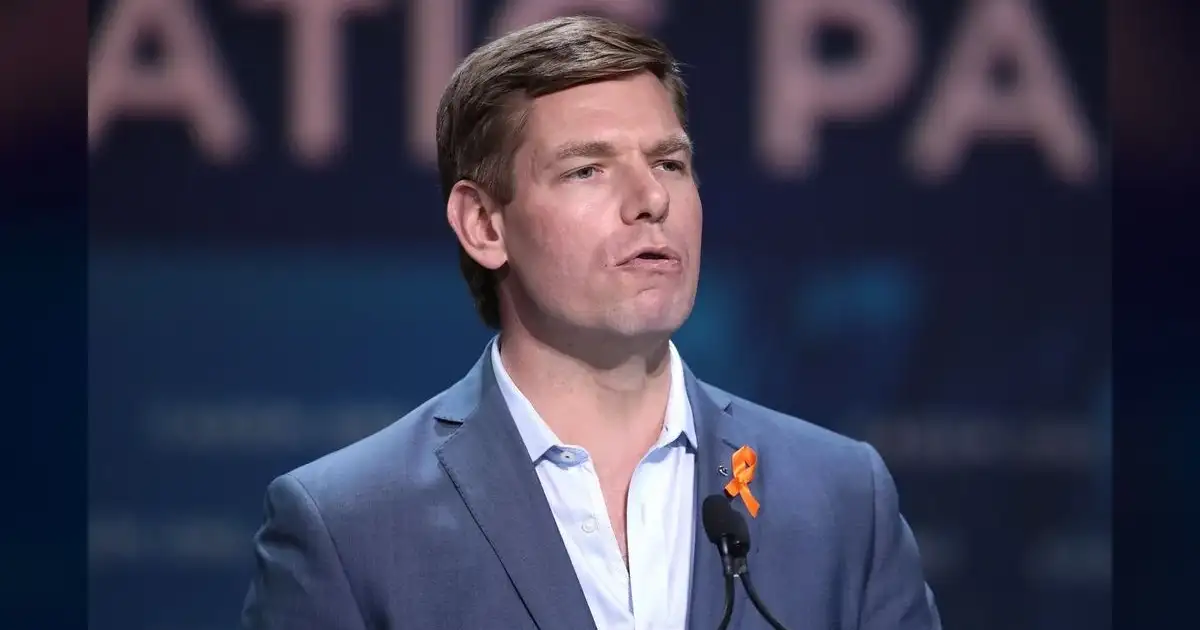

In the swampy ethics of Washington, few allegations strike with the force of hypocrisy quite like those now engulfing Congressman Eric Swalwell. He stands accused not merely of a bureaucratic misstep, but of a direct contradiction of the very laws he champions: violating Swalwell immigration law by allegedly paying an unauthorized Brazilian migrant nanny with campaign funds. This isn’t a mere paperwork error; it’s a political hand grenade, lobbed directly at the credibility of a lawmaker who has built a career on fierce demands for accountability and strict adherence to national security.
Complaints filed with the Federal Election Commission (FEC) paint a damning picture. They allege that Representative Eric Swalwell, a prominent Democrat from California, diverted his campaign war chest – funds earmarked for political activities – to pay an unauthorized foreign national for personal childcare services. These aren’t just whispers; these are formal accusations, detailing payments reportedly spanning from early 2021 through late 2022, with some continuing well after the 2022 midterms. The sums involved, while undisclosed in the initial filings, are significant enough to warrant a federal inquiry, suggesting potential breaches of both federal immigration statutes and the bedrock principles of campaign finance regulations.
At its heart, this scandal rips open two fundamental questions that should alarm any voter: Was the nanny legally authorized to work in the United States? And perhaps even more critically, is it ever appropriate for campaign contributions – donations from constituents and PACs – to subsidize a politician’s personal household staff? These funds are meant to win elections, to engage with the public, not to underwrite private conveniences.
- Who: Representative Eric Swalwell (D-CA), a Brazilian migrant nanny whose legal status is central to the allegations.
- What: Allegations of paying an unauthorized foreign national for childcare services using campaign funds, reportedly totaling tens of thousands of dollars.
- Where: Swalwell’s California congressional district, but with implications for federal election and immigration laws nationwide.
- When: Payments reportedly made over a period from early 2021 through late 2022, including crucial post-election periods.
- Why: For childcare services for Swalwell’s children, raising questions about the personal versus political nature of the expense.
This situation doesn’t just put Swalwell in the crosshairs; it exposes him as a potential fraud to his own constituents. He has meticulously crafted a political persona as a hawk on national security and a relentless crusader against foreign influence. Now, his own personal financial dealings, entangled with immigration law, threaten to unravel that carefully constructed image. The allegations don’t just cut deep; they threaten to sever his credibility entirely.
The FEC’s Precarious Stance on Childcare Funds
The FEC’s stance on politicians using campaign funds for childcare has always been a tightrope walk. In specific, carefully defined instances, they have indeed allowed such expenditures. The logic is often framed around necessity: a parent cannot effectively campaign, travel, or attend political events if their children are not cared for. This permission typically applies when childcare is a direct, unavoidable expense tied to active campaign-related travel or duties. For example, if a candidate must fly to Iowa for a debate, paying for a babysitter during that specific trip might pass muster.
However, the Swalwell complaints present a scenario that dramatically diverges from these established precedents. They allege payments to an unauthorized foreign national, a critical distinction that immediately transforms a campaign finance issue into a potential federal immigration violation. This isn’t just about a babysitter’s wages; it’s about potentially employing someone outside the bounds of U.S. law, paid for with political donations. This elevates the stakes from a mere campaign finance infraction to a far more serious legal and ethical quagmire.
The implications are already drawing sharp criticism from seasoned ethics watchdogs. Kendra Arnold, a prominent voice in campaign finance ethics, has not minced words. She specifically highlighted the troubling nature of payments made post-election, long after the immediate demands of campaigning have subsided.
“The FEC has allowed campaign funds for childcare during active campaigning,” Arnold stated in an interview with The Washington Post. “But using those funds for post-election personal expenses, especially involving an unauthorized worker, creates a very troubling precedent. It looks like an end-run around both campaign finance and immigration statutes.”
For many, this isn’t a nuanced legal debate; it’s a stark violation of fundamental principles. Campaign funds are a sacred trust, intended for the arduous, often thankless, work of winning elections and serving the public. They are not a personal slush fund for maintaining household staff, especially not when the employment itself raises grave questions about adherence to federal immigration laws.
A Glaring Double Standard in Washington
The allegations against Swalwell don’t just expose a double standard; they scream it. Politicians routinely stand on podiums, thundering about strict adherence to immigration laws, demanding accountability from businesses, and lecturing ordinary citizens. Yet, time and again, some of these very lawmakers appear to believe they operate under a different set of rules, above the fray of the laws they so eagerly enforce on others.
Swalwell himself is no stranger to this pulpit. He has been a vocal, often strident, critic of lax immigration enforcement, frequently calling for stronger border security and greater accountability for those who violate federal statutes. These complaints don’t just throw his past statements into sharp relief; they make him look like a breathtaking hypocrite to anyone paying attention. How can a lawmaker demand strict adherence to immigration law from others while allegedly flouting it in his own household?
This isn’t merely about Eric Swalwell’s personal peccadilloes. It’s about the erosion of public trust in Washington. When lawmakers face accusations of bending – or outright breaking – the very rules they craft and enforce, the bedrock of public trust cracks. People start asking, with justifiable cynicism, if anyone in power truly plays by the book, or if the rules are merely for the plebians.
Perhaps most telling is the almost deafening silence from large swaths of the mainstream media regarding these specific complaints. Is it because the story is too complex, too inconvenient, or simply not sensational enough for some outlets? While other, often less substantive, allegations against politicians ignite a media frenzy, these serious charges against Swalwell seem to quietly slip through the cracks. This selective outrage, or lack thereof, further fuels the public’s deep-seated cynicism, cementing the belief that justice and scrutiny are often applied unevenly in the nation’s capital.
- Allegation 1: Employment of an unauthorized foreign national, a direct challenge to federal immigration law.
- Allegation 2: Misuse of campaign funds for personal childcare expenses, violating FEC guidelines.
- Allegation 3: Payments continued post-election, potentially extending the misuse beyond any plausible campaign-related justification.
These are not minor issues to be brushed aside. They are a direct assault on ethical governance, demonstrating a profound potential disregard for federal statutes by a lawmaker sworn to uphold them.
The Long, Thorny Road Ahead for Swalwell
So, what happens next for Congressman Swalwell? The FEC is now tasked with reviewing these complaints, a process notorious for its glacial pace and often opaque nature. It can take months, sometimes years, to reach a resolution, during which time political maneuvering and legal wrangling will undoubtedly be in full swing. This drawn-out process itself can be a form of political purgatory.
Even if the FEC were to somehow rule in his favor on the campaign finance aspect – a long shot given the specifics – the immigration component remains a separate, far more dangerous beast. That falls under the purview of different federal agencies, most notably the Department of Justice. A DoJ investigation, unlike an FEC review, carries the weight of potential criminal charges. This isn’t a theoretical threat; it’s a very real Sword of Damocles hanging over Swalwell’s career.
Swalwell’s team will, predictably, dismiss these complaints as politically motivated attacks, a standard playbook move. They will undoubtedly argue that he meticulously followed all rules and regulations. But the political fallout, regardless of the legal outcome, is already severe. Public perception, in an era of hyper-partisanship and deep distrust, matters more than any technical legal victory. His image, already tarnished, will struggle to recover.
His constituents, those who donated their hard-earned money and cast their votes, will be watching closely. Voters demand transparency, and they expect their representatives to embody the law, not find clever ways to circumvent it. Especially not with funds explicitly donated for public service. How can he credibly champion national security or immigration reform when his own household finances are shrouded in such serious allegations?
This isn’t merely a political skirmish; it’s a profound test of integrity. It challenges the very idea of ethical conduct in elected office. Swalwell owes the public a swift, clear, and unvarnished explanation. Anything less will only deepen the public’s already profound distrust in government, confirming their worst suspicions about Washington’s elite. This isn’t just Swalwell’s problem; it’s a symptom of a larger disease plaguing Washington: the casual ease with which some politicians blur the lines between public duty and private convenience, operating as if the laws they craft are for everyone but themselves. The law, unyielding and impartial, must apply to everyone, especially those who wield the power to make them.
The complaints about Eric Swalwell’s alleged Swalwell immigration law violations and campaign finance issues are more than a stark reminder. They are a thunderous declaration that accountability cannot be selective; it must be universal, or the entire edifice of public trust will crumble.
Photo: Photo by Gage Skidmore on Openverse (flickr) (https://www.flickr.com/photos/22007612@N05/48016286211)
Source: Google News