
In a move that shattered any lingering illusions of rapprochement, former President Donald Trump declared this weekend that Iran’s pursuit of nuclear weapons capabilities is undeniable and, more provocatively, that peace talks are unequivocally dead. His chilling assertion – that he doesn’t care if Tehran ever returns to the negotiating table – wasn’t merely a stark warning; it was a deliberate, incendiary pronouncement designed to upend the delicate balance of international diplomacy and challenge the very premise of the current White House’s foreign policy.
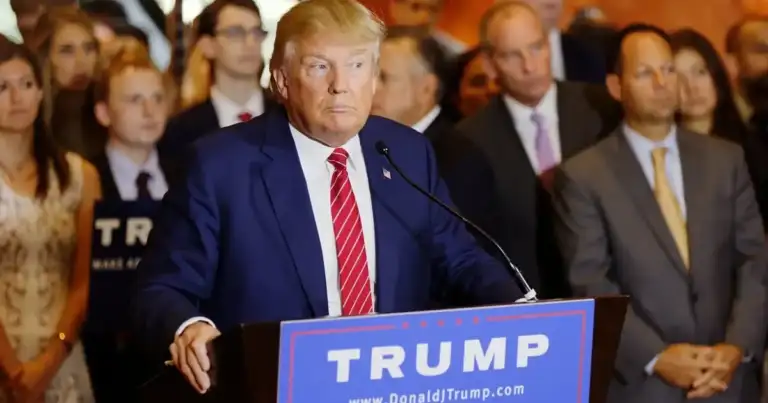
Delivering these explosive remarks with his characteristic blend of bravado and bluntness, Trump seized the spotlight at a rally in Phoenix, Arizona, on Saturday, April 11, 2026. Before a roaring crowd, he asserted unequivocally that Iran is “desperate” to acquire a nuclear weapon, painting a vivid picture of a rogue state on the cusp of a dangerous breakthrough, enabled by what he perceives as a weak and feckless American leadership.

He didn’t just call recent, informal peace talks a “complete failure”; he dismissed them as a pathetic charade, a “joke.” Trump laid the blame squarely at the feet of the current administration, accusing them of a debilitating “weakness” that, in his view, has emboldened Tehran and directly fueled Iran’s increasingly aggressive nuclear program. This isn’t just criticism; it’s a direct challenge, a gauntlet thrown down against any lingering hopes for diplomatic engagement.
Trump’s Unflinching Stance: Is Diplomacy Truly Dead?
President Trump’s statements mark an unambiguous, even brutal, break from past diplomatic efforts. He has doubled down, with characteristic resolve, on his “America First” foreign policy doctrine, a strategy that continues to resonate powerfully with a base demanding a strong, unilateral approach to global threats. This isn’t merely a political position; it’s a deeply ingrained philosophy that views negotiation with adversaries as a sign of weakness, not strength.
His words reinforce an unflinching, decisive stance against what he perceives as intractable adversaries. This confrontational policy is not only cheered by hardliners in Washington, who have long advocated for increased sanctions and robust military deterrence against Iran, but it also sends a powerful signal to regional players. These hawkish groups find profound validation in Trump’s assessment, believing, as he does, that negotiations with the current Iranian regime are inherently futile.
Crucially, key regional allies like Israel and Saudi Arabia, who harbor deep-seated concerns about Iran’s accelerating nuclear ambitions and its destabilizing regional influence, will undoubtedly feel reassured by Trump’s rhetoric. His hardline pronouncements offer a stark and welcome contrast to what they may perceive as the diplomatic softness or indecision emanating from the current American administration. The message is clear: the time for endless, fruitless talk, in Trump’s estimation, is unequivocally over.
Donald Trump (April 11, 2026, Phoenix, AZ): “Iran is desperate for a nuclear weapon, and they’re closer than ever before because of the weakness we’re showing. We tried talking, it failed, it’s a joke. Frankly, I don’t care if they ever come back to the table. We need strength, not endless, pointless negotiations.”
This uncompromising message resonates deeply with his base, positioning him as a leader unafraid to confront existential threats head-on, regardless of the diplomatic fallout. It’s a calculated move on the geopolitical chessboard, designed to reassert American dominance and project an image of unyielding resolve. The implications for global stability are profound.
The Erosion of Diplomatic Pathways
President Trump’s comments aren’t just critical; they actively and severely undermine any future diplomatic efforts, making it exponentially harder for the current administration to engage with Iran. Building any semblance of international consensus, a painstaking task even in the best of times, now becomes an almost insurmountable challenge. The very foundation of trust, however fragile, required for such high-stakes negotiations has been deliberately shattered.
Advocates for diplomacy and de-escalation, who passionately believe that dialogue remains the only viable path to preventing catastrophic conflict, now face a grim and increasingly desperate reality. Trump’s outright dismissal of talks appears not just reckless, but dangerously provocative to them, pushing the world closer to the brink of an even wider war. The global non-proliferation framework, already under immense strain, suffers a grievous blow. A complete breakdown of talks could very well push Iran to accelerate its nuclear program with even greater impunity, making the already severe global non-proliferation challenge infinitely more perilous.
The latest reports from the International Atomic Energy Agency (IAEA) paint a deeply concerning picture, laying bare grim facts that cannot be ignored. Iran’s stockpile of uranium enriched to 60% purity continues its relentless growth, now far exceeding the paltry 3.67% limit set by the defunct Joint Comprehensive Plan of Action (JCPOA). Experts from Reuters and The Guardian have consistently highlighted these alarming trends. More disturbingly, intelligence assessments suggest Iran now possesses enough 60% enriched uranium that, if further enriched, could yield material for several nuclear weapons. These trends are not just concerning; they represent an existential threat to global security and stability, demanding an urgent and coordinated international response that Trump’s rhetoric actively obstructs.
Economic Warfare and the Specter of Conflict
Iran’s economy remains deeply crippled by extensive US sanctions, a legacy of Trump’s previous “maximum pressure” campaign. The Rial remains highly volatile, reflecting the ongoing economic siege. Oil exports, once the lifeblood of the regime, are significantly below pre-sanction levels, severely impacting Tehran’s financial power and its ability to fund domestic programs.
Yet, despite this economic strangulation, Iran continues to pour vast sums into its sophisticated missile program and to fund a sprawling network of regional proxy forces, from Hezbollah to the Houthis. This unwavering prioritization of military might and regional influence over the dire needs of its own populace speaks volumes about the regime’s strategic calculations and its willingness to endure hardship for its geopolitical ambitions.
President Trump’s current position is not merely a return to; it is an intensification of his “maximum pressure” campaign, a policy he initiated during his previous term. The US withdrawal from the JCPOA in 2018, a landmark decision, was swiftly followed by crippling sanctions that plunged the region into a new era of tension. His administration argued, not without merit, that the JCPOA was fundamentally flawed, failing to adequately address Iran’s burgeoning missile program or its deeply destabilizing regional activities. This aggressive approach led to a series of dangerous incidents, including attacks on oil tankers, drone strikes, and the audacious assassination of Iranian General Qassem Soleimani, which further escalated matters to a fever pitch. The shadow of the US-Iran War 2026, a conflict already active and simmering, looms large over these latest pronouncements.
While the current administration initially sought to revive the JCPOA, they faced numerous hurdles, not least due to Iran’s escalating demands and its continued nuclear advancements. Trump’s latest remarks effectively slam the door on any such efforts, signaling a definitive return to, and potentially an even more aggressive iteration of, his hardline stance. The diplomatic tightrope has not just been cut; it has been set ablaze.
Unnamed Senior State Department Official (April 12, 2026, in response to Trump’s remarks, as reported by CNN): “The United States remains committed to preventing Iran from acquiring a nuclear weapon through diplomacy, backed by strong deterrence. We believe dialogue, however challenging, is crucial to de-escalation and finding a durable solution. The path to peace is always preferable to the path of conflict.”
Public Backlash: A Calculated Spectacle?
Predictably, public reaction to President Trump’s pronouncements exploded across online platforms. Social media threads on X and Reddit were awash with cynicism, branding his claims as “staged theater” and a “desperate psyop.” This widespread skepticism followed reports of a grueling 21-hour informal talk, during which Vice President Vance reportedly looked “deflated” after Iran allegedly “ghosted” the U.S. “final offer” on nukes.
Even some self-proclaimed MAGA skeptics voiced concerns, with former r/The_Donald alums calling it “Trump bait,” suggesting it was a calculated maneuver to push Democrats into escalating war cries. Reddit’s r/politics community, never shy with its disdain, mocked Trump’s “doesn’t care” line, labeling it “reheated 2018 JCPOA trash-talk” and pointing to Iran’s defiant “trust us first” response. Sarcastic theories spread rapidly, painting a picture of political opportunism.
Some X users quipped about an impending “Strait blockade,” claiming Iran had already shut it, and suggested Trump was “meming oil spike for midterms” – a theory that gained traction when tied to his Truth Social posts about Venezuela. Meanwhile, deep-state truthers on 4chan and Telegram insisted the talks were “fake diplomacy,” a sham hosted by Pakistan to launder Saudi cash. They viewed Vance’s “bad news for Iran” statement as a scripted loss, designed to justify a Hormuz chokehold without congressional approval. The timing, these commentators argued, screamed “election grift,” undercutting any “total victory” brag amid a fragile truce and tanking polls on gas prices.
Left-wing critics howled “warmonger relapse,” while right-wing users cheered “alpha checkmate.” Yet, a more cautious whisper of “neocon trap” could also be heard. Iranian sock-puppets, ever present, flooded replies, claiming Ghalibaf had “owned Vance” and insisting U.S. demands were “unreasonable,” further asserting that Trump was “begging for table return.” The overwhelming online consensus, cutting across partisan lines, pointed to “pure spectacle,” a calculated performance for a domestic audience, rather than a genuine shift in international relations.
Senator Lindsey Graham (R-SC) (April 12, 2026, via X): “President Trump is right. You can’t negotiate with a regime that only understands force. The time for endless talks is over. Maximum pressure must return, and this time, it must be truly maximum.”
The Nuclear Shadow Looms Large
For everyday Americans, these statements carry immense and immediate weight. A complete and utter dismissal of diplomacy, particularly from a figure of Trump’s stature and influence, dramatically raises the risk of military confrontation, a prospect that could unleash devastating human and economic consequences across the globe. We could see significant, sustained spikes in oil prices, further destabilizing an already fragile global economy. An unconstrained Iranian nuclear program doesn’t just threaten regional stability; it imperils the entire global non-proliferation regime, potentially triggering a dangerous regional arms race that would make the Middle East an even more volatile powder keg.
Escalating tensions and the inevitable imposition of new, harsher sanctions would undoubtedly disrupt global supply chains, rattle energy markets, and indirectly affect consumer prices and economic stability worldwide. The direction of US foreign policy, and indeed the future of global security, now hangs precariously in the balance. These statements highlight a stark divergence in potential paths, a geopolitical fork in the road where the choices made will reverberate for generations. Our alliances, our international cooperation, and the very fabric of global order depend on who holds the White House and what strategic course they chart. The world watches, holding its breath, for what happens next.
President Trump has, with characteristic bluntness, laid his cards on the table. His conviction that Iran is an imminent nuclear threat, coupled with his outright dismissal of further talks, doesn’t just put America at a critical crossroads; it plunges the entire world into a perilous new chapter. The choice, as he frames it, is stark: bold, unilateral action or an unending spiral of escalation. The geopolitical chessboard has been violently shaken, and for the foreseeable future, the middle ground has ceased to exist. The world now holds its breath, waiting to see if diplomacy’s death knell will be followed by the thunder of war, a conflict already simmering and now dangerously close to a full boil.
Source: Google News