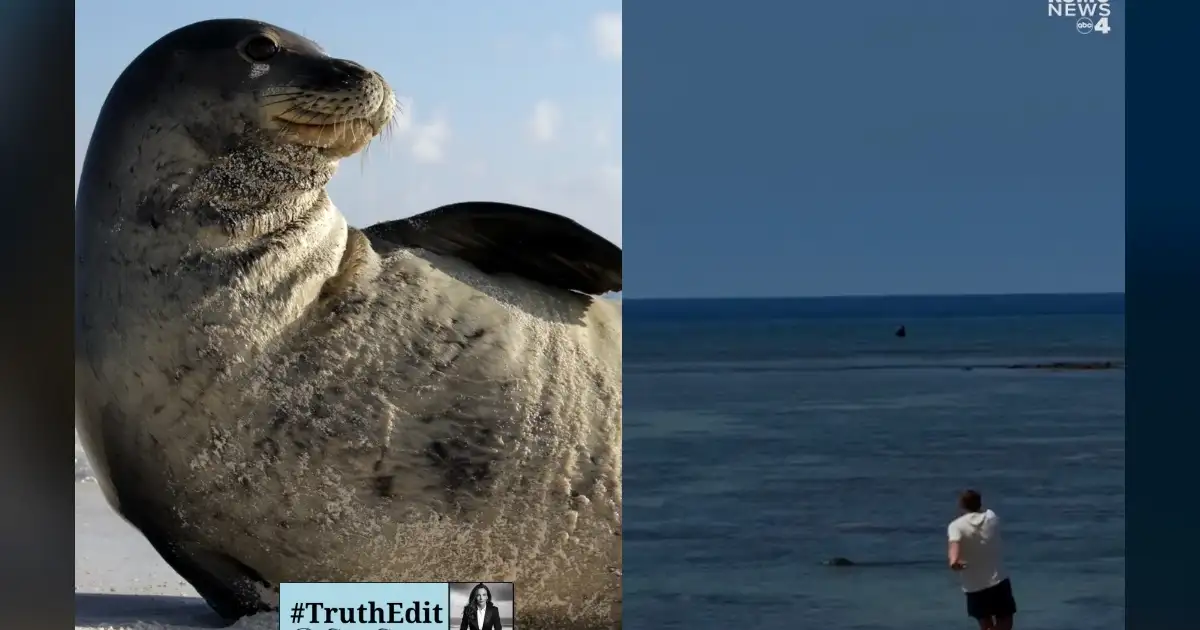

The digital ether, that insatiable maw of manufactured indignation, recently vomited forth another grotesque spectacle: humanity’s ongoing audition for the Darwin Awards. This time, the stage was a pristine Hawaiian beach, the unwitting co-star a critically endangered Hawaiian monk seal, and the villain, a tourist whose performance of unbridled entitlement was so repugnant, it deserves its own category in the annals of cultural pathology. This wasn’t merely a lapse in judgment; it was a brazen declaration of superiority, a middle finger extended to nature, common decency, and the very concept of consequence.
The Spectacle of Contempt
The footage, swiftly disseminated across every platform, showed a figure, unequivocally human, casually picking up a sizable rock.

The subsequent arc, the splash, the seal’s startled flinch—it was all there, laid bare for the world to witness. But the truly chilling part wasn’t just the act of casual cruelty; it was the immediate, unapologetic follow-up.
As the camera kept rolling, the perpetrator, a woman whose face was a mask of sneering defiance, declared with unshakeable certainty, “I’m rich. I can do whatever I want.”
The audacity. The sheer, unvarnished contempt for everything beyond her own immediate, insatiable ego. It was a moment so perfectly emblematic of our era’s rot, it felt almost staged, a dark parody of privilege run wild.
The video, which circulated primarily on X and TikTok, became an instant flashpoint before being scrubbed in a belated, and frankly pathetic, attempt at damage control.
The immediate, visceral reaction from the internet was predictable: a torrent of vitriol, demands for justice, and the inevitable doxxing. But what happens after the initial storm? That’s where the real sickness of our current culture comes into focus.
Performative outrage often gives way to the even more performative apology.
The Anatomy of an “Astonishing Excuse”
Because, naturally, the story didn’t end there. Faced with overwhelming public condemnation and the looming specter of legal action (harassing a Hawaiian monk seal, specifically the Neomonachus schauinslandi, is no minor infraction; they are a critically endangered species, protected under both the Endangered Species Act and the Marine Mammal Protection Act, carrying potential fines up to $50,000 and imprisonment), our protagonist, let’s call her “Karen with a Capital K,” did what any self-respecting titan of self-importance would do: she issued a statement. And it was, in a word, astonishing.
“I was merely attempting to ‘engage’ with the local fauna, to create a ‘moment’ for my content, and the ‘I’m rich’ was a satirical commentary on materialism.”
Let that sink in for a moment. “Engage.” With a rock. “Content.” For followers she likely bought.
“Satirical commentary.” While physically assaulting a protected animal and boasting about her financial immunity. This isn’t an excuse; it’s a manifesto of delusion.
It’s the byproduct of a culture so steeped in performative self-importance that reality itself becomes a malleable narrative for personal gain.
Every interaction, every location, every living creature, is just a prop in the grand movie of their own lives. They are manipulated, exploited, and then rationalized away with a straight face.
Does she truly believe anyone, outside her own echo chamber of sycophants, would buy such a transparent fabrication? It’s an insult to our collective intelligence.
When Privilege Becomes Performance Art
The “astonishing excuse” isn’t for the seal, nor is it for public consumption as a genuine apology.
It’s a transparent, cynical attempt to reframe an act of monumental audacity as “performance art” or “engagement” to mitigate legal and social fallout.
The “I’m rich” wasn’t satire; it was an explicit declaration of perceived impunity. It was a boast that money buys a pass from consequences.
Her true motive is simple: she believes her wealth and self-importance elevate her above the rules. The excuse is merely a flimsy, post-facto justification for an ego run riot.
It’s not about satire; it’s about privilege weaponized for virality. It’s a desperate, failing bid to control a narrative that’s already written.
The Main Character Syndrome and Its Discontents
This incident isn’t just about one entitled tourist; it’s a glaring symptom of a wider malaise.
Today, “main character syndrome” has metastasized into a full-blown epidemic. Everyone is the star of their own self-produced reality show, and the world is merely the set.
Consequences are for extras. Authenticity is merely the most convincing performance.
This woman wasn’t seeking to connect with nature or even genuinely “engage.” She was seeking a viral moment, an anecdote for her curated life, an opportunity to demonstrate her perceived superiority and untouchability.
The seal, the rock, the boast—they were all components in a cheap, desperate bid for attention. It was a pathetic attempt to assert dominance in a world she clearly believes revolves solely around her.
The irony, of course, is that this desperate grab for “content” often backfires spectacularly, transforming the would-be icon into a pariah.
But even then, the narrative isn’t truly about remorse. It’s about damage control, crafting a new storyline that paints them as a victim of cancel culture.
They become a misunderstood artist, or a brave truth-teller. The goal is never genuine accountability; it’s always the reclamation of narrative control.
It’s about the preservation of the self-image, no matter how flimsy or detached from reality. This incident serves as a stark reminder: there’s a difference between curating a life and fabricating one.
There’s a difference between genuine interaction and cynical exploitation. And sometimes, the universe, or at least the internet, delivers a swift, undeniable verdict on the latter.
Source: Google News