
The 2026 NFL Combine is a charade. A glorified track meet where grown men in spandex chase arbitrary numbers, and the talking heads in Bristol hyperventilate over tenths of a second. We’re told this spectacle is crucial for evaluating talent, that it separates the contenders from the pretenders. It’s nonsense. Pure, unadulterated, draft-industrial complex nonsense.
Every year, we watch as perfectly capable football players are dissected, their careers potentially derailed, by a few inches on an arm measurement or a slightly slower 40-yard dash, so in 2026 NFL. Meanwhile, actual on-field performance, the kind that wins games, gets relegated to a footnote. It’s a bizarre, almost insulting, way to assess athletes who have spent their entire lives honing a craft that has nothing to do with vertical leaps in an empty stadium.
Related: Jets to franchise tag Breece Hall if no deal by March 3
The Cult of the Measurable – 2026 NFL
Let’s talk about the obsession with measurements in 2026 NFL. Rueben Bain Jr.’s “historically short arms” became a headline. His 30⅞-inch arms, we’re told, are a potential death knell for an edge rusher. This is the kind of drivel that makes you question the sanity of NFL front offices. Has anyone watched Bain play? Has anyone seen him shed a block, chase down a quarterback, or make a game-changing tackle?
Apparently, those moments are less important than the distance from his shoulder to his fingertips. We’re talking about a game played on a gridiron, not a tailor’s shop. The notion that a few inches of arm length will definitively determine a player’s 2026 NFL success is a fallacy perpetuated by those who prioritize quantifiable data over actual football instincts and skill.
D’Angelo Ponds, another supposed victim of the tape measure, is “undersized” at 5-foot-8 and 182 pounds. Yet, the source material begrudgingly admits his “play on the field has been fantastic.” Imagine that – a good football player who doesn’t fit the cookie-cutter mold. And then, the scramble to find an exception: Antoine Winfield Jr. is trotted out as proof that undersized players can succeed. This isn’t proof; it’s a desperate attempt to justify a flawed system. If Ponds is a fantastic player, his height and weight are irrelevant. The game is about making plays, not fitting into a neat little box on a scouting report.
The entire enterprise smacks of overthinking. Teams are so terrified of missing out on the “next big thing” that they’ve become paralyzed by data. They’re drafting spreadsheets, not players. And the media, bless their hearts, gobble it up, turning every measurement into a seismic event.
The 40-Yard Dash Delusion in 2026 NFL
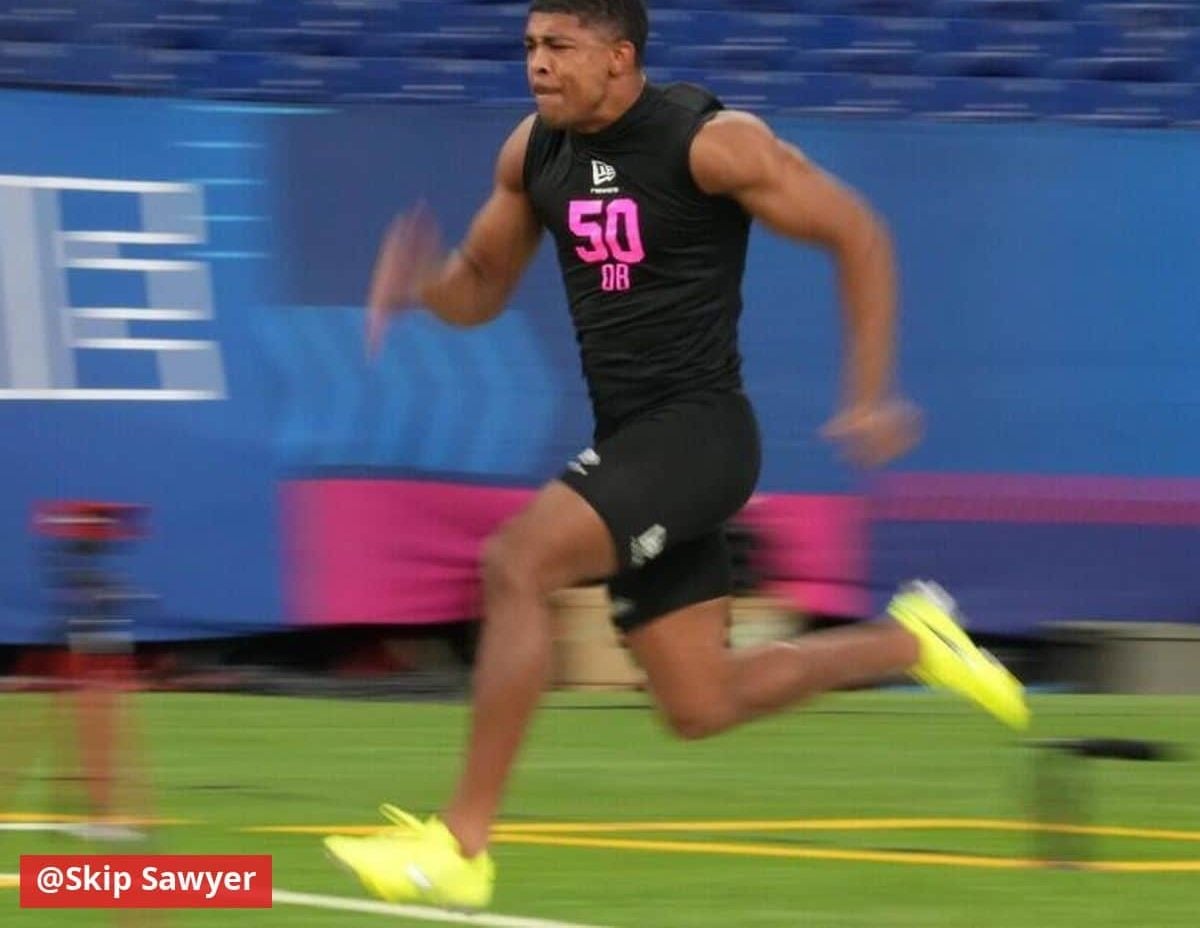
Then there’s the 40-yard dash, the undisputed king of combine events. A player runs in a straight line for 40 yards, and suddenly, their entire 2026 NFL career is projected. It’s ludicrous. When, in the course of an actual football game, does a player run 40 yards in a straight line without pads, without defenders, without a ball, and without a specific play call?
Speed is important, yes. But it’s football speed that matters – the ability to accelerate, decelerate, change direction, and react to the chaos of the game. That’s not measured by a glorified sprint. Arvell Reese, Sonny Styles, and David Bailey apparently “performed like bona fide top-five picks” because their numbers were good. Good for them. But let’s see them do it with pads on, against NFL-caliber competition, when the game is on the line.
The Combine creates false narratives. Players who “win” the Combine often turn into busts, while those who “underperform” become stars. Remember Mike Mamula? Combine warrior, NFL afterthought. Tom Brady? Slowest 40 time imaginable, but a pretty decent career, I hear. The correlation between Combine performance and 2026 NFL success is tenuous at best, and yet, we treat it like gospel.
This year, tight ends are getting lighter. The average weight is down two pounds from last year. Who cares? Are they catching more passes? Are they blocking better? Is their functional strength improving? These are the questions that matter, not whether they shed a few ounces for a weigh-in. It’s an exercise in mental gymnastics, trying to extract meaning from data points that have minimal bearing on the game itself.
The NFL Combine is a spectacle designed to generate buzz and fill airtime during the offseason lull. It’s a marketing ploy, not a legitimate evaluation tool. Teams would be far better served by focusing on game film, scouting reports, and character assessments. Stop obsessing over arm length and 40 times, and start looking for football players who can actually play the game.