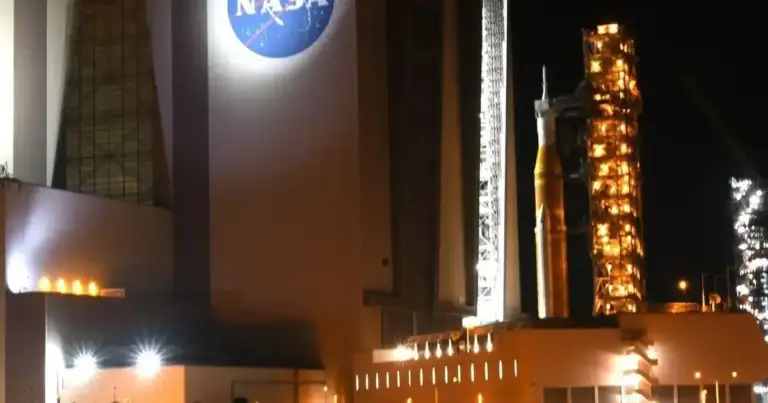
NASA’s $4.1 billion Artemis II mission faces unexpected delays, not from rocket science, but from persistent Microsoft Outlook email problems. This isn’t just a minor technicality; it exposes a critical vulnerability in the operational core of high-stakes space endeavors, sparking debate about relying on commercial software for mission-critical functions.
The Artemis II crew—Commander Reid Wiseman, Pilot Victor Glover, Mission Specialist Christina Koch, and CSA’s Jeremy Hansen—are preparing for a historic lunar flyby. Yet, their rigorous training and billions in investment are undermined by basic IT failures, an irony not lost on a bewildered public.

When Billions Meet Basic Bugs: The Outlook Imbroglio
Commander Wiseman’s viral lament, “I have two Microsoft Outlooks, and neither one of those are working,” highlights the disconnect. How can a mission pushing human exploration boundaries, costing astronomical sums, falter over email? This quote has fueled public ridicule, with social media incredulity.
The global reaction has been swift and critical. Observers are lambasting NASA’s procurement choices. The prevailing sentiment is that if commercial off-the-shelf software is unreliable terrestrially, its use where error margins are nonexistent is indefensible. As Bluesky user Niki Grayson put it, “I’m so sorry we’ve sent these souls to the moon and they’re using Outlook?” This mirrors widespread frustration with underperforming software, amplified by a mission traveling at 240,000 miles per hour.
The Treacherous Terrain of Commercial Software Dependence
NASA’s decision to integrate Microsoft Outlook for essential communication in a mission of this magnitude is perplexing. Commercial software inherently has frequent updates, patches, and glitches that can cause unforeseen complications. For an undertaking demanding meticulous planning and absolute reliability, this reliance on an unstable commercial product is a significant gamble.
This issue extends beyond email. The Artemis II mission is an intricate system of interconnected elements. A minor failure in one component, especially communication, can trigger cascading detrimental effects. This isn’t just about sending an email; it’s about the seamless flow of critical data, coordination, and command underpinning mission success.
Geopolitical Ripples: An IT Blunder’s International Impact
Space exploration symbolizes national capability and international collaboration. The Artemis program, aiming to return humanity to the Moon, represents global partnership, including the Canadian Space Agency (CSA). Public technical embarrassments, however minor, can erode confidence among international partners and on the global stage.
Consider the geopolitical context. While emerging space powers like China advance their capabilities, the US-led initiative struggles with IT issues. This juxtaposition provides ammunition for rivals, fostering an image of operational fragility. This is not the message a preeminent spacefaring nation wants to project.
The Artemis Accords, establishing norms for peaceful space exploration, rely on signatories’ credibility and operational excellence. When a flagship mission faces such basic, visible operational failures, it raises a critical question: how can international partners trust a system struggling with its own communication infrastructure?
Beyond the Jest: A Grave Security Imperative
While the internet laughs, a serious concern arises: security vulnerabilities from commercial software dependence. Proprietary systems often contain undocumented features, potential backdoors, or unpatched flaws exploitable by malicious actors. In space missions, where assets are irreplaceable and data invaluable, such risks are unacceptable.
Cybersecurity in space is essential. A seemingly innocuous software glitch or perceived weakness in a commercial product could be a vector for sophisticated cyberattacks. This is not fiction; it is a principle of critical infrastructure protection. The incident demands a rigorous re-evaluation of NASA’s IT security protocols. Are they robust enough? Or is there an unspoken reliance on good fortune? In space, hope is not a viable strategy.
“The Worst Email Service on Earth” Takes Flight
The internet’s long-standing verdict on Microsoft Outlook as “the worst email service on Earth” now has a cosmic dimension. As PC Gamer noted, “You can’t escape Outlook issues even in space.” This sentiment, while humorous, underscores a deep-seated frustration that has reached an unprecedented zenith.
The humor masks a serious point. Why are highly trained astronauts, whose time is invaluable, diverted by troubleshooting email? Their time is a precious national resource, dedicated to lunar exploration, not battling recalcitrant software.
This incident necessitates a transparent examination of NASA’s procurement processes. Were robust alternatives evaluated? Was a comprehensive cost-benefit analysis conducted, weighing commercial product savings against bespoke, hardened solutions for space? The answers are crucial for safeguarding future space endeavors.
A Resounding Call for Space-Grade Solutions
The Artemis II Outlook fiasco must be a wake-up call for space agencies. It mandates a fundamental re-evaluation of their IT infrastructure. They need solutions engineered for space exploration, not adapted commercial products ill-suited for critical applications.
This requires substantial investment in bespoke systems, meticulously designed for unparalleled reliability, impenetrable security, and absolute mission efficacy. It means prioritizing these tenets above all other considerations, including perceived cost savings. It demands a rigorous commitment to learning from past mistakes. The ultimate cost of failure in space is immeasurable, encompassing human lives, national prestige, and the trajectory of human exploration.
This incident is more than a viral meme. It is a stark reminder that even humanity’s most ambitious endeavors can be halted by trivial failures. NASA, and all space agencies, must move decisively beyond these embarrassing missteps. They must ensure the next giant leap for humankind is not undermined by an email glitch.
Photo: Photo by NASA Johnson on Openverse (nasa) (https://www.flickr.com/photos/29988733@N04/52530824918)
Source: Google News