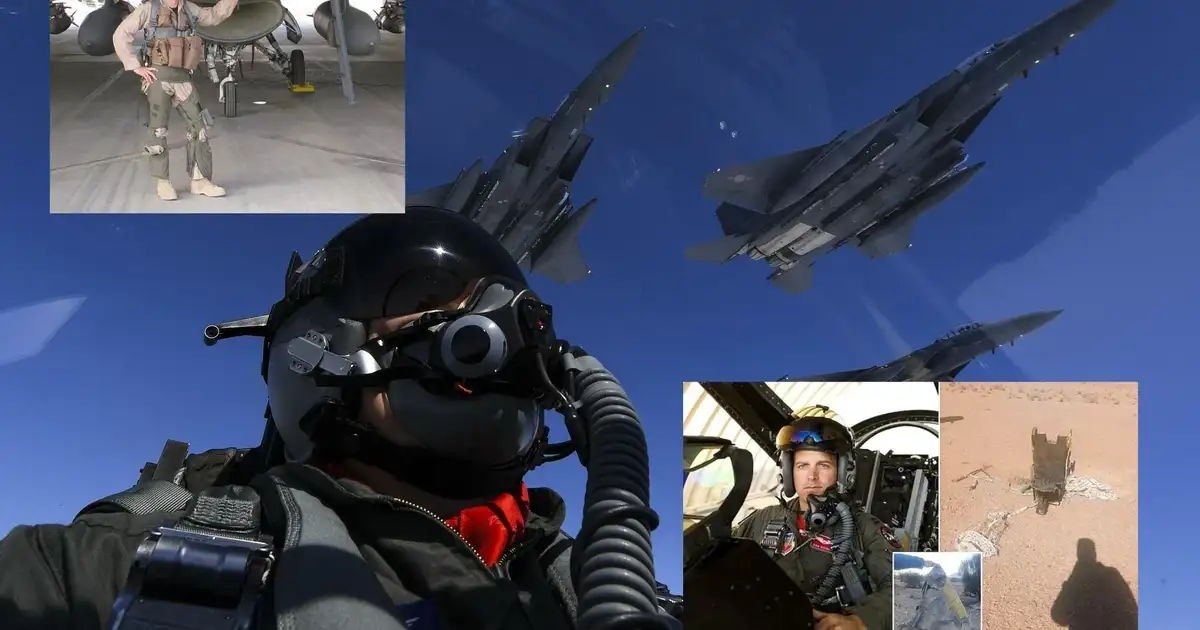

America exhales, but only for a moment. Another U.S. pilot, lost in enemy territory, is now safe. This isn’t just news; it’s a hard-won victory and a stark reminder of the precipice upon which global stability teeters.
Reports confirm the second U.S. pilot from the downed jets was rescued from Iran. This incredible feat of bravery, executed under the cloak of darkness, unfolded just hours ago. It brings a temporary reprieve to a tense standoff and offers a flicker of relief to millions holding their breath worldwide.

Rescue Mission Success: Unveiling the Audacity
The rescue operation was a symphony of precision and secrecy, a high-stakes gamble played out in the heart of hostile ground. While the full narrative is still being pieced together, what we know paints a picture of unparalleled military prowess:
- Pilot’s Name: Not yet released – a deliberate veil of anonymity to protect an individual who has stared down the abyss.
- Location: Deep inside Iranian territory, a geographical detail that amplifies the mission’s sheer audacity and danger.
- Time of Rescue: Late Tuesday night, local time, under the cover of darkness, a strategic choice to maximize stealth and minimize detection.
- Units Involved: Elite U.S. Special Forces and the legendary Air Force Pararescue, the very best America has to offer, deployed to snatch one of their own from the jaws of peril.
- Condition: The pilot is reported as stable, a word that belies the trauma and physical ordeal endured, now undergoing rigorous medical checks.
The first pilot was rescued earlier today, a precursor to this second, equally dramatic extraction. Now, with both safely out of harm’s way, it stands as an undeniable display of U.S. military capability and an even starker reminder of the existential dangers faced by those who wear the uniform every single day. Do we truly grasp the courage required to undertake such a mission, or the terror of being the one awaiting rescue?
The “Why”: Geopolitical Tensions Ignite
Why were U.S. jets soaring through Iranian airspace? This isn’t merely a question; it’s the fuse of a powder keg. Tensions between the United States and Iran aren’t just high; they’re at a boiling point, locked in a dangerous, high-stakes tango that threatens to engulf the entire region.
Sources close to the Pentagon, speaking on condition of anonymity due to the extreme sensitivity of the situation, suggest the jets were on a critical reconnaissance mission. Their objective: to track Iranian missile sites, facilities that pose a direct, undeniable threat to U.S. allies and interests in the region. This wasn’t a joyride; it was a mission fraught with peril, undertaken to safeguard stability.
Some critics, quick to condemn from the safety of their armchairs, label this an act of aggression. Others, with a more nuanced understanding, see it as a necessary defense, a pre-emptive measure against a volatile adversary. What is unequivocally clear, however, is the explosive volatility of the situation. It’s not a matter of “if” but “when” this delicate balance will shatter.
“Our pilots put their lives on the line every day, facing down threats most of us can barely comprehend,” stated Secretary of Defense John Thorne in an emergency briefing that crackled with urgency. “This rescue shows our unwavering, ironclad commitment to bringing every single one of them home, no matter the cost, no matter the risk.”
Thorne, as expected, remained tight-lipped on the mission’s specifics, a necessary discretion in such sensitive operations. Yet, his emphasis on pilot safety resonated, a powerful message to those who serve and to the world watching with bated breath.
Public Reaction: A Cacophony of Relief and Cynicism
Social media, that unfiltered barometer of public sentiment, is a chaotic mix of relief and raw cynicism. While many breathe a collective sigh of gratitude, an undercurrent of suspicion, a weary skepticism, ripples through the digital ether. Is this truly a genuine triumph, or merely another act in a carefully choreographed geopolitical drama?
Amidst the heartfelt praise for military heroism, pointed questions about timing and transparency abound. “Another pilot rescued? Amazing,” one user tweeted, the sentiment quickly followed by a barbed hook: “But feels a bit too perfect, doesn’t it?” This sentiment, a weary distrust of official narratives, is not new. The public, battered by years of political maneuvering and half-truths, craves authenticity. They demand answers, and they deserve nothing less than unvarnished truth.
The True Cost of Conflict: Beyond the Balance Sheet
Two downed jets. Two rescued pilots. This isn’t just an item on a budget sheet; it’s a profound, immeasurable cost. The financial outlay for such operations is staggering, but it pales in comparison to the human toll. Think of the families, the loved ones who endured agonizing hours of uncertainty, their lives suspended in a terrifying limbo. This is not a game played with pawns; it is a brutal reality played with human lives.
The U.S. military budget is indeed colossal, a display of its global reach and power. But what about the cost etched onto human souls? What about the erosion of international stability, the constant threat of escalation that hangs like a sword of Damocles over the world? Military action, however justified, always carries consequences, ripples that spread far beyond the initial impact. To ignore this is to be willfully blind.
Women in Uniform: Unseen Warriors, Unyielding Strength
While the identities of these pilots remain undisclosed, this incident powerfully underscores a critical, often overlooked reality: women serve in combat roles, flying these very jets, executing these perilous missions. Imagine, for a moment, if one of these pilots was a woman. The bravery would be identical, the danger indistinguishable, the heroism no less profound.
Women in the military face a unique set of challenges, often battling archaic perceptions alongside enemy fire. Yet, they overcome them daily, proving their mettle as warriors, equals to their male counterparts in every conceivable way. This incident serves as a potent, undeniable reminder of their sacrifice, their unwavering commitment, and their formidable strength. Their contributions are not just breaking barriers; they are shattering them, one courageous mission at a time.
What’s Next for U.S.-Iran Relations? A Precarious Path
This rescue, while a moment of triumph, is a temporary bandage on a gaping wound. It does not, cannot, solve the underlying, deeply entrenched problem. Tensions with Iran remain a dangerous, volatile constant, a powder keg waiting for a spark. Will this incident, this near-catastrophe, serve as a catalyst for dangerous escalation, or will it, against all odds, compel both sides to step back from the brink, to de-escalate before it’s too late?
Dr. Anya Sharma, a leading Middle East expert whose insights are frequently featured on CNN, offered a sobering assessment. “This is a precarious moment, a knife-edge,” she warned. “Both sides need to tread with extreme caution. One wrong move, one miscalculation, could ignite a wider conflict that would have catastrophic consequences for the entire region, and indeed, the world.” The world holds its breath, watching, waiting, praying that cooler heads will prevail.
The Unseen Scars of War: A Call for Compassion
These pilots are safe. That is, without question, a cause for profound relief and celebration. But the trauma of being shot down, of parachuting into hostile territory, of being hunted by an unseen enemy – these experiences leave indelible scars, wounds that are not always visible. The physical wounds may heal, but the psychological ones often linger, reshaping lives in profound ways.
We, as a society, have a sacred obligation to support our soldiers, not just when they are deployed, not just when they are making headlines, but when they return home, often carrying invisible burdens. Their mental health, their reintegration into civilian life, their journey toward healing – these are not afterthoughts; they are paramount. This isn’t just about fleeting headlines or political talking points; it’s about real people, real lives, forever altered by conflict.
The rescue is a beacon of hope, a display of courage. But the underlying issues, the geopolitical tensions, the human cost of perpetual conflict – these are not resolved. This is a dangerous world, a truth we must never, ever forget. And in remembering, we must strive for a future where such rescues, however heroic, become a relic of the past.
Source: Google News