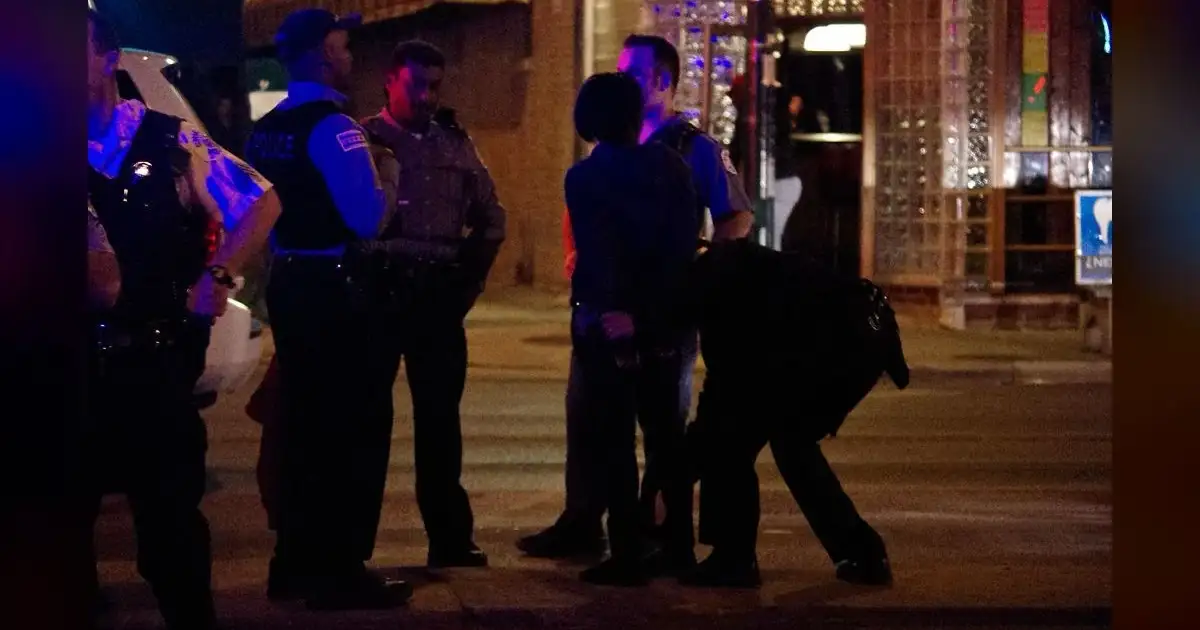

The brutal death of Alexander “Xander” Kazanowski, a 25-year-old Chicago father, has devastated his family and ignited a fierce public debate. Just weeks shy of welcoming his second child, Kazanowski was tragically beaten to death outside an Avondale bar on March 24. In early April 2026, police released images of four suspects, transforming this personal tragedy into a flashpoint for broader societal anxieties.
A Community Shaken, A City Divided
Kazanowski’s senseless killing reverberated through Chicago, particularly within the Avondale community. This area, once stable, is now central to a heated city-wide discussion about escalating crime. Grief for a young father quickly morphed into widespread anger, amplified across social media, making the incident a stark symbol of deeper frustrations.

As police appeal for information on the four suspects, the narrative surrounding Kazanowski’s death has expanded beyond the search for justice. It now serves as a focal point for examining Chicago’s ongoing struggle with public safety and urban policy effectiveness.
Chicago’s Crime Crisis: A Battleground of Blame
Online forums and social media channels instantly seized upon Kazanowski’s death, transforming it into a potent symbol of Chicago’s persistent crime challenges. Many users swiftly attributed the tragedy to current city policies, expressing a palpable sense of insecurity and frustration.
“Another night in Biden’s Chicago—dems let animals roam free while dads die waiting for babies,” a popular X thread proclaimed, garnering over 15,000 likes and reflecting a sentiment that directly links local tragedy to national political figures and party affiliations.
This widespread sentiment underscores a profound frustration among many citizens who increasingly feel unsafe in their own neighborhoods. It speaks to a broader disillusionment with governance, where local incidents are quickly framed within national political narratives.
Similar concerns echoed on platforms like r/Chicago, where Redditors highlighted the perceived demographic shifts in formerly stable areas, attributing rising crime to a confluence of factors.
“Avondale used to be safe Polish turf, now it’s a warzone thanks to unchecked illegals and soft-on-crime Lori Lightfoot ghosts,” one comment with 2,000 upvotes asserted, pointing to deep-seated anxieties that intertwine crime rates with immigration policies and past mayoral administrations.
These comments reveal a complex interplay of fears, connecting perceived increases in crime to the city’s status as a sanctuary city—a policy frequently targeted by critics. The debate often becomes less about specific criminal acts and more about the broader societal implications of immigration and judicial reform.
Official statistics lend weight to these concerns, with local crime trackers reporting Chicago’s homicide rate for 2026 up a concerning 12% year-over-year. Such data provides potent ammunition for those critical of current city leadership and its approach to public safety, fueling demands for tougher measures and stricter law enforcement.
The Disturbing Undercurrents of Online Discourse
Tragically, the discourse surrounding Kazanowski’s death quickly transcended grief and legitimate policy debate, descending into a battleground for cynical political narratives. In some disturbing instances, the victim himself became a target of ridicule and blame.
“Model dad kicked out for ‘comments’—probably said the N-word or triggered a soy boy pack. Darwin award for barhopping at 3AM?” a viral X meme callously suggested.
Such cynical and dehumanizing remarks highlight a harsh, often unforgiving online culture, quick to assign blame and strip individuals of their dignity, even in the face of profound personal loss. This phenomenon raises critical questions about the erosion of empathy in digital spaces.
Even more alarmingly, extreme voices propagated baseless conspiracy theories, labeling the entire event a “staged psyop.” These claims, devoid of any factual grounding, seek to exploit genuine tragedy for ideological ends.
“Staged psyop to push gun control or ‘migrant crime’ narrative—why release potato-quality pics NOW, months later? Dad-of-the-year model with perfect family? Smells like actor script,” some corners of the internet speculated, despite police releasing images just weeks after the attack.
This dangerous speculation not only ignores the profound suffering of the victim’s family but actively undermines efforts to find justice by spreading misinformation and fostering distrust in official channels. The release of blurry CCTV images, a common challenge in real-world investigations, also drew criticism, with some questioning the timing and quality, further fueling skepticism among certain online groups.
The Politicization of Local Crime: A National Reflection
A tragedy like Xander Kazanowski’s death serves as a stark illustration of how local events are instantly absorbed into larger ideological battles, exposing deep societal fractures. The debate around “soft-on-crime” policies, a perennial concern, gains renewed urgency with every violent incident, driving calls for more stringent measures and a tougher stance on law enforcement.
Concurrently, the concept of “sanctuary policies” frequently emerges as a contentious issue. Opponents contend that such policies compromise public safety by inadvertently shielding individuals who may pose a risk, linking them to an increase in criminal activity. Conversely, supporters argue that these policies are crucial for fostering trust between marginalized communities and law enforcement, encouraging cooperation without fear of deportation, and ultimately enhancing overall public safety.
The online discourse surrounding Kazanowski’s death is a microcosm of a deeply polarized nation, where every incident is filtered through partisan lenses. Facts often become secondary to narrative construction, and the focus frequently shifts from solving crimes and supporting victims to scoring political points. This trend is by no means unique to Chicago; cities across the nation grapple with the dual challenges of managing rising crime rates and navigating intense, often politicized, public scrutiny.
Eroding Community Trust in the Quest for Justice
The public’s multifaceted reaction to Kazanowski’s death—a blend of sorrow, anger, political frustration, and cynical theorizing—erodes community trust. This potent mix renders objective discussion difficult and potentially hinders police investigations. When citizens perceive the system as rigged, their willingness to cooperate or believe official accounts diminishes, making even standard police procedures like releasing suspect photos points of contention in a hyper-skeptical online environment.
The release of suspect photos, a standard police procedure intended to aid investigations, can itself become a point of contention in a hyper-skeptical online environment. Its timing, clarity, and perceived effectiveness are scrutinized, often through a lens of pre-existing distrust.
For the family of Xander Kazanowski, this tragedy remains deeply personal. As they prepare for a new child, they simultaneously pursue justice for their devastating loss. Their private pain is often overshadowed by the relentless din of broader political noise, a poignant reminder of how individual suffering can be subsumed by collective societal anxieties.
This incident vividly underscores a critical truth: local crime has far-reaching implications beyond individual lives. It profoundly shapes societal perceptions of safety, governance, and democratic institutions. As the search for those responsible continues, Chicago—and many American cities—must confront both the perpetrators of violence and the complex, fractured narratives that emerge, raising the question: How can a city heal and find justice when its citizens are so divided on the problem’s nature?
*
For more on how global trends impact local communities, visit DailyNewsEdit.com.
*
Photo: Photo by Kevin Gebhardt on Openverse (flickr) (https://www.flickr.com/photos/31545680@N03/8008579196)
Source: Google News