
The commander-in-chief declares a vital global chokepoint “wide open,” yet his own Navy issues a chilling directive: “prepare to be boarded.” This isn’t merely a gaffe; it’s a dangerous, destabilizing disconnect at the highest levels of American power, leaving global shipping in perilous limbo and America’s strategic posture looking dangerously incoherent.
The contradiction is stark, almost cinematic in its absurdity. It leaves global shipping in chaos and America’s posture looking weak, inviting exploitation by adversaries.

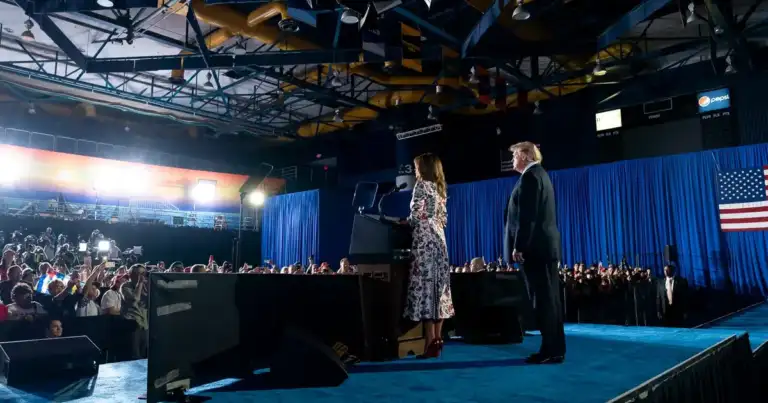
Just days ago, on April 13, 2026, President Trump, in a characteristic display of bravado during a rally in Phoenix, Arizona, proclaimed the Strait of Hormuz “wide open, fully secured, and free for all global commerce.” He promised an unyielding American presence, vowing no nation would dare close such vital waterways. It was a declaration designed to project strength, an assurance meant to calm markets and deter adversaries.
Then, less than 24 hours later, on April 14, 2026, the operational reality hit. The U.S. Navy’s Fifth Fleet, headquartered in Bahrain – the very tip of America’s spear in the Gulf – issued a new, heightened maritime security advisory. Citing “recent aggressive and unsafe interactions” from Iranian Revolutionary Guard Corps Navy (IRGCN) vessels, the warning was unmistakable, stark, and utterly at odds with the President’s pronouncements.
“Mariners are advised to maintain maximum situational awareness, report any suspicious activity immediately, and be prepared for potential boarding actions by unauthorized forces should they fail to comply with demands for inspection or diversion.”
That phrase, “prepare to be boarded,” screams escalation. It directly contradicts the President’s breezy assurances, tearing a gaping chasm in policy messaging. This isn’t just a miscommunication; it’s an alarming exhibition of an administration speaking with two entirely different voices, one from the political stump, the other from the deck of a warship confronting real threats.
President Trump’s Dangerous Double Talk and its Repercussions
President Trump’s words echo hollow against the Navy’s stark reality. The US-Iran War 2026 is not some theoretical exercise; it is an ongoing, active conflict, and the Strait of Hormuz is its volatile epicenter. To declare it “wide open” while the Navy warns commercial vessels to prepare for hostile boardings is not merely reckless; it borders on strategic malpractice. Does the commander-in-chief genuinely believe his rhetoric can alter the operational facts on the ground, or rather, on the water?
This isn’t some abstract debate confined to Washington think tanks. It’s about real ships, real crews, and the very real threat of global economic paralysis at a critical global choke point. The President’s rhetoric, intended to project strength and unwavering resolve, instead falls flat, exposed as disconnected from the ground truth by his own military.
This doesn’t just undermine the authority Trump desperately seeks to project; it actively cripples it, painting his administration as not merely disjointed, but fundamentally incoherent on the global stage. What message does this send to Tehran, or to Beijing, or to Moscow, watching for any sign of American weakness or internal division?
We’ve seen this dangerous movie before, and the script is eerily familiar. The Iran-Iraq War in the 1980s devolved into the brutal “Tanker War,” where attacks on commercial shipping in the Gulf were rampant. The U.S. Navy, under Operation Earnest Will, intervened then, undertaking the largest convoy operation since World War II to protect vessels. History, it seems, is not just rhyming; it’s screaming a dire warning, yet the current administration appears to be listening to a different tune entirely.
The Stark Reality: A Strait Under Imminent Threat
The Navy’s advisory isn’t some bureaucratic formality, nor is it based on outdated intelligence. It’s a direct, urgent response to real, present threats. The IRGCN is not playing games; their “aggressive and unsafe interactions” are not hypothetical future scenarios, but current events. These often involve swarming tactics with fast attack craft, harassing commercial vessels, and attempting to enforce their own interpretations of maritime law. The warning is for today, for this hour, not some distant contingency.
What specific intelligence prompted this sudden, unambiguous alert? While CENTCOM remains tight-lipped, the gravity of the warning itself tells you everything you need to know. The Navy is not crying wolf; something serious is brewing, or has already transpired, compelling them to issue such a stark directive. This level of alert suggests credible, actionable intelligence pointing to an elevated risk of direct confrontation or seizure attempts against commercial shipping.
Approximately one-fifth of the world’s total oil consumption, a staggering 21 million barrels per day, flows through Hormuz. Furthermore, roughly one-third of the world’s liquefied natural gas (LNG) also passes through this narrow passage. Any significant disruption here doesn’t just cause a ripple; it unleashes a tsunami across the global economy.
The economic fallout from even a temporary closure or heightened threat level would be catastrophic, far beyond mere inconvenience.
The “prepare to be boarded” warning sends shivers down the spines of shipping magnates and insurance underwriters alike. Shipping companies, already operating on razor-thin margins, face immense pressure. They must implement heightened security protocols, hire private security details, and consider costly rerouting around the Arabian Peninsula.
All of this costs serious money. Insurance premiums have already surged hundreds of percentage points during past escalations, adding millions to shipping costs for a single voyage. This isn’t just a financial burden; it’s a nightmare that disrupts global supply chains and drives up prices for everyone.
Who Benefits from This Dangerous Confusion?
- Iran: They revel in this perceived U.S. confusion. It’s a strategic gift, emboldening them to test American resolve, probe for weaknesses, and escalate their aggressive acts with less fear of unified reprisal. Uncertainty also drives up shipping costs and disrupts global energy markets, a key objective for Tehran in its asymmetric warfare strategy.
- It allows them to demonstrate their capacity to inflict economic pain without direct military confrontation with the U.S. Navy.
Who Loses from This Self-Inflicted Mess?
Everyone else takes a hit, and the consequences are far-reaching.
- Global Shipping Industry: They are caught squarely in the crossfire. Increased risk, paralyzing uncertainty, higher security costs, potential delays, and the crushing expense of rerouting are their new, unwelcome normal. These aren’t abstract figures; they are real financial costs that threaten solvency and stability across the entire logistics chain.
- Trump Administration: This apparent disconnect isn’t just a misstep; it’s a foreign policy disaster. It fundamentally undermines the credibility of the President’s foreign policy, weakens America’s defense posture, and makes the administration look amateurish and fractured on the world stage. It suggests a lack of coordination and strategic foresight that adversaries are quick to exploit.
- U.S. Credibility: Internationally, America appears to lack a coherent strategy, projecting an image of internal disarray rather than decisive leadership. Allies question our resolve and reliability, while adversaries see an opening to push boundaries. This is a dangerous signal to send in an already volatile geopolitical landscape.
- Regional Allies: Nations in the Gulf Cooperation Council (GCC), from Saudi Arabia to the UAE, depend existentially on the Strait of Hormuz for their economic lifelines. They rely on clear, consistent U.S. security assurances to maintain stability. Instead, they receive a baffling contradiction, leaving them to question the reliability of their most powerful protector. They are watching with deep concern, weighing their own options in a rapidly shifting regional dynamic.
The Public Pays the Ultimate Price
Ordinary people might dismiss this as mere geopolitical drama, a distant squabble among distant powers. Think again. Disruptions, or even the heightened threat of disruption, in the Strait of Hormuz hit your wallet directly, and they hit it hard. The intricate web of global commerce ensures that instability in one critical node reverberates across the entire system.
Higher oil and gas prices are not just inevitable; they are already a looming threat. This means more expensive trips to the pump for your daily commute, climbing heating bills as winter approaches, and rising manufacturing costs for nearly every product you buy.
These costs are not absorbed by corporations; they are passed directly to you, the consumer. Everything from your groceries to your electronics will get pricier, fueling inflation and eroding purchasing power.
Geopolitical instability isn’t abstract; it’s concrete. It’s the rising cost of living, the threat of economic slowdowns, and the specter of wider conflict that could draw America into yet another costly entanglement. The lack of a unified, consistent message from the U.S. leadership doesn’t merely fuel this fire; it actively pours gasoline on it, making an already dangerous region even more volatile. It emboldens bad actors and sows doubt among allies.
This is a mess created at the highest levels of power, and the American people, as always, will be left to pay the bill.
When the commander-in-chief’s pronouncements are directly contradicted by his own Navy’s dire warnings, it isn’t just a failure of communication; it’s an abdication of leadership. The world, teetering on the brink in a volatile region, demands clarity, consistency, and a unified front from the Oval Office. What it’s getting instead is a dangerous, self-inflicted wound. The price will be paid by us all.
Source: Google News