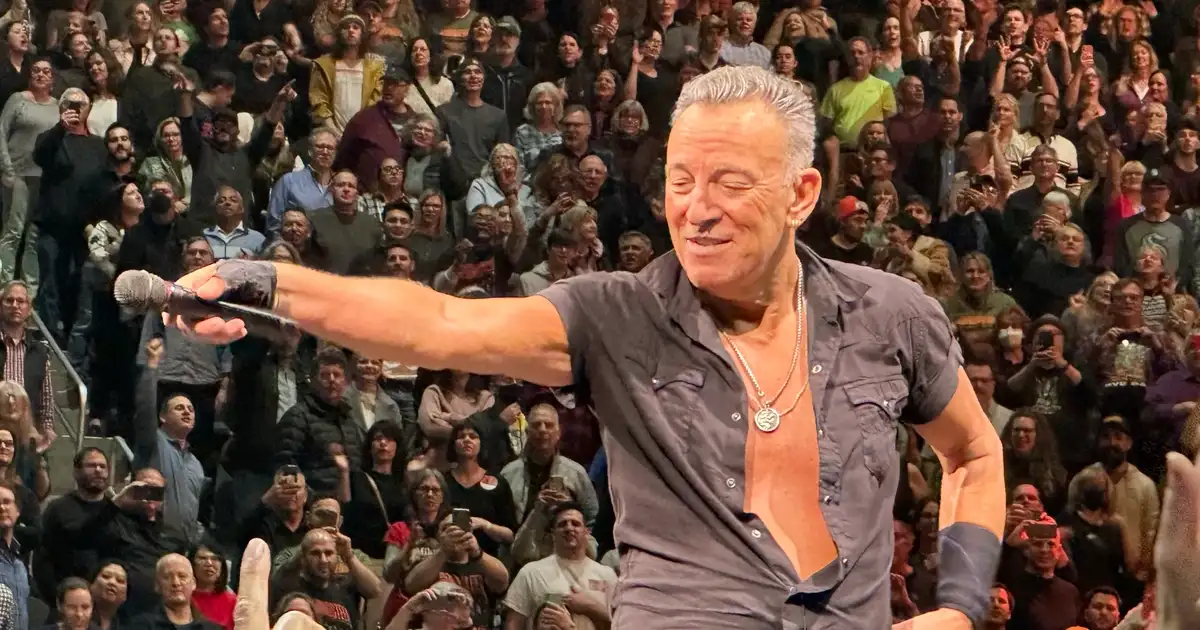

In a move that sent shockwaves through the political arena, Bruce Springsteen, the notoriously anti-MAGA rocker, executed a stunning tactical retreat at the White House Correspondents’ Dinner, publicly praying for President Trump’s safety. This wasn’t a moment of unexpected civility; it was a calculated play, born from crisis, that has since ignited a firestorm of controversy.
The “Boss” made his unexpected move within the last 48-72 hours, following a security incident—a reported shooting at the dinner. While specific details surrounding the shooting itself remain murky, the sheer gravity of the event immediately shifted the focus from the political spectacle to raw human concern, albeit briefly.

The incident involved a California man named Cole Allen. It was in the chaotic aftermath of this security breach that Springsteen, a long-time, vocal critic of President Trump, pulled a surprise play, offering a public prayer for the President’s well-being. A gesture that, for many, was as unbelievable as it was unexpected.
The Fumbled Play: Public Reaction and Strategic Blunder
This gesture hit like a fumbled snap, sparking immediate and brutal backlash across every digital platform. Social media exploded, a furious digital mob tearing into Springsteen’s sudden, almost saccharine, compassion. The verdict from the cynics was unanimous: “performative bullshit” designed to deflect, not genuinely connect.
This wasn’t just a pivot; it was a desperate PR scramble, a naked attempt to reclaim relevance in the cutthroat cultural wars of 2026, where authenticity is currency and perceived hypocrisy is a death knell. Many saw a “washed-up boomer rocker” chasing headlines, trying to navigate a landscape he himself had helped polarize.
While traditional outlets like Fox News and Mediaite attempted to spin this as a “stunning” act of civility, a rare moment of bipartisan grace, the internet, ever the unfiltered judge, wasn’t buying the narrative. Not for a second. On platforms like Reddit’s r/politics and across X threads, the chorus grew louder, accusing the left of blatant hypocrisy on violence, a charge amplified by Springsteen’s sudden, convenient piety.
“Boss prays for the fascist he wants dead? Lmao, damage control after his audience cheers the gunman,” one top X post declared, racking up 12,000 likes and encapsulating the prevailing sentiment.
The digital mob instantly forged the link between Springsteen’s past fiery rhetoric and this sudden, almost saccharine, piety. The perceived contradiction was glaring, the narrative undeniable: this was pure, unadulterated damage control, a desperate attempt to clean up a messy public image, and the public saw right through it.
Beyond the Sidelines: Conspiracy Theories and Memes Erupt
Beyond the immediate backlash, the locker room talk went wild, devolving into a cacophony of sarcastic theories and dark accusations. Some whispered that Springsteen’s “prayer” was a meticulously “scripted” maneuver, orchestrated by his handlers to “dodge cancellation” after years of aggressively anti-Trump posturing. Was this an act of genuine concern, or a strategic shield?
Recall his “dark times” tour kickoff, where he savaged President Trump as a “rogue nation” destroyer, a threat to democracy itself. Against that backdrop, this sudden act of spiritual benevolence felt not just forced, but utterly disingenuous to a significant portion of the public. The memory of his past condemnations made his present piety ring hollow.
Meanwhile, in the darker corners of the internet, on platforms like 4chan and Gab, a far more sinister narrative took root. The entire WHCA “shooting” incident, they claimed, was a deep-state false flag operation, a meticulously staged event designed to martyr President Trump and manipulate public sentiment. This wasn’t merely a security incident; it was a grand conspiracy.
Springsteen’s timely sermon, in this twisted logic, became the “establishment’s unity signal,” a carefully deployed piece in a much larger, more nefarious game – a calculated political maneuver designed to disarm and distract. The “Boss” was no longer just a musician; he was a pawn in a shadowy, high-stakes political chess match.
A viral TikTok skit, racking up over 500,000 views, perfectly encapsulated the public’s cynical mood: “Anti-MAGA icon suddenly loves prayer? He’s not praying; he’s auditioning for the Lincoln Project grift!” MAGA trolls, sensing blood in the water, piled on with gleeful abandon. The gloves were off.
“Too late, prune—your E Street sellouts booed the prayer anyway,” they sneered, twisting the knife. The cynicism was not just palpable; it was a tidal wave. Memes, savage and relentless, flooded the internet, brutalizing Springsteen’s carefully cultivated image and leaving it in tatters. Photoshopped images, depicting “The Boss” kneeling reverently before a MAGA hat, became a potent visual insult. The public, by and large, saw a performer caught in a desperate act, not a penitent experiencing a genuine change of heart.
The Game Plan: What Was Springsteen Thinking?
For years, Springsteen has been relentlessly on the offense against President Trump, a vocal critic who has called him out, blasted his policies, and cemented his anti-MAGA stance into his very brand. So, when the “Boss” executed this sudden, jarring pivot, the question echoed across every locker room and news desk: Why now?
A security incident at a high-profile event doesn’t just change the playbook; it rips it up. The specter of violence, or even the credible threat of it, demands a different kind of response, a strategic shift that transcends personal politics. Suddenly, it’s all about optics, about managing public relations in the face of crisis, whether the “Boss” likes it or not. The stakes were too high for political posturing.
His core audience, largely staunchly anti-Trump, undoubtedly saw this as a profound betrayal, a sudden capitulation to the very forces he’d railed against. Yet, a smaller segment might rationalize it as a necessary evil, a desperate play to de-escalate a volatile situation, even if the gesture itself felt hollow, almost performative. The division within his own fanbase was immediate and stark.
The “Boss” has always cultivated the image of the common man’s champion, but his increasingly strident political stances have undeniably alienated a significant portion of that very base. This prayer, then, could be interpreted as a desperate Hail Mary, an attempt to bridge a chasm he himself helped widen with years of divisive rhetoric. Was he trying to unify, or simply save face?
This was an incredibly risky play, a high-stakes gamble with his legacy. He’s caught in the crossfire between deeply ingrained political convictions and a desperate, perhaps belated, desire for broader appeal. Or, and this is the long shot, perhaps it was a genuine, albeit startling, moment of raw human empathy, a flicker of shared vulnerability in a hyper-polarized world. The stunned silence from the crowd certainly testified to its unexpected nature, leaving us to ponder the true motive behind the curtain.
The Aftermath: A Divided Field and Lingering Questions
This single, jarring act didn’t just create two distinct camps; it cemented a chasm. One side, the overwhelming majority, sees a hypocrite, a man bending with the political winds, a performer whose convictions are as fluid as his setlist. They point to his past fiery rhetoric, his unyielding condemnations, and brand this prayer as the ultimate sellout, a betrayal of everything he once stood for.
The other side, a significantly smaller contingent, might have glimpsed a fleeting hope for unity, a rare moment where the brutal game of politics momentarily yielded to basic human concern. But make no mistake: the dominant narrative, amplified by every corner of the internet, is clear. Cynicism reigns supreme, casting a long, dark shadow over the ‘Boss’s’ intentions, questioning the very core of his public persona.
In the high-stakes game of public perception, Springsteen made his move. It was a messy play, executed under pressure, and it certainly wasn’t universally praised. It left a multitude of unanswered questions hanging heavy on the field, like fog after a brutal contest. The clarity of his convictions, once unshakeable, now seems irrevocably blurred.
Did he genuinely fear for the President’s safety, a rare moment of non-partisan concern? Or was this a coldly calculated attempt to soften his image, to perform a strategic retreat after years of aggressive, contentious rhetoric? The court of public opinion, it seems, has already delivered its damning verdict, and it’s not in the ‘Boss’s’ favor.
This wasn’t a touchdown for civility; it felt more like a desperate, off-target Hail Mary pass thrown in the dying seconds of a losing game. And the crowd, both in the room and the digital arena, was quick to pick it apart, dissecting every angle with surgical precision. The play failed to achieve its apparent objective.
The ‘Boss’ stepped onto a minefield of his own making, and the detonation was immediate and widespread. His public prayer for President Trump’s safety, a moment intended perhaps to humanize, has instead become a defining, and likely damaging, chapter in his public persona. He played the game, but in the brutal court of public opinion, he didn’t just lose; he alienated a significant portion of his base and solidified the cynicism of his detractors. The question now isn’t if he can recover, but at what cost to his legendary status and the authenticity of his brand.
Source: Google News