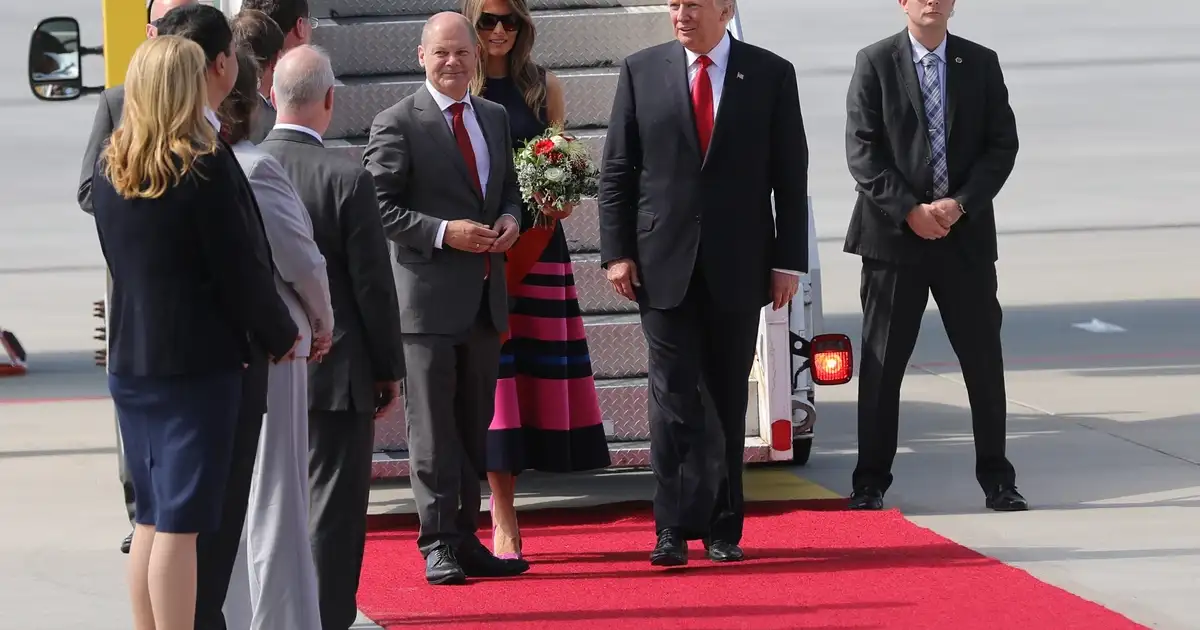

President Donald Trump has unleashed a brazen act of geopolitical sabotage, ordering the stunning withdrawal of 5,000 US troops from Germany. This isn’t a strategic realignment; it’s a direct, petty rebuke to Chancellor Friedrich Merz, a move so transparently vindictive it borders on self-immolation for American interests.
The White House, in a late-night announcement on April 30, 2026, attempted to cloak this punitive measure in the tired rhetoric of Germany’s failure to meet NATO defense spending targets. They tacked on vague grievances about trade and energy policy, but no one is fooled. First troop contingents are already preparing for redeployment, logistical movements seen with unsettling haste at US bases across Germany, following weeks of increasingly heated, personal rhetoric between Washington and Berlin.

A Spat, Not a Strategy: Trump’s Vengeful Gambit
Chancellor Merz, who took office in late 2025, has been an inconvenient truth-teller, daring to criticize America First unilateralism. He specifically called out US trade tariffs on European goods and, crucially, questioned Washington’s increasingly isolationist stance on the ongoing conflict in Eastern Europe. For Trump, such defiance is an unforgivable sin.
The Trump administration, predictably, fired back. They accused Germany of “freeloading” on US security and pursuing economic policies detrimental to American interests. This troop withdrawal is not merely a response; it is a direct, punitive strike, marking a catastrophic breakdown in US-German relations.
To suggest this is about grand strategy is to insult the intelligence of every serious foreign policy analyst. This is about hurt feelings, a presidential tantrum dressed up as foreign policy. Some in Washington now openly call it “petty revenge porn.”
Democrats like Adam Smith, a voice of reason in a cacophony of chaos, rightly called it “not grounded in any coherent U.S. national security policy.” It is pure vengeance, a move designed to gut warfighting formations and, in doing so, embolden America’s rivals.
Trump, with characteristic disregard for law and logic, ignores bipartisan congressional mandates. He dismisses Germany’s critical base access and plunges the Western alliance into disarray. This creates a vacuum that risks spiraling into deeper Middle East chaos.
This withdrawal is not a calculated risk. It is the direct consequence of a personal clash, a leader prioritizing ego over national security.
“Germany has been delinquent for too long. They don’t pay their fair share, and they take advantage of the American taxpayer. We’re bringing our troops home, or we’re putting them where they’re needed. It’s time for Germany to step up, or step aside.”
— President Trump (April 30, 2026), as reported by The Washington Post
This statement isn’t just a political declaration; it’s a confession. It reveals the true, unvarnished motivation: not global security, but a perceived slight, a demand for tribute from a sovereign ally. It’s a transactional approach that fundamentally misunderstands the nature of alliances, treating partners as mere tenants rather than essential pillars of collective security.
The Real Cost: Undermining NATO, Empowering Adversaries
The crucial, terrifying question is this: Will this troop withdrawal actually compel Germany to increase its defense spending? Or will it simply weaken NATO, fracture the transatlantic bond, and push Germany closer to other, potentially less reliable, powers?
History offers a grim, immediate lesson. A partial withdrawal ordered by Trump in 2020 did not magically boost German defense spending. Germany’s defense spending still hovers around 1.8% of GDP, stubbornly below NATO’s 2% target.
Some incremental increases have occurred, yes, but no dramatic shift. There has been no sudden capitulation to American demands.
Chancellor Merz, a pragmatic leader, faces immense domestic pressure. His government grapples with persistent economic issues. A rapid, massive increase in defense spending is not just politically unpopular; it’s a non-starter.
It would necessitate drastic cuts to social programs. This is a sacrifice German citizens, already wary of military expenditures, will not easily accept. Trump’s move is less a lever for change and more a wrecking ball to Merz’s political capital.
The withdrawal covers 5,000 troops, roughly 14% of the 35,000 US troops in Germany. These forces are not merely symbolic; they are the backbone of rapid deployment capabilities, intelligence gathering, logistical hubs, and critical command structures for US European Command. Their removal creates a dangerous, destabilizing void, one that reverberates far beyond Germany’s borders.
NATO allies across Eastern Europe are not just concerned; they are deeply alarmed. Countries like Poland and the Baltic states, acutely aware of Russia’s aggressive posture, rely heavily on US security guarantees.
They see this withdrawal not as a German problem, but as a direct weakening of NATO’s eastern flank. It sets a dangerous precedent that could embolden an increasingly assertive Russia.
This isn’t just about troop numbers. It’s about the erosion of trust and the perception of American commitment, which is priceless in deterrence.
“This decision is a grave mistake, a stunning rebuke to an ally, and a dangerous signal to those who wish to undermine peace in Europe. Germany will not be blackmailed. Our commitment to NATO remains, but our patience with unilateral dictates does not.”
— Chancellor Friedrich Merz (May 1, 2026), in a statement to Reuters
Merz is unequivocally right. Blackmail does not forge alliances; it shatters them. Germany’s commitment to NATO is clear and unwavering, forged through the intense challenges of post-war reconstruction.
But its patience with Trump’s self-serving, unilateral strong-arming has demonstrably run out. This isn’t a negotiation; it’s an ultimatum, and Germany is refusing to blink.
Europe’s Future: Fractured or Forged Anew?
This reckless move will undoubtedly accelerate European defense efforts, but not in a way that benefits the United States. Initiatives for “strategic autonomy” will gain unprecedented traction. These are no longer merely theoretical concepts but urgent necessities.
Increased cooperation within the EU, or specifically with a militarily robust France, becomes not just more likely, but inevitable. Europe will be forced to develop independent defense capabilities faster and more comprehensively. This development, while perhaps laudable in principle, risks fragmenting Western solidarity and reducing American influence on the continent.
A weakened US-German bond could fundamentally reshape global alliances. Germany, a linchpin of European stability, might seek stronger security partnerships within Europe. It could explore non-NATO defense arrangements or even a more independent foreign policy stance.
This would not make the US safer. It would force America to shoulder more burdens alone, diminish its diplomatic leverage, and create a less predictable, more dangerous world.
The economic impact on German communities near US bases will be severe, compounding the insult. Thousands of German civilians are employed there, and millions in local spending will vanish, hitting an ally already grappling with economic headwinds.
Jens Stoltenberg, NATO Secretary General, captured the gravity of the situation with diplomatic understatement, but the message was clear. “Any reduction in Allied presence in Europe is a matter of concern,” he stated. “NATO’s strength lies in its unity and collective defense. We urge all allies to engage in dialogue to resolve differences and maintain our shared security.”
“Any reduction in Allied presence in Europe is a matter of concern. NATO’s strength lies in its unity and collective defense. We urge all allies to engage in dialogue to resolve differences and maintain our shared security.”
— Jens Stoltenberg, NATO Secretary General (May 1, 2026), during a press conference reported by CNN
Dialogue, however, is precisely what Trump avoids. He prefers diktat, punishment, and the flexing of unilateral power. This is not how robust, enduring alliances are built; it is how they are dismantled, piece by painful piece.
The True Cost of Isolationism: America Alone
Trump’s “America First” approach is not making America stronger; it is isolating America. It reduces its global influence and ultimately forces the US to shoulder more burdens alone.
Alienated European partners, once reliable allies, will not rush to assist when America inevitably finds itself in a bind. This troop withdrawal is a political stunt, pure and simple, playing to a narrow domestic base and reinforcing a dangerous isolationist narrative.
But the real-world consequences are dire, far outweighing any fleeting political gain.
This withdrawal does not just weaken NATO
Source: Google News