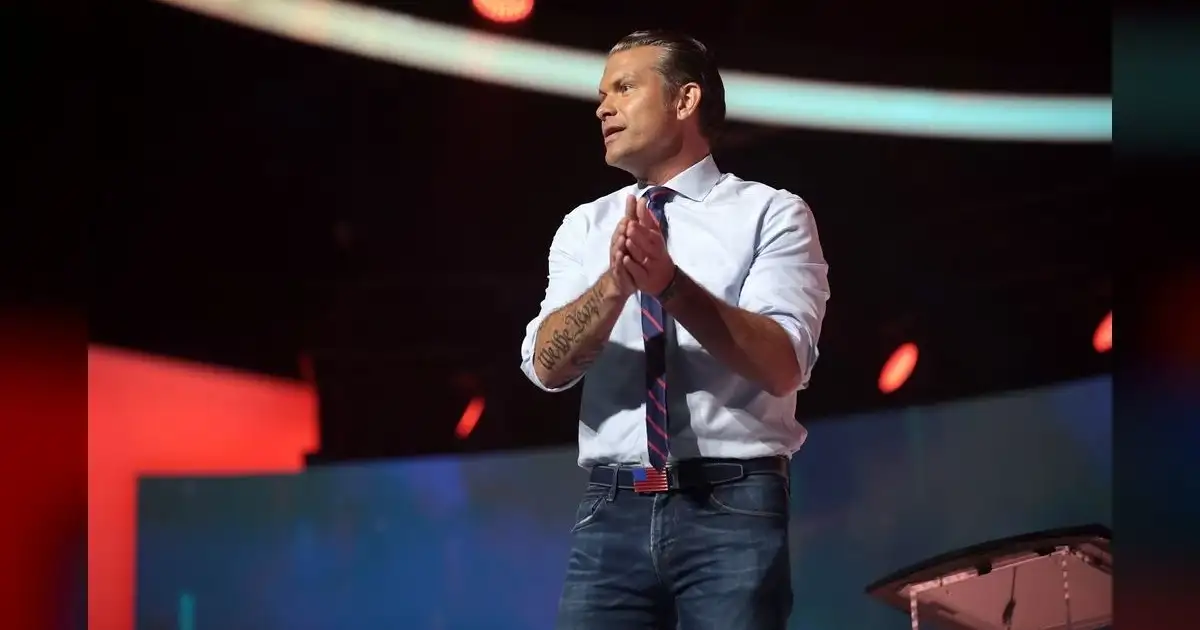

The sight of Pete Hegseth, now Secretary of Defense, perfectly mimicking President Donald Trump as he recounted his path to the Pentagon wasn’t merely a political parlor trick. It was a stark, almost theatrical, revelation of how power is truly brokered and wielded within this administration’s Washington.
Forget the staid policy papers and the meticulously crafted résumés of yesteryear. This is about raw, unyielding loyalty, an almost visceral personal connection, and an uncanny ability to channel the man at the very apex of power. Hegseth’s performance wasn’t just accurate; it was a profound, public declaration of his absolute fealty, a direct demonstration of the singular currency President Trump demands from his inner circle.

The Trump Doctrine of Loyalty
Pete Hegseth’s ascent to Secretary of Defense didn’t just ‘raise eyebrows’ in traditional defense circles; it sent tremors through the entrenched establishment. Hegseth, a decorated veteran and a prominent media firebrand, bypassed every conventional rung of the Pentagon ladder. His improbable journey to one of the nation’s most powerful cabinet posts doesn’t merely highlight a pattern; it underscores the bedrock principle of the Trump White House: unwavering, personal loyalty trumps all else.
That ‘surprisingly accurate’ impression wasn’t a mere amusing anecdote. It was a calculated, brilliant performance, signaling an almost telepathic grasp of the President’s intricate mind. It proved, beyond doubt, that Hegseth not only understands Trump’s famously unconventional communication style but also deeply internalizes his unique, often disruptive, perspective on governance itself.
This profound alignment isn’t merely what President Trump ‘seeks’; it is what he demands. He surrounds himself exclusively with those who speak his precise vernacular, individuals who absorb his vision not just without pushback, but without even the need for translation. They are, in essence, extensions of his own will.
As a senior White House correspondent for The Washington Post, known for her deep-seated connections within the administration, recently observed:
Such an intimate, almost symbiotic, connection doesn’t merely bypass layers of bureaucratic red tape; it obliterates them. It cuts with surgical precision straight to the core of the absolute, unquestioning fidelity the President demands from his highest-ranking officials.“Under President Trump, cabinet appointments are less about checking boxes on a résumé and far more about forging an unbreakable, personal trust. Hegseth’s uncanny ability to channel the President’s essence proves he doesn’t just ‘get’ it; he lives it.”
The Unconventional Path to Power
Hegseth’s startling journey to the Department of Defense doesn’t just ‘illustrate’ the unconventional nature of the Trump administration; it epitomizes it. His platform wasn’t built in the quiet halls of policy think tanks or through years of diplomatic postings, but loudly, proudly, and relentlessly as a vocal champion of the President on cable news. This media omnipresence granted him not just direct access, but a public persona that resonated powerfully with the Trump base, forging a bond far stronger than any traditional credential.
This was no slow, arduous climb through military ranks or diplomatic postings. This was a lightning-fast, direct ascent, shaped by his media presence and unwavering, often pugilistic, advocacy. For countless career military officials and seasoned defense experts, it wasn’t merely ‘an affront’ to traditional meritocracy; it was a slap in the face, a public repudiation of the very system they had dedicated their lives to.
Yet, for President Trump, Hegseth embodied something infinitely more valuable than any conventional qualification. He offered a voice that didn’t just understand populist sentiment; he channeled it. He brought a perspective utterly unburdened by, and actively hostile to, the ossified thinking of the D.C. establishment.
The President has always, always, prioritized unshakeable trust over dusty credentials. His conviction is simple: a fiercely loyal, perfectly aligned individual will not only learn the ropes faster but will execute directives without the subtle, often insidious, bureaucratic sabotage that can plague a seasoned but disloyal appointee. Hegseth’s impression didn’t just ‘solidify’ this bond; it etched it in stone, a public covenant of absolute trust.
It was a public, undeniable demonstration of both his fidelity and his deep comprehension of the President’s strategic mind. It was a clear, unambiguous signal that he would execute the Commander-in-Chief’s directives without a flicker of hesitation or internal debate. For a role as pivotal as Secretary of Defense, especially in wartime, such absolute certainty isn’t just desirable; it’s existential.
Secretary of Defense in a Time of War
The sheer, terrifying weight of Hegseth’s appointment is impossible to ignore, particularly given the volatile global landscape. The United States finds itself locked in an active, grinding military conflict with Iran, a war that erupted on February 28, 2026, with joint strikes alongside Israel.
The Strait of Hormuz remains a powder keg, a constant flashpoint threatening global commerce and stability. The stakes are not just ‘high’; they are apocalyptic. In such an environment, the individual commanding the Pentagon must be not merely ‘in lockstep’ with the Commander-in-Chief, but an extension of his very thought process, a direct conduit for his strategic will.
This is unequivocally not a role for a cautious skeptic, nor for someone prone to questioning directives. It is for a loyalist who can seamlessly translate the President’s often unconventional strategic vision into actionable policy.
Source: Google News