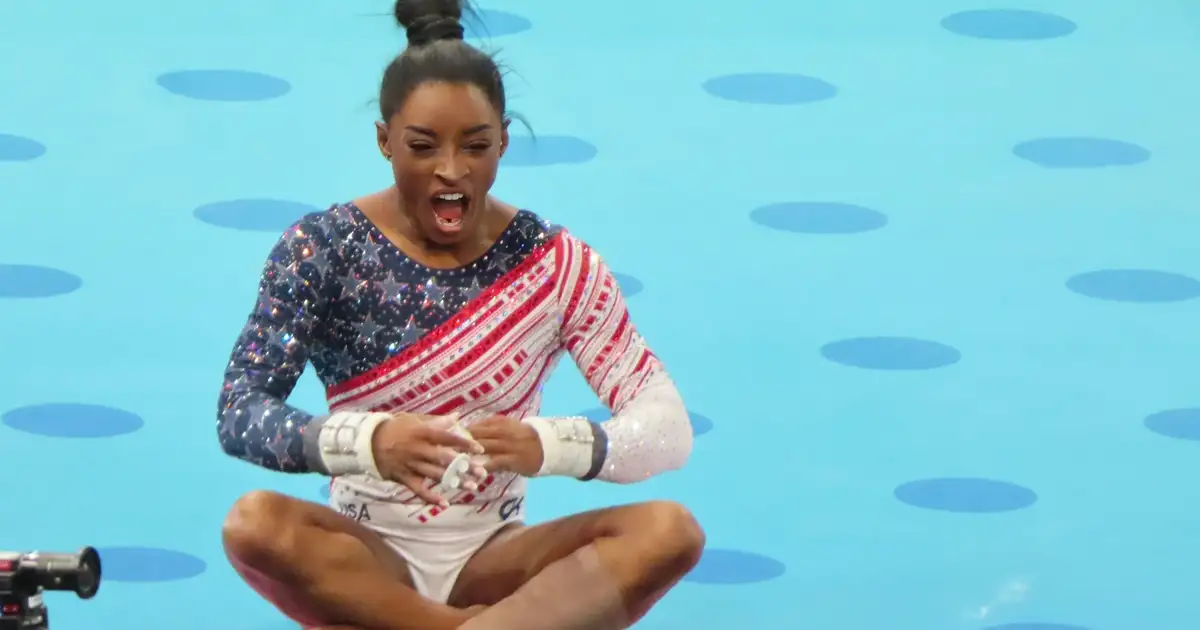

The sports world reeled this week from a gut-punch revelation: Simone Biles, the undisputed titan of gymnastics, faced a terrifying health scare, revealing she “almost died” in the hospital. This isn’t just a headline; it’s a stark, brutal reminder that even the most dominant champions are not immune to life’s most savage realities, a truth that hits harder than any blindside tackle.
The Olympic legend didn’t just share her ordeal; she ripped open the curtain on a near-death experience that sent shockwaves through every locker room and training facility. Her raw honesty doesn’t just highlight the intense physical and mental demands on elite athletes; it lays bare the brutal, often hidden, toll professional sports exacts from its greatest competitors.

The Unseen Battle for Elite Athletes
Biles has always been a trailblazer, not just on the mat, executing maneuvers few dare to attempt, but also in advocating for athlete well-being. She famously, and controversially at the time, stepped back from competition during the Tokyo Olympics. That decision wasn’t about a sprained ankle; it was about her mental blocks, the debilitating “twisties,” which rendered complex, high-stakes moves suicidal. Her courage didn’t just shift a conversation; it detonated a paradigm shift in how we view athlete health, forcing the world to acknowledge the unseen battles.
Her past struggles hammered home a truth many in sports conveniently ignore: health isn’t merely about avoiding a broken bone or a torn ligament. It’s about ironclad mental fortitude and maintaining emotional stability under the kind of crushing pressure that would buckle lesser individuals.
This latest, terrifying health crisis, though the full details remain under wraps, doesn’t just amplify that message; it screams it from the rooftops. It confirms that the fight for an athlete’s total well-being is a relentless, never-ending war.
The constant, unforgiving pursuit of perfection in elite sports demands an unimaginable, often unseen, toll. Every gravity-defying jump, every bone-jarring landing, every grueling training session pushes the human body beyond its engineered limits. Athletes don’t just live; they exist on a razor’s edge, constantly flirting with career-ending injury and total exhaustion. Biles’s unflinching honesty doesn’t just pull back the curtain; it rips it down, exposing the raw, hidden struggle that defines their existence.
NFL Pressures and the Biles-Owens Connection
The brutal demands of elite sports aren’t confined to the gymnastics mat; they extend to every arena, every field of play.
Simone Biles’s husband, Jonathan Owens, a hard-hitting safety for the Green Bay Packers, faces similar high-stakes physical and mental challenges every single snap. He doesn’t just contend with the NFL; he survives a league infamous for its punishing schedule and its unyielding physicality.
His career, by its very nature, is a constant encounter with “terrifying” health-related risks, a weekly gamble with his body and future.
It’s a grim reality we witness every season: concussions that steal memories, torn ligaments that shatter careers, and injuries so severe they force players into early retirement. Take Gervarrius Owens, a promising safety for the New York Giants. He, like every other player, is subjected to relentless, bone-grinding physical conditioning, pushed to the absolute brink. They must be in peak form, but this very process, this ceaseless quest for physical dominance, inherently breeds risk. The constant, looming threat of injury doesn’t just ‘hang over’ them; it’s a shadow cast over every snap, every brutal tackle, every single play.
The physical toll is immense, a brutal accounting paid in blood, sweat, and shattered cartilage. But the mental pressure? That’s just as heavy, if not heavier.
Players are forced to perform under the most intense scrutiny imaginable, week after grueling week. They don’t just ‘push through’ pain; they gut it out, battling fatigue, the fear of failure, and the constant threat of being cut.
It’s a relentless grind, a psychological test of endurance that doesn’t just push limits; it fractures them. This harrowing reality forms an unspoken bond, a shared experience for high-profile athletic couples like Biles and Owens, uniting them across different sports.
As the upcoming NFL season looms, these critical concerns aren’t just brought into focus; they are thrown under a harsh spotlight for every franchise, including the Chicago Bears. Their defensive strategies don’t just ‘hinge’ on players’ physical readiness and mental resilience; they demand it. These aren’t abstract discussions about Xs and Os; they are fundamental questions about the athletes’ very capacity to survive, perform, and dominate under extreme duress.
Make no mistake: the physical and mental toll on these athletes is not merely ‘often underestimated’; it is routinely ignored until a crisis erupts. Every season, every game, is not just a contest for victory; it’s a brutal, high-stakes battle for longevity, a fight against the inevitable breakdown.
Biles’s unflinching advocacy, though rooted in her own sport, echoes with undeniable force across all professional leagues.
Her voice isn’t just a reminder; it’s a thunderclap, demanding that the human element, the flesh-and-blood reality behind the jerseys and leotards, can no longer be ignored.
The “terrifying” aspect of an athlete’s health isn’t always a sudden, dramatic, game-stopping event. More often, it’s the insidious, cumulative wear and tear, the silent battles fought in the dark, and the relentless, constant threat of injury that defines their careers.
A Call for Deeper Scrutiny
This latest, harrowing incident involving Simone Biles isn’t just a wake-up call; it’s an emergency siren blaring across the entire sports landscape. It demands that we rip our gaze away from the highlight reels and the gleaming championship trophies. We aren’t just ‘examining’ the support systems in place; we must brutally scrutinize them. The critical question must be asked, without equivocation: Are these organizations truly prioritizing the long-term well-being of their most valuable assets over the fleeting glory of short-term performance?
Biles has not merely ‘championed’ a more holistic approach to athlete care; she has been a relentless advocate, a lone voice in the wilderness, for years. Her uncompromising influence has already fundamentally reshaped public discourse, forcing uncomfortable truths into the open. Now, with her own severe health scare, the demand for robust injury prevention, comprehensive rehabilitation, and unequivocal mental health support isn’t just growing louder; it’s a deafening roar that can no longer be ignored. This isn’t merely about one extraordinary athlete; it’s about the fundamental welfare of every single one of them.
The sports industry, from the top brass to the coaching staff, must not just ‘double down’ on athlete welfare initiatives; it must execute a full-court press, a strategic overhaul. This demands a massive allocation of resources, the implementation of ironclad protocols, and the cultivation of a culture that not only tolerates but demands honesty about struggles, both physical and mental. We simply cannot afford to lose our heroes, our titans of sport, to preventable health crises that stem from systemic neglect. The stakes are not merely ‘too high’; they are existential.
Simone Biles’s courage in ripping open her own terrifying ordeal doesn’t just solidify her legacy; it elevates it to legendary status far beyond any medal count. Her fight is no longer just for her own sport; it’s an unwavering, necessary battle for the fundamental dignity and well-being of all athletes. Her message isn’t merely ‘clear’; it’s a thunderous ultimatum to an industry that often prioritizes profit over people: Adapt, evolve, and truly protect your gladiators, or face the consequences. The sports world doesn’t just ‘owe her that much’; it owes her its very soul, and it’s long past time to pay up.
Photo: Fernando Frazão/Agência Brasil
Source: Google News