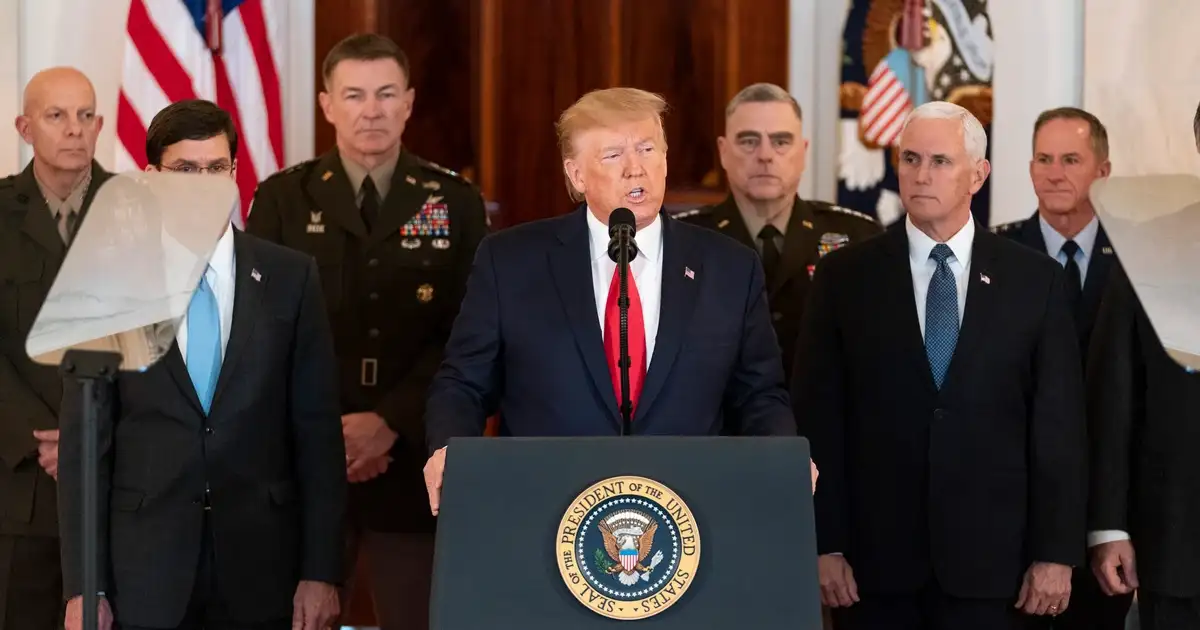

President Donald Trump’s startling declaration to seize Kharg Island and strike Iran “very hard tonight” has not merely rippled through global stability; it has torn a gaping hole in it. This direct, unambiguous threat from the sitting President escalates an already volatile region into dangerously uncharted territory, demanding immediate and sober assessment from international observers.
The White House swiftly confirmed President Trump’s intent regarding Kharg Island, Iran’s indispensable oil export terminal. This strategic facility is the lifeblood of Iran’s economy, handling an astonishing 90% of the nation’s crude oil exports.

The President’s vow to hit Iran immediately follows a protracted period of intense regional tension, significantly exacerbated by the ongoing US-Iran War 2026. The implications of targeting such a critical economic artery are profound, signaling a dramatic shift in the conflict’s trajectory.
Global oil markets reacted with immediate and visceral alarm. Brent crude futures jumped over 4% in early trading, reflecting widespread fears of severe supply disruption from the Strait of Hormuz.
This narrow choke point, a maritime bottleneck of unparalleled strategic importance, sees roughly one-fifth of the world’s total oil consumption pass through it daily. Any threat to its stability sends shivers through the global economy, impacting everything from energy prices to international trade routes.
Tehran’s Unflinching Retort and Military Posture
Iranian officials wasted no time in condemning President Trump’s remarks, framing them not merely as aggressive but as a profound violation of international norms. Foreign Ministry spokesperson Nasser Kanaani characterized the threats as “provocative” and “a clear breach of international law,” underscoring the gravity with which Tehran views such pronouncements. He issued a stark warning, promising a “crushing and decisive response” to any perceived miscalculation by the United States.
“Such threats would be met with a crushing and decisive response, the scope and intensity of which would leave no doubt about Iran’s resolve and capability to defend its sovereignty and interests.”
Nasser Kanaani, Iranian Foreign Ministry Spokesperson, as reported by Reuters
In parallel, Iran’s elite Revolutionary Guard Corps (IRGC) has reportedly increased its readiness levels, deploying forces to high alert positions across the Persian Gulf. This heightened state of alert is not merely symbolic; it reflects a tangible increase in defensive and potentially offensive capabilities, given the IRGC’s history of assertive actions in the waterway, including past confrontations with U.S. naval assets. The stakes could not be higher, with both sides now poised on the precipice of a direct military confrontation that risks spiraling beyond immediate control.
Global Alarm Bells Ringing: A Call for Restraint
The international community, particularly allies in Europe and Asia, expressed profound and immediate concern. Foreign ministries across the globe issued urgent calls for de-escalation and a renewed commitment to diplomatic engagement. Their apprehension stems from a pragmatic understanding that a wider regional conflict would have devastating and far-reaching consequences, potentially destabilizing global trade and security alliances.
The United Nations Secretary-General’s office, through a spokesperson, issued a strong statement urging all parties to exercise maximum restraint. The UN emphasized the paramount importance of upholding international peace and security, highlighting the potential for a catastrophic humanitarian crisis should the situation escalate further.
The White House, meanwhile, has maintained a tight-lipped stance, reiterating only that “all options are on the table” to counter Iranian aggression. This phrase, in the current context, only amplifies global anxieties rather than assuaging them. The question remains: how effective can diplomacy be when one side explicitly threatens immediate military action?
The Historical Precedent of Pressure and Escalation
The United States and Iran share a long, complex, and often hostile history, with animosity deepening significantly after the 1979 Iranian Revolution. President Trump’s previous administration pursued a “maximum pressure” campaign against Tehran, a strategy designed to cripple Iran’s economy and force concessions on its nuclear program and regional influence. This campaign included the controversial withdrawal from the Joint Comprehensive Plan of Action (JCPOA) nuclear deal in 2018, followed by the imposition of crippling sanctions that severely impacted Iran’s oil exports and financial sector.
That period saw multiple dangerous escalations, including attacks on oil tankers in the Gulf and drone shoot-downs. The 2020 assassination of Iranian General Qassem Soleimani, a pivotal figure in Iran’s regional security apparatus, brought both nations to the absolute brink of war. The current conflict, the US-Iran War 2026, has only intensified these deep-seated hostilities, demonstrating that the “maximum pressure” approach, rather than leading to de-escalation, has instead paved the way for open warfare and now, potentially, direct strikes on Iran’s economic infrastructure.
The Economic Fallout: Beyond the Barrels, a Global Reckoning
This threat of military confrontation in the Persian Gulf directly impacts ordinary people worldwide, far beyond the immediate belligerents. A disruption of this magnitude could send shockwaves through global markets, triggering an energy crisis unlike any seen in decades.
Energy prices would skyrocket, leading to significantly higher gas prices for consumers at the pump, increased utility costs for households, and a surge in inflationary pressures globally. The ripple effect would be felt across every sector, from manufacturing to transportation.
The potential disruption to the Strait of Hormuz is immense and cannot be overstated. Roughly one-fifth of the world’s total oil consumption and a quarter of global LNG trade passes through this critical waterway.
Any blockage, even temporary, would mean immediate, severe global economic repercussions. Businesses would face unprecedented supply chain challenges, investor confidence would plummet, and the specter of a global recession would loom large. The economic stability of nations far removed from the conflict zone hangs precariously in the balance.
Humanitarian Stakes and Regional Tremors: A Looming Catastrophe
Beyond the economic calculus, the human cost of such a conflict is staggering and demands urgent consideration. A full-scale war in the Persian Gulf could spark a massive humanitarian crisis, leading to widespread displacement of populations, countless casualties, and the destruction of vital infrastructure. Regional instability, already a persistent challenge, would only worsen existing tensions, potentially igniting proxy conflicts and exacerbating sectarian divisions across the Middle East.
The risk of drawing in other nations remains a major concern for international strategists. Such a conflict could easily expand into a wider regional war, with devastating consequences for allies like Saudi Arabia, the UAE, and Israel, who face the immediate threat of retaliatory strikes on their borders.
While some regional actors might privately welcome a tougher stance against Iran, they also bear the brunt of immediate conflict and its destabilizing effects. Europe’s fervent calls for diplomacy are not merely idealistic; they are rooted in a pragmatic and profound fear of devastating global fallout, recognizing that the repercussions of this conflict would extend far beyond the immediate battleground.
President Trump’s declaration is not mere rhetoric; it is a direct challenge with immediate, tangible, and potentially catastrophic consequences. As the world holds its breath, the question is not if tonight brings a “very hard” hit, but what irreversible global changes will unfold in its wake.
Source: Google News