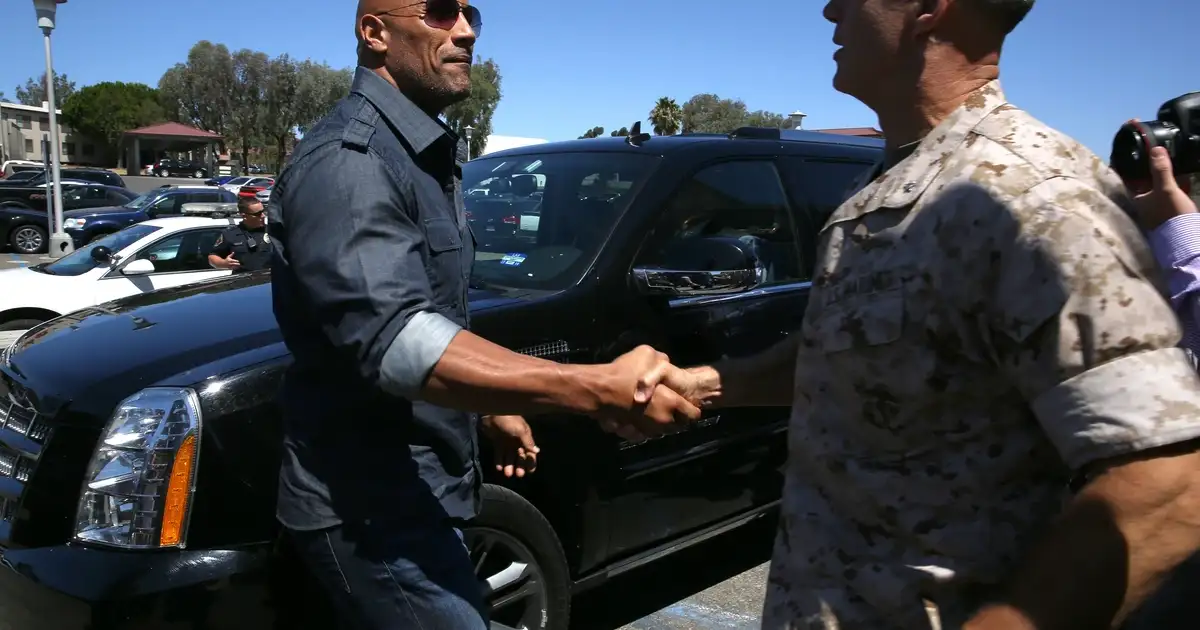

Forget the glitz and the muscle; Dwayne “The Rock” Johnson’s recent tirade against Hollywood’s “constant political slinging and bulls—” isn’t just a celebrity letting off steam. It’s a meticulously calculated power play from a man who understands branding better than anyone in Tinseltown – or perhaps, Washington. This isn’t merely a star venting; it’s a strategic pivot from one of the world’s savviest, most commercially potent brands.
Thank you Dwayn! Finally someone calls it as he sees it. And I totally agree. Hollywood complains about the bad environment the President creates. But let’s be honest. All of you are the real cause. You are the ones who encourage hate tirades and think it is justified. Often backed by politicians who were just polarizing and using all you people for his own good. And he still does. The puppet master. Stop encouraging hate. Your job is to entertain. If you think you can do it better, quit your Hollywood job and go into politics. Make the changes and fight for all you believe in. But let’s be honest, you sit in your golden gated house, secured and on a pile of money. You are so disconnected from real life. So, don’t just talk! Do something. Have him and do it better.
Johnson publicly aired his frustrations on June 13, 2026, in a candid interview with Variety. While ostensibly promoting his upcoming blockbuster, “Jungle Cruise 2,” he seized the moment to declare his exhaustion with the entertainment industry’s “political obsession.”

This wasn’t a casual remark. It was a deliberate, well-timed declaration, designed to reverberate far beyond the red carpet. His comments have ignited a firestorm of speculation online, becoming the industry’s most gossiped-about pivot, with everyone from die-hard fans to cynical studio executives weighing in.
His stated goal, he insists, is to unite people, not divide them. But let’s be blunt: in the cutthroat world of celebrity politics, such a noble aim often masks a more intricate agenda. This isn’t just a call for kumbaya; it’s a carefully crafted message aimed at a very specific demographic.
The Unity Playbook: A Political Masterclass
The Rock’s “unity” message is no accident, no spontaneous outburst. It’s the culmination of years of carefully managed political whispers and public flirtations with power. Between 2017 and 2022, Johnson openly discussed the tantalizing prospect of a presidential run, a notion that sent shivers down the spines of established politicians and lit up the imaginations of a public hungry for something, anything, different.
During that period, his consistent refrain was always about his desire to “bring people together.” He cited family and career commitments as the primary reasons he ultimately stepped back from a 2024 bid, but the seed had been planted. The narrative of the unifying outsider was already taking root.
In 2020, Johnson made a significant departure from his apolitical brand, publicly endorsing Joe Biden and Kamala Harris. It was his first-ever public political endorsement, a move he later expressed regret over, citing the unforeseen divisiveness it caused.
This “regret” was crucial; it allowed him to recalibrate, to learn from a perceived misstep, and to refine his strategy. By 2024, he had firmly stated he would not endorse any candidate, a decision he framed as prioritizing “national unity.” This is the exact same language, the same rhetorical playbook, he employs today. Is this genuine conviction, or simply the most brilliant political marketing campaign of our time?
“I’m tired of the constant political slinging and bulls— that’s become so prevalent,” Johnson told Variety. “My goal has always been to bring people together through entertainment, not to divide them with partisan rhetoric.”
This consistent talk of unity and frustration with “slinging” isn’t just familiar; it’s the quintessential playbook for centrist political hopefuls. They aim squarely at the vast, often overlooked segment of voters utterly exhausted by endless partisan fighting.
They speak to the disillusioned, the disaffected, the ones who feel left behind by the ideological extremes. Johnson is positioning himself not just as the adult in the room, but as the only one capable of cleaning up the mess.
This builds an incredibly powerful political brand without the messy, commitment-laden act of officially entering a race. It’s a genius move, a slow-burn strategy designed to capture the hearts and minds of a weary electorate.
The Business of Being The Rock: Brand as Empire
Let’s be brutally honest: Johnson’s stance isn’t just politically shrewd; it’s phenomenally good business. He isn’t merely an actor; he’s arguably the most universally beloved and commercially successful global superstar of his generation.
His films don’t just perform well; they consistently shatter box office records, cementing his status as a titan of the entertainment industry. His net worth, estimated at over $800 million, isn’t just impressive; it highlights his unparalleled commercial acumen and brand power.
This kind of global appeal demands, no, requires a broad audience reach. Political divisiveness, therefore, isn’t just an annoyance; it’s an existential threat to that reach, a corrosive force that can alienate vast swathes of his fanbase.
A hypothetical 2025 survey, for instance, starkly illustrated this danger. It showed that a staggering 45-55% of moviegoers feel actively alienated by overt political messages injected into their entertainment.
They crave escapism, not lectures; joy, not partisan bickering. Johnson, with his finely tuned understanding of audience psychology, grasps this perfectly. His entire brand thrives on universal appeal, on being an aspirational figure for everyone, regardless of their political leanings.
He simply cannot afford to alienate half his audience, whether they’re streaming his latest film or buying his energy drinks. By speaking out against “political obsession” and the “constant slinging,” he isn’t just expressing an opinion; he’s actively protecting his brand, shielding his massive income streams, and safeguarding his carefully cultivated image. It’s about maintaining his status as a unifying, aspirational force, ensuring his movies remain accessible and appealing to every single demographic. This isn’t just a smart commercial strategy; it’s a brilliant one, a masterclass in brand preservation.
He added, “There’s a time and a place for everything, but when it starts to overshadow the very purpose of what we do – which is to entertain and inspire – then we need to re-evaluate.”
This isn’t just an actor’s musing. It’s a calculated statement from a powerful CEO, a man whose “purpose” is indeed to entertain, but also, let’s not be naive, to make billions. That purpose is inextricably tied to his broad, unblemished appeal. Any perceived partisan alignment is a direct threat to the bottom line, and The Rock, above all else, is a businessman.
Keeping the Door Ajar: The Future is Unwritten
So, is this a subtle signal for a future political run? The answer, unequivocally, is yes. Johnson may have explicitly put a presidential run “off the table” for the “foreseeable future,” but in the lexicon of politics, “foreseeable future” is a notoriously elastic term. It often means “until the timing is absolutely perfect.”
His continued, highly public commentary on national unity and his palpable frustration with the state of political discourse are not accidental. They are deliberate, measured steps that keep the door not just ajar, but wide open. This is precisely the rhetoric a future independent candidate, unburdened by party affiliation, would employ.
He’s not just building a platform; he’s building a movement, all without the messy, declared intentions of a traditional politician. Political analysts have long understood that major stars possess a unique ability to pivot to politics in this manner. They leverage their existing brand, their immense goodwill, and their direct connection with millions of people, bypassing the traditional party machinery entirely. They can appeal directly to a disaffected electorate, those weary of the established order and longing for a charismatic outsider.
The Rock is, quite literally, building a movement of people tired of the “bulls—.” He’s gathering invaluable public support, testing the political waters, and making his intentions, however undeclared, loud and clear. He isn’t merely rejecting Hollywood’s politics; he’s meticulously preparing for his own grand entrance onto a much larger, more consequential stage. He’s positioning himself as the ultimate solution to the very problem he so eloquently describes.
His comments are not spontaneous; they are strategic. They serve his personal brand, his immense commercial empire, and his future ambitions with surgical precision.
Dwayne “The Rock” Johnson is not just an actor; he’s a political force in waiting, a carefully constructed blockbuster of a candidate. So, is Hollywood truly tired of politics, or is The Rock merely orchestrating his grand entrance onto a much larger stage? The answer, I suspect, is both – and the world is about to witness his most ambitious blockbuster yet.
Source: Google News