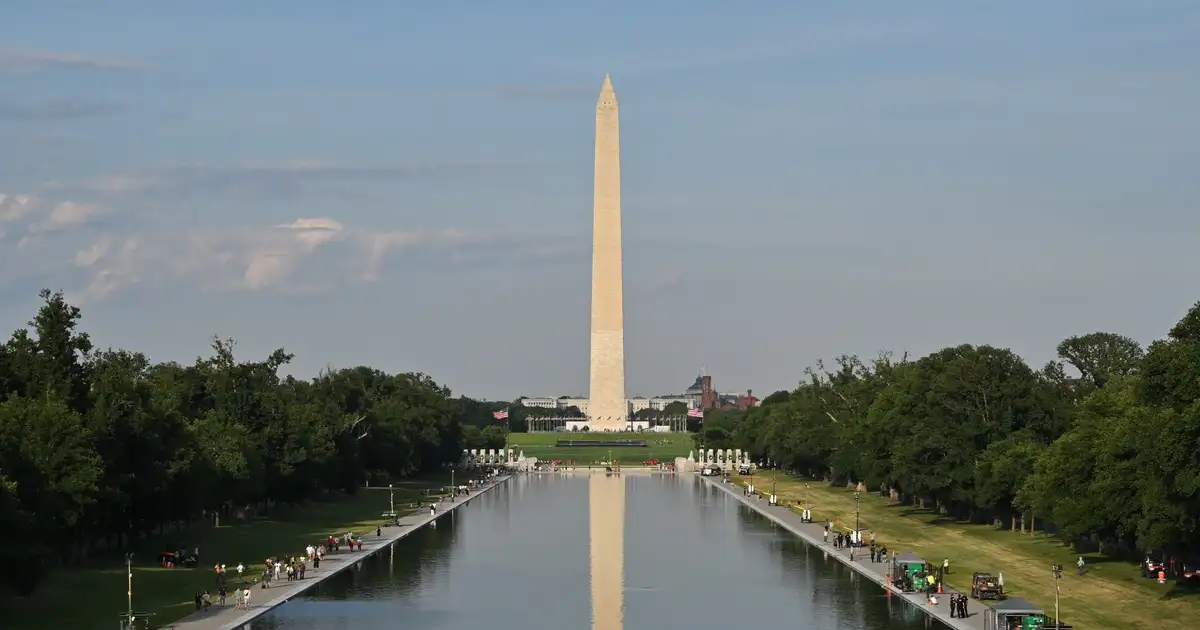

The White House Reflecting Pool, a symbol meant to evoke national grandeur and enduring American spirit, has become a literal and metaphorical swamp under President Trump’s watch. Just weeks after its lavish unveiling, the $14.2 million renovation, marked by the President’s personally selected “American flag blue” paint, is already a catastrophic failure, with chunks of paint flaking off into the very waters it was meant to glorify. This isn’t merely an unfortunate oversight; it’s a glaring, public indictment of an administration that promised competence and fiscal responsibility, yet delivers only expensive, visible decay.
A National Landmark Adrift in Neglect
The reports, emerging on June 18, 2026, paint a grim picture. What was intended as a patriotic masterpiece has devolved into an embarrassing eyesore. Large sections of the pool’s basin show visible peeling and flaking, the once vibrant blue now a mottled, fading mess. Imagine, if you will, the visual: fragments of “American flag blue” paint, like discarded confetti, drifting across the water’s surface, a stark, almost perverse contrast to the intended majestic tableau. This isn’t just about aesthetics; it’s about the integrity of our national symbols and the stewardship of taxpayer funds.

This renovation project, touted as a symbol of American pride, reportedly siphoned a staggering $14.2 million from the public purse. Let’s be clear: this isn’t pocket change, nor is it a rounding error in a federal budget. This is a substantial sum, earmarked for a project that has spectacularly failed its most basic function within weeks. The Reflecting Pool, a hallowed space where presidents have addressed the nation and citizens have gathered for moments of unity and reflection, now stands as a monument to waste and demonstrable incompetence, visible for all the world to see.
For decades, this iconic landmark has embodied stability and the enduring strength of the republic. Now, it symbolizes something far more unsettling: a profound disconnect between rhetoric and reality, between grand promises and shoddy execution. What message does a crumbling national symbol send to a populace already grappling with cynicism and distrust in government? It’s not a message of strength; it’s a lamentable whisper of decline.
Trump’s “Stark Theory” and the Scramble for Accountability
In the face of this very public debacle, President Trump has, predictably, offered a “stark theory” for the rapid decay. While the specifics of this theory remain conveniently vague, one can almost hear the frantic whispers and the desperate scramble within the White House to craft a narrative that deflects blame. Is it an act of sabotage? A deep state conspiracy against patriotic paint? The very notion of a “theory” for a basic engineering failure underscores a troubling pattern of avoiding direct accountability and sidestepping uncomfortable truths.
This isn’t merely a debate about paint adhesion; it’s a fundamental crisis of accountability. Who, precisely, signed off on the contractors for this multi-million-dollar project? Who conducted the due diligence on their qualifications and track record? More importantly, who approved the materials – a crucial decision given the pool’s exposure to the elements and its symbolic importance? The American people deserve concrete answers, not vague theories or thinly veiled excuses. This is about more than just a botched renovation; it’s about the integrity of government procurement and the stewardship of public assets.
A project costing $14.2 million should, without question, be built to last for decades, not mere weeks. This egregious failure raises profound questions about the oversight mechanisms, or lack thereof, within the current administration. It’s not an isolated incident but rather a symptom of a larger, systemic issue concerning how taxpayer money is allocated and managed on high-profile government projects. The “drain the swamp” mantra rings hollow when the swamp itself gets a fresh, albeit peeling, coat of expensive paint.
The Political Optics of a Crumbling Icon
The Reflecting Pool is far more than a mere body of water. It serves as a majestic backdrop for presidential addresses, a solemn stage for national events, and a powerful symbol of American strength and endurance. To see it now, visibly decaying, is to witness a glaring symbol of dysfunction at the very heart of American power. The optics are disastrous, projecting an image of disarray and incompetence to both domestic audiences and international observers.
One can only imagine the media frenzy, the relentless scrutiny, had this calamity occurred under any other administration. The outrage would be palpable, the calls for resignations deafening. The standard of accountability should remain unwavering, regardless of who occupies the Oval Office. This visible decay erodes public confidence, not just in this specific project, but in the broader capacity of government to execute even the most straightforward tasks effectively. This isn’t a partisan squabble; it’s a stark revelation of a competence deficit that transcends political affiliations.
The immediate fiscal cost is a staggering $14.2 million, effectively flushed down the drain. But the long-term costs are far more insidious and potentially much higher. Repairs will undoubtedly be necessary, almost certainly at additional taxpayer expense, perpetuating a disheartening cycle of waste. This isn’t just about fixing a pool; it’s about rebuilding trust and demonstrating a fundamental capacity for effective governance.
The contractors responsible for this demonstrably poor work must be held to account, rigorously and publicly. Was the bidding process truly competitive and transparent, or was it rushed and compromised? Were sufficient quality controls implemented and enforced, or were corners cut in a rush to completion?
These are not trivial questions; they are central to restoring faith in government contracting and ensuring the responsible use of public funds. Every dollar squandered on rectifying this mess is a dollar diverted from critical investments in infrastructure, essential veterans’ care, or the future of our nation’s education system. It’s a direct, tangible hit to the public purse and a betrayal of public trust.
A Patriotic Vision Flaking Away
President Trump’s personal selection of the “American flag blue” color for the Reflecting Pool was intended as a bold statement of patriotism, a visual evocation of national pride. It was meant to be a signature touch, a personal stamp on a national treasure. Now, that carefully curated patriotic vision is literally flaking away, piece by agonizing piece. The optics are, to put it mildly, abysmal. It looks less like a monumental government project and more like a cheap, hastily executed knock-off, an embarrassment rather than an inspiration.
The symbolism of peeling blue paint, representing the very color of the American flag, cannot be dismissed as mere coincidence. It sends a troubling, perhaps even prophetic, message about the state of affairs, whether intended or not. It speaks to a superficiality that prioritizes appearance over substance, grand gestures over meticulous execution. When the symbols of national pride begin to crumble, what does it say about the underlying foundations?
Washington’s Enduring Cycle of Waste
This Reflecting Pool fiasco serves as yet another stark example of Washington’s seemingly endless cycle of problems: grand pronouncements, exorbitant expenditures, and, all too often, precious little to show for it. It’s a bitter reminder that the “swamp” does not, in fact, drain itself. Instead, it frequently receives a fresh, expensive, and ultimately ephemeral, coat of paint that peels off within weeks, exposing the rot beneath. This cycle of waste, incompetence, and deflection must be broken.
The everyday American, who works tirelessly for their earnings, rightly expects their hard-earned tax dollars to be utilized with prudence and foresight. This $14.2 million project falls spectacularly short of that fundamental expectation, demonstrating a profound disrespect for the public trust. This is not merely a cosmetic problem; it represents a fundamental breakdown in project management, oversight, and accountability. It reflects poorly on every individual and entity involved, from the highest levels of the administration to the contractors who delivered such a substandard product.
As The Washington Post recently highlighted in an analysis of government spending, “The true cost of inefficiency is not just measured in dollars, but in the erosion of public faith.” This incident exemplifies that erosion with painful clarity.
What Happens Next? The Inevitable Blame Game
The White House now faces an unenviable choice. Will they opt for another hasty, superficial fix, risking further embarrassment and additional taxpayer expense? Or will they finally commit to a full, transparent investigation into the contractors, the materials, and the approval process that led to this costly blunder? The public, rightly indignant, will be watching closely.
They demand to know who is truly responsible for this expensive and highly visible failure. They want assurances that this will be corrected, not by throwing more good money after bad, but through genuine accountability and competent remediation. Expect the inevitable blame game to commence with vigor. Fingers will point, excuses will be crafted, and narratives will be spun. But the undeniable fact remains: the White House Reflecting Pool is a national mess, and American taxpayers footed the $14.2 million bill.
Ultimately, this entire situation is a profound black eye for the administration, a visible mark of poor planning, flawed execution, and a stunning lack of oversight. The American people deserve more than a crumbling symbol of patriotism; they deserve a government that can manage its most basic responsibilities without turning national landmarks into national embarrassments.
Source: Google News