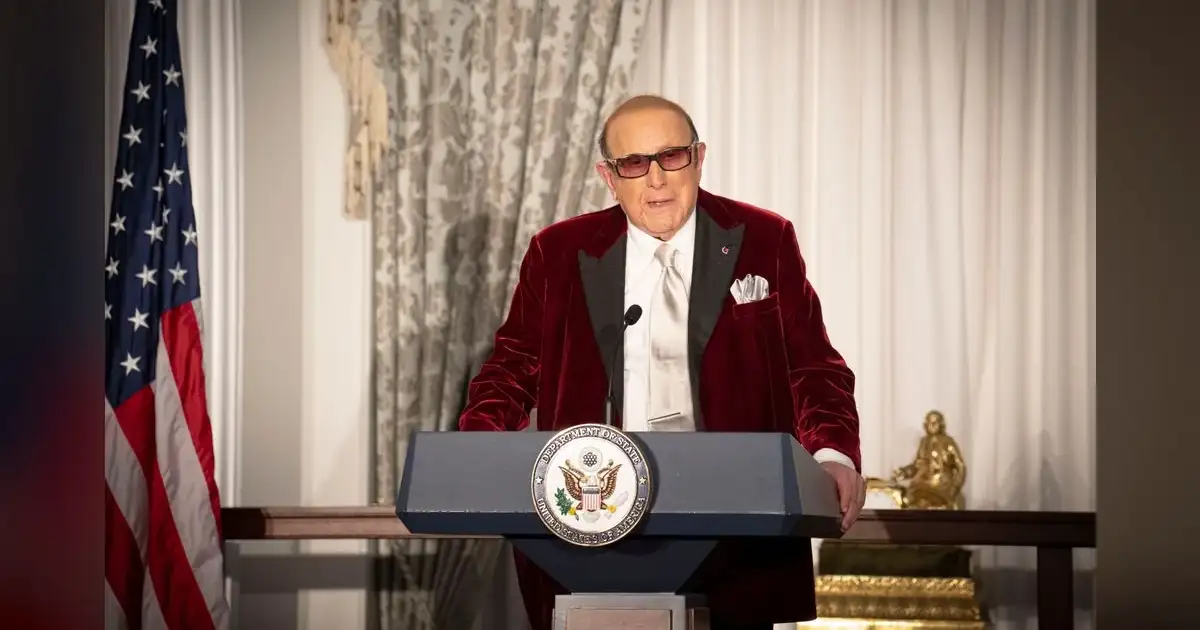

In an industry obsessed with the ephemeral, where today’s viral sensation is tomorrow’s forgotten algorithm, Clive Davis, at a remarkable 94, stands as a titan. He is not merely a living legend; he is a monument, a poignant reminder of an era when music was built on intuition, vision, and an almost alchemical ability to transmute raw talent into cultural bedrock.
Variety recently lauded Davis with a feature titled “Clive Davis: Still the Architect of Sound, ‘No One More Fabulous’ at 94,” a piece that didn’t just celebrate his longevity but underscored his indelible imprint on modern music. It sparked not just appreciation, but a collective sigh for a time when such singular figures held sway.

Those closest to him affectionately dub him “the man with the golden ears.” This isn’t just hyperbole; it refers to his almost mystical faculty for discerning nascent brilliance, for hearing the future in a voice or a melody before anyone else could. He didn’t just discover artists; he meticulously sculpted their careers, shaping generations with a vision as precise as it was expansive.
The Golden Age of A&R: A Maestro’s Touch
Artists universally speak of Davis’s profound mentorship, a partnership that transcended mere business. He didn’t just sign a contract; he committed his entire being to their success, guiding them through the labyrinthine music industry with meticulous care. As one artist eloquently put it:
“Clive didn’t just sign you; he invested his whole being into your success. He taught me how to be an artist – not just a singer, but a storyteller, a presence.”
This wasn’t a passive role; it was an active, hands-on engagement. Davis was reportedly a constant presence in studios, offering not just creative feedback but also strategic counsel on everything from song selection to stage presence. He understood that true artistry required nurturing, a long-game approach that is tragically absent in today’s instant-gratification landscape.
Industry colleagues, often fierce competitors, grudgingly acknowledge his strategic brilliance and unparalleled negotiation skills. Davis navigated the treacherous waters of the music business with a foresight that bordered on prescience. His roster was a masterclass in genre-bending diversity, signing acts that spanned the spectrum from rock to R&B to pop, proving that good music, regardless of its packaging, always finds an audience when championed by a true believer.
Beyond the boardroom and the studio, his family paints a portrait of a fiercely loyal and driven man whose passion for music was matched only by his unwavering integrity. They speak of a warmth and generosity behind the scenes, a paternal figure who genuinely cared for the well-being of his artistic protégés. This human element, this deep personal connection, was a cornerstone of his empire.
The commercial success under Davis’s stewardship is nothing short of breathtaking. The artists he nurtured collectively sold an astronomical hundreds of millions of albums worldwide. Whitney Houston alone, his most iconic discovery, moved over 200 million records globally, becoming one of the best-selling music artists of all time under his guidance. Her success wasn’t just a statistical anomaly; it was a cultural phenomenon, a testament to Davis’s ability to identify and amplify transcendent talent.
His artists have garnered countless Grammy Awards and other prestigious accolades, their trophy shelves groaning under the weight of industry recognition. Davis himself boasts an impressive five Grammy Awards, a testament to his own creative and executive genius. He didn’t just sign artists; he built entire empires, founding powerhouses like Arista Records in 1974, where he famously discovered Whitney Houston and Barry Manilow, and later J Records, where he launched the career of Alicia Keys. These ventures generated not just billions in revenue but also immense cultural capital, shaping the soundscape of multiple decades.
His career began in the 1960s at Columbia Records, where he swiftly signed legends like Janis Joplin and Santana, demonstrating an early, uncanny ability to spot revolutionary talent that would define an era. His autobiography and the critically acclaimed documentary “Clive Davis: The Soundtrack of Our Lives” further cemented his legendary status, offering intimate glimpses into his unparalleled journey. And, of course, his annual pre-Grammy gala remains the most coveted invitation in the industry, a legendary event where power, talent, and legacy converge under one roof.
Can Another Davis Emerge in the Algorithm Age?
The true profundity of Davis’s legacy isn’t merely in celebrating his past achievements; it lies in the stark, unsettling question of whether such a figure could ever exist again. In our relentlessly fragmented, digital-first music industry, the landscape is not just unrecognizable; it’s practically alien to the world Davis conquered.
The traditional A&R model, once the beating heart of talent development, has been largely obliterated. No longer do discerning executives scour dive bars and demo tapes; instead, digital platforms and social media algorithms now dictate talent discovery. A single “gatekeeper” like Davis, possessing the singular power to launch a career, holds virtually no sway in a world where artists can connect directly with millions of fans via a smartphone.
The sheer volume of new music released daily is not just overwhelming; it’s a deafening cacophony. Artists, empowered by accessible distribution channels, bypass traditional labels and executives, often achieving viral fame before any industry “ears” have even had a chance to listen. Fewer acts, if any, still rely on one executive’s “golden ears” for their career-defining break; instead, they chase engagement metrics and trending hashtags.
Modern A&R is a cold, data-driven beast. Streaming numbers, social media analytics, and demographic breakdowns guide decisions, replacing the purely subjective, deeply human musical intuition that Davis mastered. The art of listening, of truly hearing potential beyond the immediate numbers, has been supplanted by spreadsheets and predictive analytics. It’s a focus group masquerading as a muse.
Davis famously invested years, sometimes decades, in developing his artists, understanding that true artistry blossoms with time and dedicated nurturing. Today, the industry demands immediate, often fleeting, returns. Long-term career development is not just a rare luxury; it’s an endangered species. The patience required to cultivate a Whitney Houston or an Alicia Keys simply doesn’t exist in a market obsessed with quarterly reports and viral spikes.
Furthermore, Davis’s legendary status was forged not just in the studio, but in the creation of indelible cultural moments. His pre-Grammy parties were iconic events, power hubs where deals were struck, legends mingled, and the very fabric of the music industry was woven. This potent blend of intuition, business acumen, and unparalleled cultural influence is a unique alchemy that cannot be replicated by data points or TikTok trends.
The music world, in its relentless pursuit of efficiency and virality, has undeniably lost its human touch. Algorithms dictate taste, often amplifying the lowest common denominator, rather than a visionary ear guiding us towards lasting artistry. The industry prioritizes fleeting virality over enduring legacy, often sacrificing genuine talent at the altar of instant gratification.
The Irreplaceable Vision: A Legacy Beyond Measure
Clive Davis didn’t just hear music; he heard futures. He possessed an almost prophetic ability to discern the cultural, commercial, and artistic potential in a voice or a melody that eluded everyone else, and then he built empires around that potential. No one else, before or since, has possessed his unique, potent combination of instinct, business acumen, and an unwavering belief in the power of music.
“He didn’t just hear music; he heard futures. He heard the potential in a voice or a melody that no one else did, and then he built an empire around it, brick by painstaking brick.”
He was more than an executive; he was a surrogate family member to his artists, pushing them relentlessly towards their absolute best, but always with a bedrock of support. “He believed in me when others doubted, when the industry was ready to write me off,” a prominent artist once confided. “No one more fabulous, truly, in every sense of the word.” That belief, that unwavering advocacy, is a rare commodity.
Even at 94, his passion for music remains remarkably infectious. He still listens, still discovers, and still fights for the music he believes in, his dedication a luminous beacon in an increasingly cynical industry. This isn’t mere nostalgia; it’s an active, vibrant engagement with the very art form he helped define.
The “so what” factor of Clive Davis is not just immense; it is immeasurable. He cultivated cultural icons whose voices became the veritable soundtrack to millions of lives, transcending generations and geographical boundaries. Their music isn’t just background noise; it’s woven into the tapestry of our collective experience, marking milestones, healing wounds, and sparking joy.
His story serves as a powerful, enduring testament to the transformative power of vision and mentorship. True genius, whether musical or entrepreneurial, often needs a guiding hand, a discerning ear, and an unwavering champion. In a world increasingly dominated by data-driven decisions and disembodied algorithms, Clive Davis represents an irreplaceable human element – the heart, the soul, and the sheer, unadulterated passion that once defined the music industry.
We celebrate Clive Davis now, not just for the glorious past he shaped, but because he is a poignant relic of a better time, a golden age that, tragically, may never dawn again. His kind of profound, human-centric influence will likely never grace the industry again, leaving us to wonder what masterpieces, what cultural touchstones, we might be missing in his absence.
Photo: FREDDIE EVERETT
Source: Google News