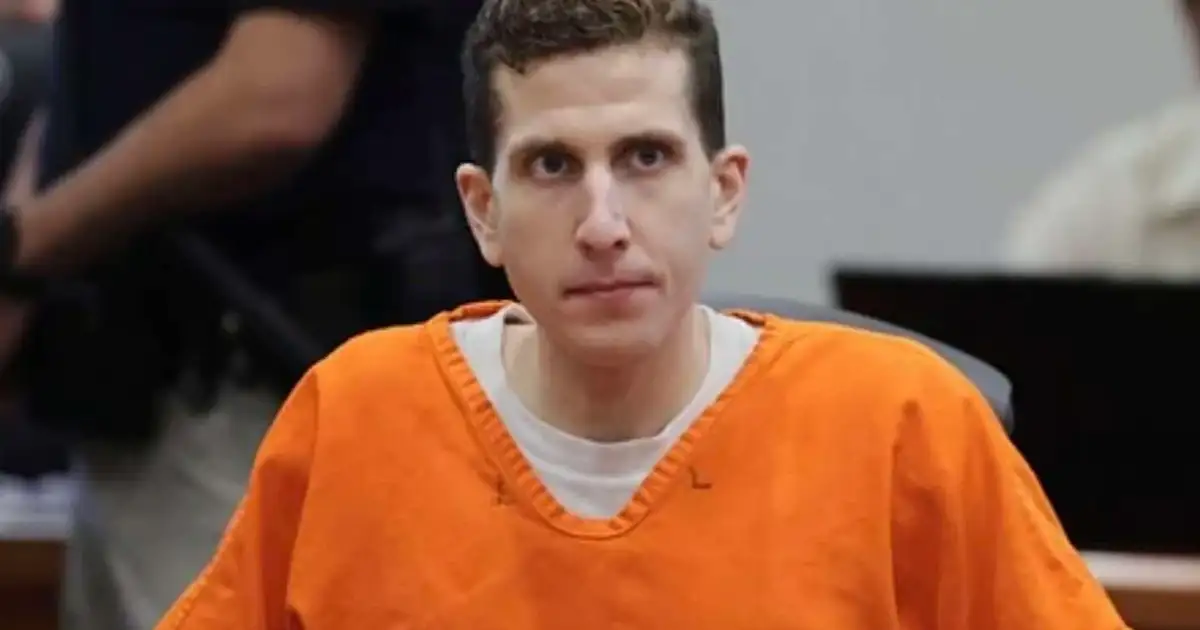

The blood had barely dried in that quiet Moscow, Idaho, student house when the chilling truth began to emerge: the man accused of butchering four promising young lives was not some shadowy stranger from the fringes. Bryan Kohberger, a Ph.D. student steeped in the very study of crime, a teacher’s assistant instructing others on justice, had even interviewed for a police job in the same horrific year he allegedly committed these unspeakable acts. This isn’t merely a fact; it’s a brutal rupture in our collective understanding of evil, a profound, terrifying disconnect that screams from the headlines and rips apart every comforting illusion we hold about criminal minds.
The man now facing the gravest charges once sought to wear the badge, to join the very forces that would eventually hunt him across state lines. He dissected criminal psychology, lectured on forensic techniques, and immersed himself in the mechanics of law enforcement. Then, with an alleged precision as cold as it was calculated, he committed a crime so monstrous it sent shivers through the nation, leaving a wound that may never fully heal.

The Twisted Path of a Criminology Student: A Betrayal of Knowledge
The details of Bryan Kohberger’s life before the predawn horrors of November 13, 2022, are not just sickening; they are a direct affront to the very ideals of academic pursuit and public service. He was a Ph.D. student at Washington State University (WSU), a stone’s throw from the victims’ home. His chosen field? Criminology. His role? A teacher’s assistant in that very department, tasked with guiding nascent minds through the intricacies of crime, punishment, and justice.
Consider the profound, grotesque irony. This man, who stood before students discussing the motivations of murderers and the methods of investigators, is now accused of embodying the darkest elements of his own curriculum.
He understood criminal psychology, not as an abstract theory, but with an intimacy that now appears chillingly predatory. He knew police procedures, not as an outsider, but as someone who had studied their every nuance, perhaps even their vulnerabilities. He was immersed in the world of law enforcement and justice, not to uphold it, but, prosecutors allege, to subvert it with a terrifying efficiency. This paradox doesn’t just defy comprehension; it mocks it.
Yet, the story darkens further. In that same horrific year, 2022, Kohberger took another step into the world of law enforcement. He interviewed for a police department job in Pullman, Washington, a mere short drive from the very house where Kaylee Goncalves, Madison Mogen, Xana Kernodle, and Ethan Chapin would later lose their lives. One cannot help but wonder: what thoughts coursed through his mind during that interview? Was it a perverse desire to understand the hunter, to refine his own alleged methods? Or was it a mask, a calculated performance of normalcy designed to deflect suspicion?
Think about that for a moment, truly let it sink in. A man with aspirations to wear a badge, to protect and serve. A man teaching others about the societal scourge of crime. He is now accused of the most heinous, intimate acts imaginable against four innocent students. It doesn’t just make your stomach churn; it makes you question the very fabric of human identity. Was this an intellectual curiosity gone horribly awry, or something far more sinister – a fascination with the dark side that ultimately consumed him?
The victims – Kaylee Goncalves, Madison Mogen, Xana Kernodle, and Ethan Chapin – were vibrant, full of life, and utterly defenseless. Their lives ended in a horrific manner, allegedly at the hands of a man who was, by all appearances, a student of crime itself. This isn’t merely a random act of violence; it is a cold, calculated betrayal of trust, not just of individuals, but of the very institutions of academia and justice. It is a wound inflicted not just on families, but on the public’s faith in the ordinary.
Defense Fights to Reshape a Dark History: An Impossible Task?
Now, Bryan Kohberger’s past, once reflecting academic ambition, is under fresh, forensic scrutiny. Defense motions filed on July 29, 2026, have thrust these uncomfortable truths back into the harsh glare of public and legal scrutiny. While many of these filings remain under seal, shrouded in the tactical secrecy of high-stakes litigation, their intent is clear.
Legal analysts contend that the defense desperately seeks to reframe his history, to sanitize the narrative of a man seemingly obsessed with crime. They are challenging the prosecution’s damning portrayal, attempting to explain away his academic pursuits as legitimate intellectual curiosity, and his police application an indicator of a desire to help society. It is an audacious, perhaps even impossible, task.
The prosecution, conversely, views these details as a smoking gun, as damning evidence of a mind uniquely equipped for its alleged depravity. They argue, with compelling force, that Kohberger used his intimate knowledge, twisting insights gleaned from criminology for his own dark, unspeakable ends. His expertise, far from being a benign academic pursuit, they suggest, made him a more cunning, more dangerous, and ultimately, a more elusive killer. He didn’t just understand the system; he understood how to exploit its blind spots.
But the defense, facing the overwhelming weight of public opinion and forensic evidence, will fight this narrative tooth and nail. They will undoubtedly contend that his interest was purely legitimate, his studies merely intellectual curiosity, his police application an indicator of a desire to help society. This is more than just a desperate attempt to humanize the accused; it is an attempt to sever the psychological link between his academic life and the alleged murders, to present two distinct, irreconcilable personas.
The conflict is stark, a battle for the very soul of the narrative. Was Kohberger a budding scholar and public servant, tragically misunderstood? Or was he a predator hiding in plain sight, using the cloak of academia to mask a terrifying darkness? The legal battle, and indeed the public’s understanding, hinges on this agonizing question.
The defense team faces an uphill battle of Sisyphean proportions. They must explain the unexplainable, reconcile the irreconcilable. How do you fuse these two personas – the aspiring lawman and the alleged butcher – into a coherent, non-damning whole? How do you make sense of such a horrific, mind-bending contradiction without acknowledging a profound psychological fracture?
The Unsettling Duality: A Mind Divided?
The core of this case is not just a chilling psychological dissonance; it’s a terrifying glimpse into the potential for human duplicity. Bryan Kohberger was, by all accounts, deeply immersed in studying criminal behavior. He was a Ph.D. student in criminology at Washington State University, and a teacher’s assistant there. This meant his days were spent analyzing crime, dissecting theories of deviance, understanding forensic science, and learning the precise methods by which law enforcement investigates cases. He was, in essence, an academic authority on the very subject that now defines his alleged crimes.
Then, in 2022, the same year the world irrevocably shifted for the Goncalves, Mogen, Kernodle, and Chapin families, he applied for a job. He sought to join the Pullman Police Department. This was a direct, tangible aspiration to serve, to be part of the solution, to uphold the very laws he is now accused of shattering. Yet, in that same year, he allegedly became the ultimate problem, a perpetrator of unimaginable violence. This apparent contradiction is not merely a central puzzle; it is a gaping chasm that hints at a profoundly disturbed mind, a psyche capable of compartmentalizing on a scale most of us cannot fathom.
What truly drives such a person? Was it a deep, pathological fascination with crime, a desire to not just understand but to experience the ultimate transgression? Was it a craving for ultimate control, a twisted expression of power over life and death? Or was it a complete, terrifying break between his public, academic self and a hidden, private abyss of depravity? We are left with disturbing questions that echo in the silence of the courtroom and the minds of a horrified public.
This case forces us to re-examine everything we thought we knew about the human capacity for evil. It challenges our understanding of how well we truly know anyone, particularly those who present a façade of intellectualism or civic duty. It suggests that the most dangerous individuals might not be the obvious outsiders, but those who have mastered the art of blending in, of appearing normal, even exemplary.
“It’s incredibly rare to see someone pursuing a Ph.D. in criminology, someone who has such an intimate understanding of the criminal justice system, allegedly commit such a heinous act,” former FBI agent Jennifer Coffindaffer stated in an interview with CNN. “It beggars belief, not just for law enforcement, but for anyone who believes in the inherent goodness, or at least the inherent logic, of academic pursuit. It’s a betrayal of the highest order.”
This sentiment echoes across the nation, a collective gasp of disbelief. The idea of such a profound betrayal of trust, of knowledge weaponized against the innocent, is not just hard to swallow; it’s an indigestible truth that leaves a bitter taste in the mouth of society.
Beyond the Profile: What This Means for Society’s Fragile Trust
This case transcends the alleged crimes of one man; it challenges our very notion of safety and forces us to confront uncomfortable truths about the origins of danger. It proves, in the most brutal way imaginable, that darkness can emerge from the most unexpected places, even from the hallowed halls of academia, from minds ostensibly dedicated to understanding and preventing crime.
The community of Moscow, Idaho, will never be the same. The families of Kaylee Goncalves, Madison Mogen, Xana Kernodle, and Ethan Chapin live with an unimaginable, searing pain. For them, the thought of a criminology student as the alleged killer is not just torment; it adds another layer of perverse, incomprehensible cruelty to their grief. It renders the senselessness even more profound, transforming a tragedy into a macabre academic exercise.
This is not an isolated incident in history, though its specifics are uniquely horrifying. Individuals with similar backgrounds have indeed committed monstrous acts, exploiting their intelligence and understanding of human nature.
Ted Bundy, for example, a name synonymous with charismatic evil, famously studied psychology and law. He was a charming, intelligent man who leveraged his intellect and apparent normalcy to lure and murder scores of women. He understood the legal system, not to uphold it, but to evade it, just as Kohberger, allegedly, understood the mechanisms of investigation.
These cases force us to ask fundamental, unsettling questions: Can we truly profile evil? Can we predict who will cross the line from intellectual fascination to horrific action? Or are some individuals simply beyond our understanding, masters of deception whose inner demons remain hidden until it’s tragically too late?
The “so what” factor here is enormous, reverberating through every corner of society. This case rips apart our comfort zones, shatters the illusion of safety, and makes us question the veneer of normalcy that so often cloaks profound darkness. It shows us that malevolence can lurk in the most unexpected, seemingly benign places, turning our assumptions on their head.
We rely on law enforcement; we rely on experts in criminal justice to protect us, to uphold the social contract. When one of their own, or someone aspiring to be one of their own, allegedly commits such a heinous crime, public trust erodes at an alarming rate. It leaves a gaping, festering wound in the very fabric of society, fostering cynicism and fear where confidence should be.
The investigation itself was a monumental undertaking, spanning multiple states, consuming immense public resources, and mobilizing countless dedicated professionals. All of this to track down a man who, by all appearances, had studied their every move, their every technique, for a living. The irony is as bitter as it is profound.
The Unanswered Questions of Motivation: A Void That Chills
The most haunting question remains, a cold wind blowing through the heart of the case: Why? How could someone so deeply involved in studying crime, in dissecting its psychological roots and societal impacts, allegedly commit such a brutal, seemingly motiveless act? What does this say about his true motivations, his inner world, and the terrifying potential for knowledge to be twisted into a weapon?
Here are the hard facts that don’t just scream for answers, but demand them, challenging our very capacity for comprehension:
- Academic Immersion and Authority: Bryan Kohberger was not merely a student; he was a Ph.D. student in criminology at Washington State University and a teacher’s assistant. This signifies a deep, professional, and intimate engagement with criminal behavior, forensic science, and justice systems. He was an insider, not an outsider.
- Law Enforcement Aspiration: In 2022, the very year of the savage murders, Kohberger actively interviewed for a position with the Pullman Police Department. This wasn’t a fleeting thought; it was a concrete step towards joining the police force, an aspiration to protect the very public he is now accused of terrorizing.
- Profound Psychological Dissonance: This shocking contradiction is not merely a detail; it is the central, most disturbing element of the case. It points to a complex, perhaps fractured, psychological profile. It could involve a dark, pathological fascination with the taboo, a desire for ultimate control, or a severe, terrifying disconnect between his public persona and his private, alleged actions. The mask, if it was one, was perfectly crafted.
- Defense’s Desperate Recontextualization: The defense’s July 29, 2026, filings are a strategic gambit, aiming to reframe his past, to divorce his academic and professional interests from the alleged violence. They will undoubtedly argue his interest was legitimate, an intellectual pursuit of understanding crime, not a blueprint for committing it. This directly challenges the prosecution’s narrative of motive, attempting to create reasonable doubt where public opinion sees none.
- The Haunting Lack of Clear Motive: Perhaps most chillingly, no definitive, publicly disclosed motive has emerged that fully reconciles his background with the alleged crime. This void leaves open immense, terrifying questions about his underlying psychological drivers, about the true nature of the darkness that allegedly consumed him.
The defense will try to separate the astute student from the alleged killer, to present his academic work as a noble intellectual pursuit rather than a twisted preparation for murder. It is, as one legal analyst commented to Reuters, “their only play, a desperate attempt to sever the undeniable link between knowledge and alleged depravity.”
But the facts are stubborn, unyielding. They paint a picture of a man who knew too much, a man who understood the system from the inside out. And then, allegedly, he exploited that profound knowledge for the most horrific, unimaginable ends.
A Systemic Failure in Plain Sight? The Shaking Foundations of Trust
This case exposes not just a terrifying blind spot in our understanding of human nature, but a profound systemic vulnerability. How do we identify individuals like Kohberger? How do we prevent someone so intimately intertwined with the study and practice of justice from allegedly becoming a monster of their own making?
It’s not just about one man’s alleged crimes; it’s about the gaping cracks in our understanding of human behavior, about the very limits of psychological profiling. We operate under the assumption that those who dedicate their lives to studying crime do so out of a desire to prevent it, to understand its mechanisms in order to safeguard society. We assume a certain level of ethical conduct, a moral compass aligned with the public good.
This assumption, in Kohberger’s case, appears shattered beyond repair. The system, in its well-meaning pursuit of knowledge and public safety, allowed someone with deep, intimate knowledge of criminal justice to operate freely, to move between academic study and alleged horrific violence without detection. This gap, this terrifying space between intent and action, is a profound failure. It is a failure of foresight, a failure of understanding, and ultimately, a failure of imagination to conceive of such a betrayal.
We must ask ourselves, with a renewed sense of urgency and dread: What warning signs were missed? What psychological vulnerabilities went unaddressed in his academic or personal life? How can we, as a society, prevent another individual from weaponizing their knowledge, their intellect, against the innocent and the unsuspecting?
The answers are not simple, nor are they comforting. But the questions must be asked, loudly and relentlessly. They must be screamed from the rooftops until they penetrate the complacency that often allows such horrors to fester in the shadows. We cannot afford to look away from this terrifying reality, to dismiss it as an anomaly. To do so would be to invite its recurrence.
The very foundation of trust, the bedrock upon which civil society is built, is shaken to its core. When those who study crime allegedly commit it, when the lines between good and evil blur so catastrophically, it is a chilling prospect for everyone. It forces us to confront the uncomfortable truth that the most dangerous threats might not be external, but internal, born from the very systems designed to protect us.
Bryan Kohberger’s alleged actions force us to stare into an abyss, a void where knowledge becomes not a tool for enlightenment, but a weapon for destruction. It’s where the pursuit of understanding turns into a path of unimaginable cruelty, where the promise of intellect curdles into depravity. This nightmare, this profound betrayal of trust and knowledge, will haunt us for generations, a stark and terrifying reminder of the darkness that can lurk beneath the most unassuming surfaces. The echoes of his alleged crimes will forever challenge our faith in humanity, leaving us to wonder: how many more are hiding in plain sight?
Source: Google News