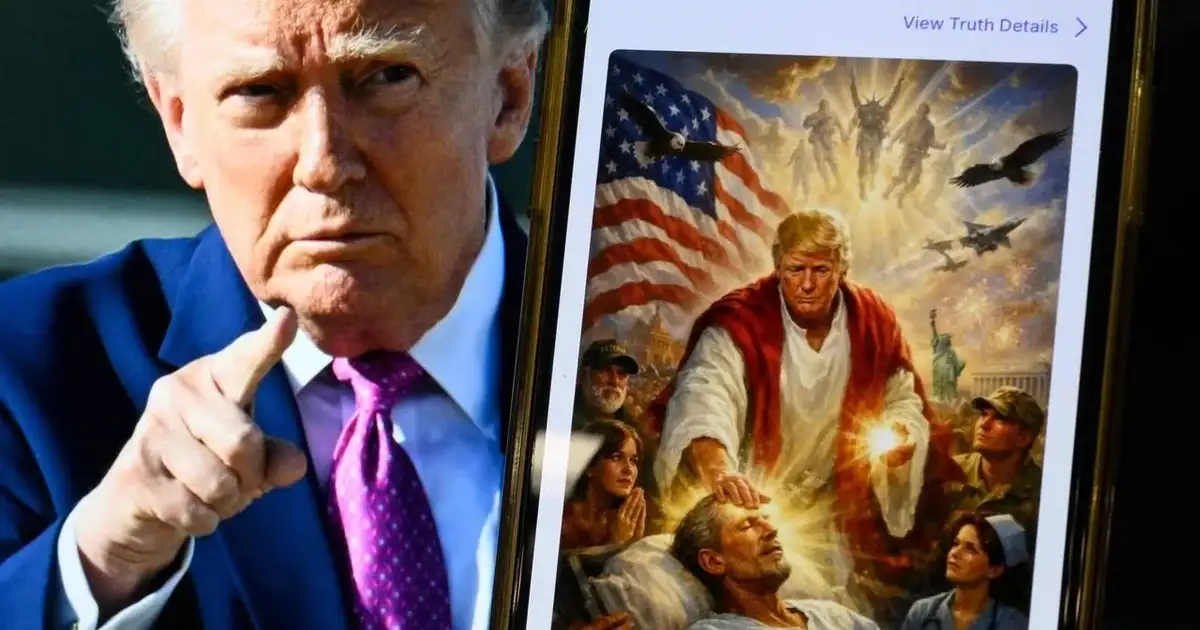

In a move that could only be described as vintage Trump, President Donald J. Trump has once again sent shockwaves through the global political landscape, boldly declaring that Pope Leo XIV, the first American-born pontiff, has “probably learned a great deal about how the world really works” – a stunning, almost paternalistic pronouncement aimed squarely at the spiritual leader of over a billion Catholics. This extraordinary claim was delivered alongside his long-awaited, if predictably self-serving, explanation for deleting a controversial social media image depicting himself as Jesus Christ, further cementing his unique, often confrontational, relationship with both faith and power.
The President’s remarks, delivered with his characteristic bluntness, were not merely a casual observation but a calculated challenge to the moral authority of Pope Leo XIV. This isn’t just about a theological disagreement; it’s a direct assertion of political dominance, implying the spiritual leader has been forced to confront the harsh realities of statecraft. Trump, ever the master of narrative, then pivoted to address the weeks-long speculation surrounding a digitally altered image that had captivated and repulsed in equal measure: a depiction of himself imbued with divine attributes, which he had conspicuously scrubbed from his online presence. The confluence of these two seemingly disparate events – a public lecture to the Pope and a post-mortem on a messianic meme – speaks volumes about Trump’s audacious political playbook.

President Trump’s Message to the Vatican: A Power Play
President Trump’s statements didn’t just ‘hit hard’; they landed like a carefully aimed political broadside. By suggesting Pope Leo XIV now “understands the complexities of power,” Trump isn’t merely speculating; he’s asserting that the Pontiff has been brought to heel by the brutal realities of geopolitics, forced to temper his idealism with pragmatism. This isn’t a subtle hint; it’s a public declaration that the Vatican, too, must bend to the will of the Oval Office, or at least acknowledge its perceived wisdom. The timing, of course, is no accident. These remarks arrive amidst the escalating US-Iran War 2026, a conflict that has drawn intense global scrutiny and fervent calls for peace from nearly every corner, including, crucially, the Holy See itself. Pope Leo XIV, known for his unwavering moral compass, had previously urged profound restraint, speaking out publicly and directly against military escalation. Trump’s current narrative, therefore, is a strategic masterstroke: it implies the Pope’s perspective has fundamentally shifted, that his earlier appeals were naive, and that the ‘political realities’ of war have finally enlightened him. It’s a classic Trumpian move: reframe dissent as eventual agreement, cast critics as late learners, and appropriate their perceived capitulation as validation of his own policies.
“The Pope probably learned a great deal about how the world really works,” President Trump stated. “Some things are just facts. You can’t ignore them forever.”
This isn’t merely another instance of Trump challenging religious authority; it’s a pattern of asserting absolute dominance, demanding not just respect but outright deference, even from figures as globally revered as the Pope. His political philosophy dictates that all criticism, regardless of its source, must be met with a forceful counter-narrative, or better yet, a declaration of the critic’s ultimate conversion to his worldview. The silence from the White House on further elaboration isn’t a sign of uncertainty; it’s a calculated ambiguity. Sources close to the administration, perpetually anonymous and strategically tight-lipped, offered no confirmation of specific events underlying the President’s claims. This deliberate lack of detail only amplifies the message: the President speaks, and the world is left to interpret, to speculate, and ultimately, to react on his terms. What deeper conversations or diplomatic maneuvers might have preceded this public pronouncement? The administration offers no clues, leaving the impression that Trump’s word alone is sufficient, a testament to his unique grip on the political narrative.
The Deleted Jesus Image: Trump’s Narrative Control
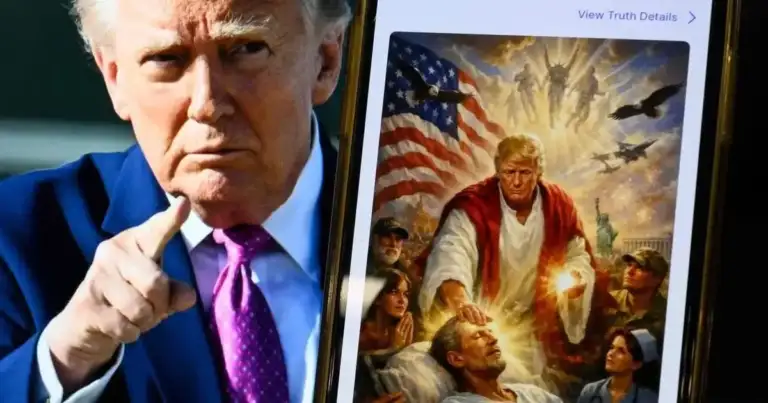
For months, the digital ether had been abuzz, dissecting the curious case of the deleted Jesus image. This audacious, digitally altered portrait, depicting President Trump with unmistakably divine attributes, had not merely circulated; it had exploded across social media, becoming an instant Rorschach test for the nation. While his most fervent supporters embraced it as a powerful, if literal, symbol of his perceived savior status, critics recoiled, decrying it as blasphemous and a grotesque exercise in cult-of-personality politics. President Trump, ever the reluctant explainer, finally offered his rationale, framing the image as ‘misunderstood’ and claiming it had generated ‘unnecessary distraction.’ This explanation, however, feels less like a genuine clarification and more like a carefully constructed narrative designed to regain control of a story that had momentarily spun beyond his preferred messaging.
“That image was powerful. It showed strength,” President Trump explained. “But some people just twist everything. They couldn’t handle the truth of it.”
He didn’t just ‘suggest’ critics weaponized the image; he unequivocally declared they “twist everything,” transforming a symbol of “strength” into an instrument of character assassination. This, in his view, was not merely unfair, but a fundamentally “dishonest” act by those who “couldn’t handle the truth of it.” His decision to delete it, therefore, wasn’t an admission of error but a strategic maneuver, designed to eliminate a ‘controversy’ that threatened to overshadow his carefully curated policy agenda. This episode is hardly an isolated incident; it echoes a recurring theme in Trump’s political iconography, where his most ardent supporters frequently employ religious imagery, casting him in the role of a modern-day savior. This practice, while deeply resonant with a segment of his evangelical base, simultaneously alienates and offends vast swathes of the population, who view it as sacrilege or dangerous political messianism. Trump’s explanation, rather than offering genuine clarity, further entrenches his familiar narrative: he is the misunderstood victim, perpetually besieged by a biased media and malicious opponents, yet always emerging stronger, always in control of his own story.
The Intertwined Politics of Faith and Power
President Trump has never shied away from intertwining his political movement with the fabric of faith, positioning himself as the ultimate defender of religious freedom – a stance that resonates deeply with his core base. His recent, extraordinary comments regarding Pope Leo XIV are not an aberration; they are a calculated extension of this strategy, a bold assertion of dominance that telegraphs his expectation of deference from every institution, even the venerable Vatican. Pope Leo XIV, globally recognized for his unyielding moral standing and consistent appeals for peace, particularly in the face of the ongoing US-Iran War 2026, represents a significant voice on the world stage. Trump’s audacious claim, therefore, isn’t just a suggestion; it’s an insinuation that the Pontiff has, in effect, capitulated, that the harsh realities of global conflict have irrevocably tempered his idealism. This is a profoundly powerful political statement, designed to reshape perception and discredit moral opposition. The impeccable timing, as always with Trump, is everything. With the US-Iran War 2026 dominating international headlines, any perceived shift, however subtle or manufactured, from the Vatican carries immense weight. This isn’t just about winning an argument; it’s about legitimizing his most controversial actions. The implicit argument is devastatingly simple: if even the Pope, the very embodiment of moral authority, has come to ‘understand’ the necessities of war, then surely Trump’s domestic and international critics should fall in line. It is a classic Trumpian gambit: leverage perceived external validation to silence internal dissent.
The deleted Jesus image, ostensibly a separate issue, plays directly into this same dynamic of control and narrative manipulation. Trump is a master craftsman of his own public image, meticulously curating a persona of unyielding strength and righteous conviction. When an image, even one initially embraced by his base, threatens to become a political liability – generating too much ‘distraction’ or too many ‘twists’ from critics – he ruthlessly excises it, only to replace it with a revised, self-serving narrative. This isn’t about truth; it’s about control of the story, always. And crucially, this strategy works precisely because it resonates with his base. They don’t see inconsistency; they see a strong leader battling a hostile world, a champion fighting against ‘unfair attacks’ and ‘fake news.’ What mainstream media often struggles to grasp, fixated as it is on literal interpretations and factual discrepancies, is that Trump operates on an entirely different wavelength. He bypasses rational debate, speaking instead directly to the emotions and grievances of his supporters. His simple, declarative statements, often devoid of nuance, cut through the complexities of policy and argument, forging an unbreakable bond with his core constituency. It’s a political alchemy few can replicate, and even fewer can effectively counter.
Let there be no mistake: his comments about Pope Leo XIV and his carefully crafted explanation for the deleted image are not accidental pronouncements. They are deliberate, calculated maneuvers, each serving a clear, overarching political purpose. They reinforce his meticulously cultivated image as a leader impervious to external pressures, unswayed by global figures, and utterly indifferent to public outcry. This approach, while deeply polarizing, is brilliantly effective in strengthening his base’s resolve, cementing their loyalty, and simultaneously widening the chasm between his supporters and his opponents. The immediate online reaction, a cacophony of fervent praise for his ‘candor’ from one side and scathing condemnation of his ‘arrogance’ from the other, is precisely the outcome he seeks. The political implications are indeed far-reaching, raising critical questions: How will the Vatican, an institution known for its measured diplomacy, choose to respond to such a direct challenge? Will Pope Leo XIV, whose moral authority is now implicitly questioned, feel compelled to issue a counter-statement, or will he opt for a strategic silence? This entire situation vividly underscores Trump’s unique, often disruptive, political style. He doesn’t merely challenge norms; he obliterates them, redefining the very parameters of acceptable political discourse with each utterance. The President, as ever, continues to dominate the narrative, shaping the conversation on his own uncompromising terms. This latest salvo ensures he remains front and center, a perpetual lightning rod, keeping his base energized and forcing every other political actor, domestic and international, to react to him.
The saga confirms a brutal truth: President Trump remains the undisputed master of political theater, a provocateur whose every
Source: Google News