
President Trump’s recent encounter with the ‘DoorDash Grandma’ has ignited a firestorm of public cynicism. Many view the moment as a carefully staged political spectacle. This event, while seemingly domestic, highlights a populist approach with profound international implications.
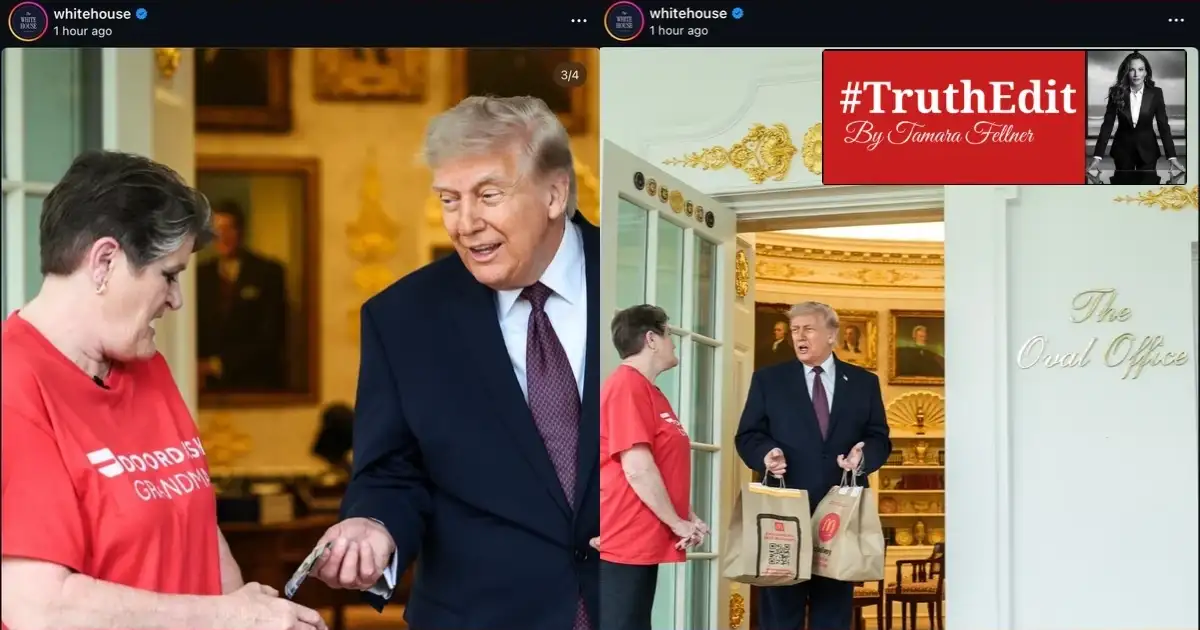
The incident unfolded during a recent public appearance. President Trump engaged directly with the elderly woman, known widely as the ‘DoorDash Grandma’.

He handed her a wad of cash. He then put her on the spot about the challenging realities of the gig economy. This issue remains a deeply controversial topic for workers nationwide.
Public Cynicism Erupts Over ‘DoorDash Grandma’ Moment
Public reaction to this interaction was swift and overwhelmingly cynical. Netizens across social media platforms quickly labeled it a “staged photo-op.” Many saw it as blatant political theater.
Users on Reddit’s r/politics and r/TrueUnpopularOpinion roasted the event, calling it “MAGA theater 2.0.”
They suggested the President used the woman’s viral story as a prop. This allowed him to appear as a savior while avoiding systemic policy discussions.
Sarcastic theories circulated widely. Some X threads claimed the cash was fake, mere “marked bills for TV optics.”
Others suggested the woman’s “spotting” was rehearsed. This echoed past criticisms of similar public engagements.
There were accusations of exploiting a 78-year-old for political gain. Critics pointed out the lack of concrete policy proposals for gig workers.
Backlash peaked on TikTok and X. Many on the left memed it as “Trump’s grift grandma hour.” They questioned why the President offered cash instead of advocating for legislative fixes.
Even some right-wingers found the moment unconvincing. They griped about “cringe pandering.”
This sentiment grew stronger given the woman’s prior fundraiser. She had already raised over $500,000.
Populist Appeal and Economic Nationalism
This domestic spectacle, despite its local focus, connects directly to President Trump’s broader ‘America First’ economic agenda. His populist appeal targets the struggles of everyday Americans.
The ‘DoorDash Grandma’ became a symbol of these struggles. Her story embodies the economic anxieties of gig workers. President Trump often frames these anxieties as needing protection from external forces.
His rhetoric frequently calls for safeguarding American jobs and manufacturing. This often involves imposing new tariffs.
These declarations send ripples through international markets. They impact diplomatic circles globally.
The President’s direct, personal engagement style reinforces this narrative. He portrays himself as the champion of the working American.
This approach, while resonating with his domestic base, creates significant international friction. It suggests a willingness to disrupt global economic norms.
This is done to prioritize perceived domestic benefits. The focus keyword, ‘DoorDash Grandma’, thus becomes emblematic. It represents the specific demographic whose concerns he claims to address.
Global Ramifications of ‘America First’ Policies
President Trump’s economic nationalism has far-reaching international ramifications. He has explicitly called for new, significant tariffs.
These would target a wide array of imported goods. Products from the European Union and China are frequently mentioned.
These declarations revive fears among global economic leaders. They recall past trade disputes.
European Union officials have voiced strong concerns. Figures like German Chancellor Olaf Scholz and French President Emmanuel Macron have issued warnings.
They caution that such measures could trigger retaliatory tariffs. This would disrupt global supply chains. It could plunge the world economy into severe instability.
The memory of the 2018-2019 trade disputes remains fresh. Those disputes saw significant tariffs on steel, aluminum, and Chinese goods.
Analysts at the World Trade Organization (WTO) and the International Monetary Fund (IMF) have also weighed in. They published reports cautioning against a return to protectionist policies.
These institutions emphasize the interconnectedness of global economies. They warn of the risk of a collective downturn.
The threat of new tariffs strains transatlantic relations. It undermines international cooperation on trade and economic stability.
The ‘DoorDash Grandma’ and the Global Stage
The choice to spotlight the ‘DoorDash Grandma’ is not accidental. It serves to humanize a complex economic narrative. It connects individual hardship to broader policy aims.
For President Trump, this moment reinforces his image. He is seen as a leader who directly addresses citizen’s immediate needs. This is regardless of the underlying systemic issues.
However, this populist strategy often prioritizes symbolic gestures. It sometimes overshadows comprehensive policy solutions.
The international community watches these domestic displays closely. They interpret them as indicators of future policy direction.
A President who champions individual economic rescue missions might also champion national economic isolation.
The exploitation of personal stories for political gain is not new. Yet, in 2026, with ongoing global economic uncertainties, such events carry extra weight.
They symbolize a deeper divide: between globalist economic principles and nationalist protectionist sentiments.
This incident, therefore, is more than a simple cash handout. It is a microcosm of a larger geopolitical strategy.
A Path Forward for International Relations
The international community faces a critical juncture. The rise of economic nationalism demands careful diplomatic handling.
Leaders must find ways to address domestic concerns without fracturing global alliances. Dialogue and multilateral cooperation are essential.
Unilateral tariff actions risk a spiral of economic retaliation. This harms all participants.
The perception of American leadership is also at stake. The world observes how the President engages with his own citizens. They watch how he addresses economic hardships.
This shapes views on America’s reliability as a global partner. The incident with the ‘DoorDash Grandma’, cynical or not, sends a clear message.
It signals a continued focus on an ‘America First’ approach. This approach prioritizes domestic sentiment above all else.
The challenge for international affairs remains. How do global institutions and allied nations prepare for such a politically charged economic landscape?
The answer lies in strengthening international frameworks. It requires fostering resilient supply chains. It demands a renewed commitment to open trade.
This incident serves as a stark reminder of the volatile nature of current global politics.
The ‘DoorDash Grandma’ encounter, therefore, is far more than a fleeting news story. It is a significant data point.
It illustrates President Trump’s ongoing populist strategy. It reinforces his economic nationalism.
This directly influences global trade policies and international relations. The world must acknowledge these connections and prepare accordingly.
This incident is not just about one person or one moment. It is about the future direction of American foreign economic policy.
It reflects how domestic political theater can dictate global economic stability. Understanding these dynamics is paramount for international observers.
The world watches, anticipating the next move in this complex geopolitical drama.
Source: Google News