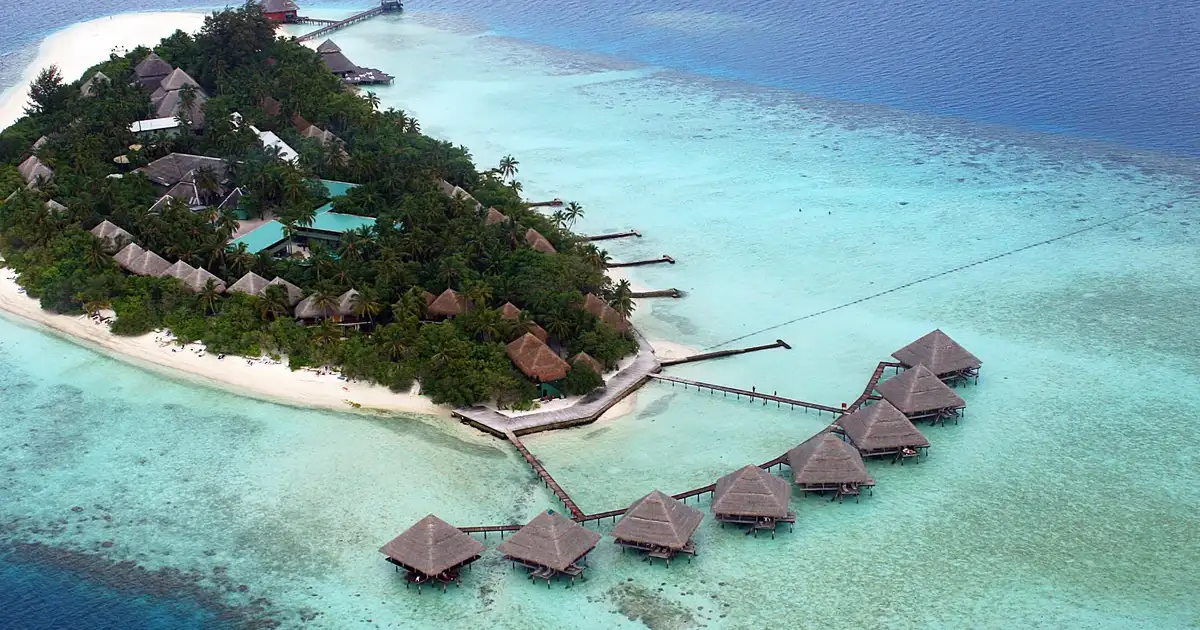

Forget your postcard dreams of the Maldives and Venice. These iconic tourist havens aren’t just facing a threat; they are staring down oblivion. Along with at least 15 other global gems, they could be gone by the century’s end, swallowed by an encroaching ocean.
This isn’t a distant possibility; it’s an unfolding reality.

Recent scientific reports confirm this terrifying trajectory. A consortium of leading climate scientists released a stark warning on April 25, 2026, their data unequivocally backed by the Intergovernmental Panel on Climate Change (IPCC).
Their projections are chillingly precise: a global average sea-level rise of 0.5 to 1 meter by 2100. For low-lying regions, this isn’t just a number; it’s a death sentence.
Consider the Maldives, a nation where over 80% of its land sits less than one meter above current sea level. A rise of even half a meter means widespread inundation, displacing entire communities and erasing islands from the map.
Meanwhile, Venice, Italy, already battles an average of 100 “acqua alta” (high water) days each year. Its historic canals, once a symbol of resilience, could soon be permanently submerged, its unique architecture dissolving into the Adriatic Sea.
The Deeper Threat: A Public Health Catastrophe Unfolding
This isn’t merely about losing picturesque landscapes or architectural marvels. The true tragedy, the one that keeps public health experts awake at night, is the inevitable humanitarian crisis.
Millions will be displaced, creating a public health emergency on an unprecedented scale. Entire populations will be forced from their ancestral lands, their lives uprooted by forces beyond their control.
Mental Health Fallout: The Invisible Scars of Displacement
Imagine the profound trauma of losing everything you know. Homes, livelihoods, cultural ties, community networks—all gone.
Climate-induced migration will unleash a wave of psychological suffering that current healthcare systems are ill-equipped to handle. Widespread anxiety, crippling depression, and post-traumatic stress disorder (PTSD) will plague displaced communities.
Children, in particular, will bear the brunt of this emotional upheaval, their development hindered by instability and loss. The psychological toll will echo for generations, a silent epidemic born of environmental collapse.
“We are not just losing land; we are losing our homes, our culture, our very identity. The world must understand the public health crisis unfolding in our communities, a crisis that leaves invisible scars deeper than any floodwater.”
— A Maldivian environmental activist, as reported by BBC News
Disease Hotbeds Emerge: A Perfect Storm for Outbreaks
Mass displacement inevitably leads to temporary settlements. These are often characterized by overcrowding, inadequate sanitation, and severely limited access to healthcare.
This combination creates a perfect storm for the rapid spread of infectious diseases. We will see devastating outbreaks of cholera, typhoid, and dengue fever.
Shifting climate patterns will only worsen vector-borne diseases. Warmer temperatures and altered rainfall expand the range of disease-carrying mosquitoes, bringing illnesses to new regions. The very infrastructure needed to combat these outbreaks will be overwhelmed or nonexistent.
Food and Water Under Siege: The Basic Necessities Disappear
Sea-level rise brings with it the insidious threat of saltwater intrusion. As oceans creep inland, freshwater aquifers become contaminated, rendering them unusable.
Agricultural land, particularly in fertile coastal deltas, turns barren as salt poisons the soil. This directly threatens food security for millions, leading to widespread malnutrition.
Vulnerable populations like children and the elderly will suffer most. The ripple effects will be felt globally, destabilizing food markets and exacerbating existing inequalities.
Global Burden: Host Nations Strained to Breaking Point
When millions are displaced, where do they go? Host countries, often already struggling, will face immense pressure.
Their public health systems, designed for stable populations, will crack under the strain of providing housing, sanitation, and medical care to a sudden influx of people. This isn’t just a logistical nightmare; it’s a profound ethical challenge.
It demands global solidarity and unprecedented resource allocation.
Lost Livelihoods, Lost Lives: The Erosion of Human Dignity
Beyond the immediate health crises, traditional ways of life will vanish. Fishing, farming, and tourism—entire economies built over centuries—will be wiped out.
This creates chronic poverty, widens existing health disparities, and erodes human dignity. Access to basic healthcare and education will become a luxury for many.
Generations will be trapped in cycles of deprivation and despair. The loss isn’t just economic; it’s cultural, spiritual, and existential.
Can We Stop the Tide? A Race Against Time
Venice famously invested billions of euros in its MOSE barrier system, a colossal network of mobile gates. It offers a temporary reprieve from high tides, but it is not a permanent fix.
The city’s mayor understands this harsh truth: MOSE is a stopgap measure. This engineering marvel can only hold back the inevitable for so long.
Its design capacity will eventually be surpassed by accelerating sea-level rise, rendering it obsolete.
“MOSE buys us time, precious time, but without drastic global emissions cuts, we are fighting a losing battle against the sea. We need the world to act, not just for Venice, but for every coastal community.”
— The Mayor of Venice, in a recent interview with The Guardian
The science is clear and unforgiving. Dr. Anya Sharma, Lead Climatologist at the Global Climate Institute, stated it plainly on April 25, 2026: “The science is unequivocal: sea-level rise is accelerating at an alarming rate. For island nations like the Maldives, this isn’t a distant threat on a graph; it’s an immediate, existential crisis.” She called for “immediate, coordinated global action to drastically cut emissions and prevent a humanitarian catastrophe of unimaginable proportions.”
The global tourism industry, a trillion-dollar business, stands to lose billions from this unfolding disaster, as iconic destinations vanish. But this financial cost, staggering as it is, pales in comparison to the human toll.
This crisis exposes the deep ethical responsibility of high-emitting nations, whose historical and ongoing contributions to greenhouse gases are directly fueling the destruction of vulnerable communities.
Ignoring these warnings is not just irresponsible; it is criminal. The world must act now to mitigate emissions with unprecedented speed and scale.
Simultaneously, we must prepare for the inevitable mass migration and the immense public health challenges it will bring. Otherwise, some of Earth’s most beautiful places will exist only in old photographs.
Millions will suffer devastating health, social, and psychological consequences. What kind of legacy will we leave: one of action, or one of irreversible loss?
Source: Google News