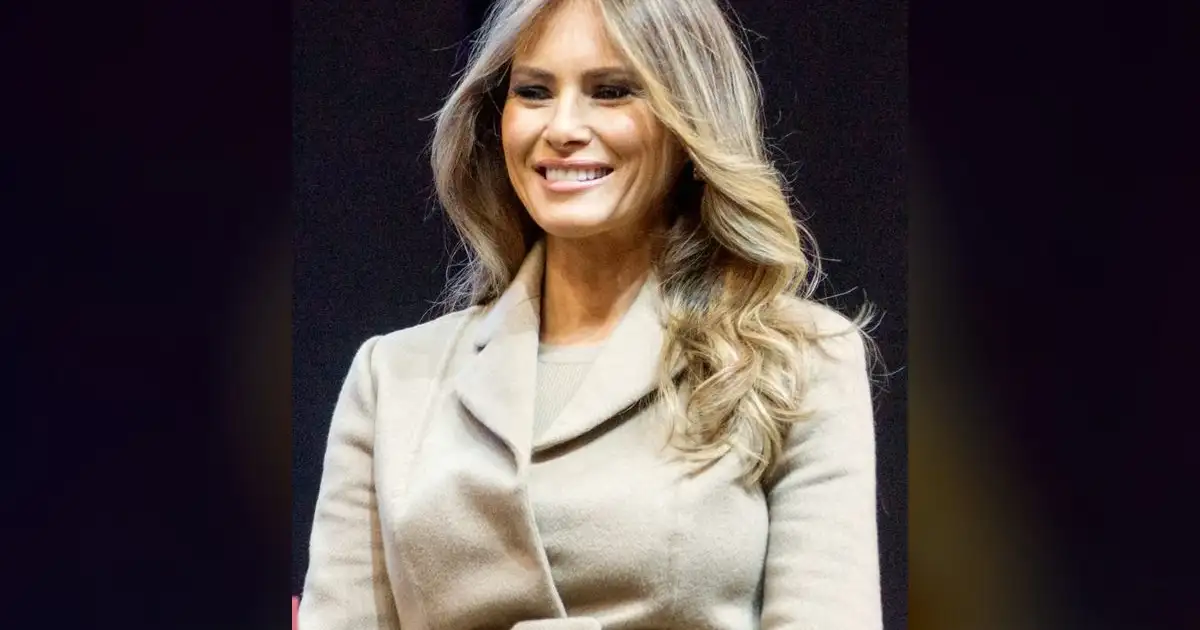

The White House Correspondents’ Dinner, Washington’s annual spectacle of self-congratulatory humor and carefully curated power, was abruptly shattered on April 27, 2024. Moments before the chaos, mentalist Oz Pearlman had just revealed a single word to First Lady Melania Trump: “hope.” That fragile sentiment evaporated instantly as gunfire erupted outside, brutally exposing the raw nerves and sudden danger that perpetually lurks beneath the capital’s polished facade.
Pearlman, performing for the First Lady, had asked her to think of a word. He then wrote “hope” on a notepad, presenting it to her just as the evening’s carefully constructed illusion of normalcy collapsed. The chilling detail, recently recounted by Pearlman in vivid interviews, provides a unique, human lens into a moment that could have spiraled into unimaginable tragedy.
One second, the genteel clinking of glasses and polite laughter. The next, alarms blared, Secret Service agents sprang into action, and the palpable tension of a genuine security emergency descended. It was a jarring, instantaneous shift from a parlor trick to a stark confrontation with Washington’s ever-present vulnerabilities.
The Illusion of Normalcy Shattered
The White House Correspondents’ Dinner is meant to be a night of bipartisan bonhomie and journalistic tradition, a brief respite from the capital’s cutthroat political battles. Yet, on that fateful night, the veneer of safety shattered with terrifying speed. Pearlman’s account is not just a personal anecdote; it profoundly demonstrates how quickly the world of power and privilege can be upended.
The mentalist described the scene with an almost disbelieving clarity. He had literally just completed his reveal to First Lady Trump when the commotion began. “I had just written down ‘hope’ on the notepad, and I was showing it to her, and that’s when you started hearing the commotion… It was just this incredibly surreal moment, going from a magic trick to realizing something very serious was happening,” Pearlman recounted.
“I had just written down ‘hope’ on the notepad, and I was showing it to her, and that’s when you started hearing the commotion… It was just this incredibly surreal moment, going from a magic trick to realizing something very serious was happening.”
— Oz Pearlman
This incident forcefully underscores the precarious nature of public life for Washington’s elite. Even within the supposedly impenetrable fortress of a high-security event, danger can manifest without a whisper of warning. For those at the apex of power, and indeed, for anyone within their orbit, absolute safety is not merely an illusion; it is a dangerous fantasy.
Washington’s Vulnerable Underbelly Exposed
The shooting outside the WHCD ignited an immediate firestorm of urgent questions. Was this a targeted assassination attempt? Was President Donald Trump or his family the intended victim? The incident ripped through the capital’s political class, sparking widespread speculation and profound concern.
Law enforcement agencies, led by the Secret Service, immediately launched a full-scale investigation. They painstakingly pieced together the shooter’s motives.
Initial reports swiftly identified Cole Tomas Allen as the lone gunman. Allen, killed by Secret Service agents at the scene, was the sole casualty. His full intentions, however, remain frustratingly opaque, feeding the capital’s relentless rumor mill.
This incident did not merely escalate security fears; it shattered any lingering illusions of invulnerability across Washington. It laid bare the glaring vulnerabilities inherent in high-profile political gatherings, proving no amount of planning can entirely mitigate the risk of a determined individual.
Calls for a sweeping review of protective measures are now not just unavoidable, they are an imperative. No one in Washington, from the lowliest intern to the most powerful senator, can afford to ignore these threats any longer.
President Trump himself wasted no time publicly condemning what he characterized as security failures, linking the incident to broader concerns about political violence. This sentiment resonates deeply with a growing unease across the nation, where many citizens question whether public figures, and indeed the public itself, are truly safe in an increasingly volatile political landscape.
Crucially, authorities have yet to confirm a direct link between Allen and the First Lady or President Trump as specific targets. The investigation continues, a painstaking process of sifting through digital footprints and personal histories. Yet, the palpable threat was undeniable, regardless of the ultimate, unconfirmed target. The very act of violence, aimed at the periphery of a presidential event, was a potent message in itself.
This event will undoubtedly reshape how the Trump family attends public engagements for the foreseeable future. Expect an immediate implementation of more stringent vetting procedures and a dramatic increase in visible and plainclothes security details. The price of public life, already exorbitant, just went up exponentially, with taxpayers footing the bill for an ever-expanding security apparatus.
The Echoes of Distrust and Cynicism
Of course, not everyone in the hyper-polarized American public accepts the official narrative at face value. A vocal chorus on social media immediately branded the entire event a “Trump-orchestrated psyop,” a cynical ploy staged for sympathy votes and political advantage.
These critics point to what they perceive as delayed reactions from VIPs on the dais, suggesting the whole terrifying incident was rehearsed, a macabre piece of political theater. This kind of conspiratorial public reaction, while disturbing, has become standard fare in today’s political climate.
It is a stark indicator of how deeply distrust runs, not just for the government, but for the very fabric of shared reality.
This pervasive cynicism complicates the Secret Service’s already impossible task. When every incident, every security breach, is immediately filtered through a lens of partisan suspicion, the ability to address real threats becomes muddled. It’s a dangerous feedback loop: political polarization breeds distrust, which in turn undermines public confidence in institutions designed to protect them.
The True Cost of the Spotlight
The WHCD shooting serves as a brutal, visceral reminder that public figures in America live under a constant, tangible threat. Their families, often unwilling participants in this high-stakes drama, endure this burden too, a silent tax on their personal lives. The financial cost of protecting them is astronomical, a bill that ultimately lands squarely on the shoulders of American taxpayers.
Every security detail, every reinforced venue, every additional agent deployed – it all adds up to billions. This money, diverted from schools, infrastructure, and healthcare, comes directly from the pockets of everyday Americans. It is the unseen, unwritten tax of a volatile, often hostile political environment that seems only to grow more dangerous with each passing year.
This incident also exposes a stark, infuriating hypocrisy at the heart of Washington. Politicians routinely preach calm, unity, and civility, yet many simultaneously fan the flames of division and inflame partisan passions for short-term political gain.
This creates a fertile, toxic ground for radicalism and violence. Then, with breathtaking audacity, taxpayers are expected to pay to protect these very politicians from the predictable consequences of their own rhetoric.
The word “hope” Pearlman wrote on his notepad feels tragically ironic, almost a cruel jest. Hope often feels distant, a forgotten ideal, in a city consumed by power plays, ambition, and the constant dance between influence and danger. Washington, for all its gilded halls and marble monuments, lives on a knife-edge, perpetually teetering on the brink.
This incident reminds us that the stakes are undeniably real. They are not merely political chess moves or abstract policy debates; they are profoundly human. A simple magic trick, intended to entertain, mutated into a moment of pure terror. That, in its rawest form, is the true reality of D.C. today.
The question is not simply about who was targeted, or what the gunman’s motives truly were. The more profound question is how much more the American people are expected to endure. How much more will security cost? How much more will we sacrifice – financially, emotionally, and civically – for a system that increasingly struggles to protect itself from the very divisions it often cultivates?
Washington’s gilded halls are not immune to the chaos outside; this incident proves it with chilling clarity. The political class needs a wake-up call, a stark reminder that their security concerns are our financial burden, and their rhetoric has real-world consequences. The show, they insist, must go on. But at what true, unsustainable price?
Source: Google News