
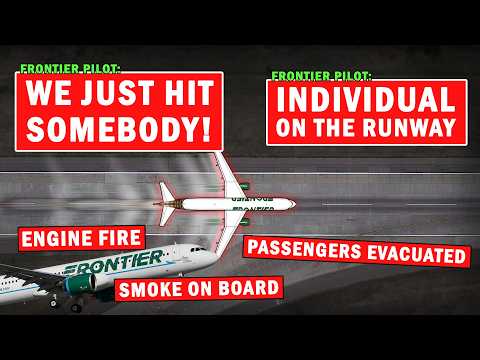
A Frontier Airlines flight became a scene from a nightmare on the runway, a pedestrian struck and killed during takeoff, forcing a mass slide evacuation for 231 souls onboard at Denver International Airport (DIA). The raw terror of the incident—a mangled fuselage, terrified passengers scrambling for safety—was horrifying enough. But the true horror, the one that lingered long after the smoke cleared, was the internet’s immediate, savage response.
The Internet’s Gallows Humor
You’d expect shock. You’d hope for sympathy. You’d be wrong.
The internet, in its predictable, brutal fashion, immediately went for the jugular—of the victim. Social media platforms like X, Reddit, and TikTok exploded with pitch-black memes.
Sympathy for the pedestrian? There was none. Not a shred.
The individual was instantly, universally roasted as a “Darwin Award winner.” This isn’t just dark humor; it’s a stark cultural indictment.
We’ve become a society that instantly defaults to mockery when tragedy strikes, especially if the victim can be framed as somehow “deserving.” It’s a chilling barometer of our collective moral compass, or lack thereof.
“Fence-jumper meets physics,” tweeted @AirplaneMemes, racking up 15k likes for a Photoshopped image of the plane as a Roomba.
The sentiment was clear, brutal, and unforgiving. There was no room for nuance, no space for human error or mental health considerations—just a cold, hard assessment of consequence.
The pedestrian made a stupid choice. Physics, mercilessly, delivered the invoice.
Blaming the Victim, Mocking the Airline
Threads on r/aviation and r/news quickly piled on. One top post, with 8k upvotes, declared, “Bro chose violence and lost to 200 tons of aluminum.”
Another comment, dripping with disdain, added, “Not an employee, just a random moron playing Frogger on a runway. Natural selection at 150 knots.”
This isn’t just about the pedestrian. It’s about a chilling void of collective empathy, a willingness to dehumanize anyone who makes a fatal misstep.
Frontier Airlines, already known for its budget fares and often-maligned customer service, also became a convenient target. The internet’s venom shifted to the airline’s reputation, with jokes about “Cheap fares, free turbine smoothie” circulating widely. It’s a cynical swipe at a company already battling public perception, piling on misery to an already catastrophic event.
Even DIA, with its infamous murals and long-standing conspiracy theories, got pulled into the muck. Conspiracy theorists on X claimed it was “another DIA ritual sacrifice.”
Others sarcastically suggested a “protestor glitching the matrix against aviation emissions.” When tragedy strikes, the immediate reaction for too many is not concern, but a desperate scramble for conspiracy theories and cheap shots. They twist reality into whatever narrative fits their cynical worldview.
The Cynicism Contagion: When Tragedy Becomes Content
A viral TikTok, boasting 2 million views, openly mocked the phrase “231 souls” as scripted airline-speak. It implied the entire event was a “psyop” to normalize security breaches.
This kind of thinking isn’t just misguided; it’s dangerous. It trivializes real human loss and genuine fear.
It frames every incident, every moment of chaos, as part of some grand, hidden agenda, eroding trust in everything from institutions to our own senses.
Cynics went further, calling the entire incident “peak 2026 clickbait,” claiming it was “staged for airline PR reset post-strikes.” Others questioned the authenticity of pilot audio, suggesting “Deepfake audio—pilots don’t say ‘uh, we just hit somebody’ in real life.”
The default setting for too many is suspicion, not truth. Every tragedy is dissected not for understanding, but for perceived inconsistencies, fueling a relentless cycle of doubt and manufactured outrage.
This isn’t just internet culture being edgy. This is a mirror held up to a society that thrives on outrage and cynicism, where empathy has become a performative act, if it exists at all.
A real person died a horrific death. 231 passengers endured a terrifying emergency.
Yet, the conversation immediately veered into jokes, conspiracy theories, and a chilling detachment from human suffering. What does it say about us when the first instinct is to mock, not mourn?
The Cold Reality
What does this tell us? It tells us that for a disturbing segment of society, tragedy is just another content opportunity.
It’s a chance to flex dark humor, push a half-baked conspiracy, or simply garner likes and shares.
The human element, the actual suffering, becomes secondary, if it registers at all. It’s about the reaction, the engagement, the fleeting digital notoriety.
This incident, horrific as it was, became a grim stage for our worst digital impulses. It revealed a chilling truth: we are quick to judge, quicker to mock, and slowest to offer genuine human compassion.
The real horror isn’t just the death on the runway. It’s the death of empathy in the public square, broadcast for all to see.
So, the next time something truly awful happens, don’t expect a moment of silence. Expect a torrent of memes, sarcastic theories, and blame.
That’s the world we’ve built, one cynical tweet, one “lol” at a time. And frankly, it’s more terrifying than any plane crash.
Photo: Wikimedia Commons (query: Frontier Airlines denver)
Source: Google News