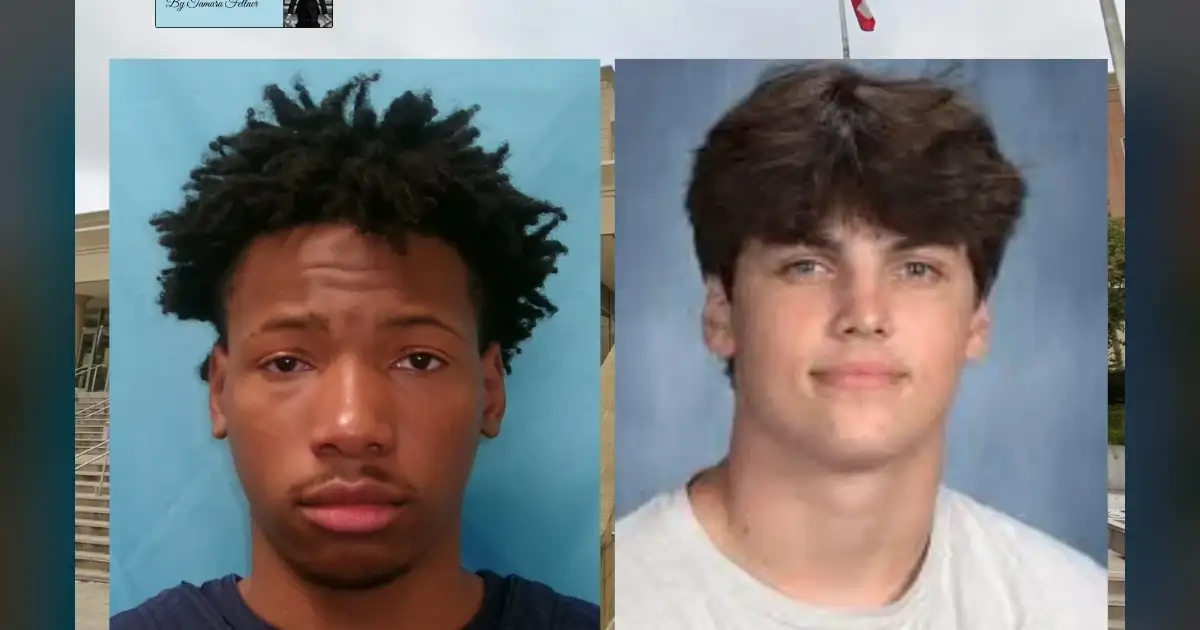

The crack of the starter pistol was supposed to signal the beginning of a race, not the end of a life. But in April 2022, on a track in Waco, Texas, the finish line became a grave. Karmelo Anthony, a teenager barely out of childhood, now faces the grim reality of decades behind bars, found guilty of murder for plunging a knife into Austin Metcalf. The community, once convinced its school grounds were sanctuaries, reeled from a shockwave that reverberates still, a stark reminder that some losses can never be undone, no matter the length of a sentence.
The horror unfolded with brutal speed. It was April 2022, a seemingly ordinary day destined to be etched into the collective memory of Waco, Texas, as anything but. Austin Metcalf, a vibrant 18-year-old with a future brimming with unspoken promises, had his life violently extinguished. The perpetrator, Karmelo Anthony, then a mere 17, committed the brutal act that would forever define both their trajectories. By October 2022, the court had delivered its damning verdict: guilty of murder, sealing Anthony’s fate within the unforgiving confines of the justice system.

The sentence handed down – 40 years in prison – is more than just a number. It represents an eternity behind steel and concrete walls, a life stolen not just from Austin, but from Karmelo himself. One young man lost his very existence; the other, his freedom, his youth, his potential. This single, devastating event didn’t just ripple through Waco; it tore a gaping, ragged hole in the very fabric of the city, a wound that festers, refusing to close, a constant ache in the community’s heart.
When the Finish Line Became a Crime Scene
A track meet, by its very nature, should be a crucible of human spirit, a vibrant display of triumph and aspiration. It should be about the exhilarating blur of speed, the raw power of strength, the quiet dignity of sportsmanship, and the communal joy of shared competition. Instead, on that fateful day in Waco, it transmuted into something monstrous, a scene of unspeakable horror that ripped through the veneer of normalcy. The rhythmic cheers of the crowd, moments earlier celebrating athletic prowess, curdled into piercing screams of terror. The chalked finish line, meant to mark the culmination of a race, became, instead, a grim, indelible crime scene, stained with the blood of a young life.
How does a high school sporting event, an arena of youthful exuberance and innocent ambition, devolve into a murder? This isn’t merely a question that haunts the residents of Waco; it is a chilling inquiry that should pierce the heart of every parent, every educator, every citizen who believes in the sanctity of childhood. It defies rational understanding, shatters any lingering sense of security, and exposes a terrifying vulnerability in the very places we deem safest for our children. What unseen currents of rage and despair must run beneath the surface of our communities for such a public, brutal act to occur?
Our children attend these events, their eyes wide with admiration, their hearts swelling with dreams. They watch their heroes compete, imagining their own futures unfolding on those very tracks and fields. On that day, however, those innocent dreams were violently overshadowed, eclipsed by the stark, brutal reality of pure, unadulterated violence. The memory of what they witnessed, the visceral shock of it, will undoubtedly stay with them, a silent, persistent shadow, shaping their understanding of the world in ways we can only begin to comprehend. How do you explain such an act to a child who only moments before was cheering for a runner?
This was no clandestine back-alley brawl, no hidden skirmish in the shadows. This was a planned, public spectacle, a community gathering that was supposed to be safe, joyous, and celebratory. The stark, horrifying reality of a young man being stabbed to death in broad daylight, surrounded by onlookers, irrevocably changed everything. It wasn’t just a life that ended; it was a collective illusion of safety that shattered, leaving behind fragments of fear and distrust.
The image of a young man bleeding out on a track, his life ebbing away amidst the echoes of what should have been cheers, is not merely indelible; it is a profound, festering stain on the community’s conscience. It is a scar on the soul of Texas, a wound that demands more than just legal retribution. This tragedy demands a deeper, more uncomfortable look into the societal cracks that allowed such an atrocity to occur. We are compelled to ask: how did we, as a society, as a community, as guardians of our youth, fail so catastrophically?
Two Futures Extinguished: The Cost of a Knife
Austin Metcalf was just 18 years old, standing on the precipice of adulthood, his entire life stretching out before him like an open road. He was more than a statistic; he was a student with burgeoning interests, an athlete with untapped potential, a beloved son, a loyal friend. All of that vibrant potential, all of that unwritten future, vanished in a single, horrifying instant. A knife blade, wielded in a moment of incomprehensible rage, ended it all, severing the threads of a life destined for so much more. What dreams did he carry? What laughter will his family now forever miss?
His family, shattered by an grief that defies description, will never witness the milestones that define a life: his graduation, the thrill of his first true love, the quiet satisfaction of building a career, a home, a family of his own. His absence is not merely a void; it is a gaping maw that consumes their joy, a constant, gnawing pain that has come to define their existence. Every empty chair, every unheard laugh, every unshared memory is a fresh stab of sorrow, a cruel reminder of what was stolen.
And what of Karmelo Anthony? At 17, he too stood at the cusp of his own future, albeit one he chose to utterly destroy with a single, irreversible act. Forty years behind bars is not just a sentence; it is a lifetime. He will enter prison as a boy and, if he lives, will emerge an old man, his youth, his choices, his opportunities, all irrevocably gone. His best years, those formative decades where identities are forged and lives are built, will be spent within the cold, unforgiving confines of a cage, a stark monument to his catastrophic decision.
He will pay a heavy price, a debt to society measured in decades of isolation and regret. But that price, no matter how steep, cannot resurrect Austin Metcalf’s life. It cannot mend the gaping wound of grief that Austin’s family carries. It cannot erase the searing memory of that terrible day from the minds of those who witnessed it, or from the collective consciousness of Waco. The scales of justice, in such cases, often feel perpetually unbalanced, no matter the verdict.
Two lives ruined, two families utterly devastated, all because of a moment of senseless, irreversible rage. This is the true, unvarnished cost of violence. It is not just a bill paid by the perpetrator or the victim; it is a profound, lingering debt incurred by everyone, by the entire community, a burden carried forever. It is a stark, brutal lesson in the fragility of life and the catastrophic consequences of unchecked anger.
Justice, or Just More Pain? The Lingering Questions
The jury delivered its verdict: guilty. The judge, in the solemnity of the courtroom, handed down a sentence: 40 years. But is this truly justice? For Austin’s family, no sentence, however long, however harsh, will ever be enough. Their son is gone, a vibrant life extinguished, and nothing, absolutely nothing, can change that agonizing reality. The legal system, for all its might, cannot bring back the dead; it can only mete out punishment, a cold comfort in the face of such profound loss.
For Karmelo Anthony, 40 years is a harsh, unyielding reality that will consume his prime. He will spend what should be his most vibrant, productive years under state custody, stripped of freedom, choice, and the simple pleasures of an ordinary life. He will miss out on everything that defines young adulthood – love, career, family, self-discovery. He will live with his choices, yes, but more significantly, he will live with the crushing, inescapable consequences of his actions, a constant reminder of the life he took and the life he forfeited.
Texas law, unforgiving in its scope, allows for a murder conviction to carry a sentence of up to life imprisonment. Anthony received 40 years. Was this a calculated compromise, a reflection of his youth at the time of the crime, a flicker of mercy in an otherwise merciless system? Or was it a pragmatic decision, balancing the severity of the act with the potential for rehabilitation, however distant? These questions, heavy with moral weight, linger in the air long after the gavel has fallen, debated in hushed tones across Waco and beyond.
Does a 40-year sentence truly deter others from committing similar acts of violence? Does it send a strong enough, unequivocal message that such brutality will not be tolerated? Or is it, as many critics argue, merely a band-aid, a reactive measure that addresses the symptom rather than the disease? We lock up the perpetrators, yes, removing them from society. But do we, in doing so, truly fix the underlying problem of youth violence, the societal fissures that allow such rage to fester and erupt? The cycle, tragically, continues with disheartening regularity.
Justice, in its idealized form, is meant to bring closure, to restore a semblance of balance to a world violently disrupted. Yet, in cases as devastating as this, balance feels not just elusive, but impossible. The scales remain perpetually tipped, heavy with the immeasurable weight of sorrow, regret, and the ghost of a future that will never be. The legal process may conclude, but the emotional and societal wounds rarely, if ever, truly heal.
Systemic Failures: Unmasking the Cracks Beneath the Surface
This tragedy, searing and public, did not erupt in a vacuum. It unfolded on school grounds, during a sanctioned event, a stark and undeniable symptom of deeper, more insidious cracks in our societal foundations. Where were the warning signs, the faint tremors preceding the earthquake? Were they simply missed in the cacophony of daily life, or, more disturbingly, were they ignored, dismissed as minor anxieties until it was catastrophically too late? The investigative journalist in me demands to know: how could such a violent act incubate and then explode in plain sight?
Our schools are not merely institutions of learning; they are meant to be sanctuaries, safe havens where children can grow, explore, and flourish without fear. When violence, especially lethal violence, erupts within these supposed bastions of safety, it screams of a profound, systemic breakdown. It is an indictment of our collective failure to protect our most vulnerable, a chilling admission that we have, in some fundamental way, failed our children, betraying the trust placed in these vital community pillars.
We pour resources into hardening our schools, transforming them into fortresses with layers of security. We install surveillance cameras, deploy metal detectors, hire armed guards, and conduct active shooter drills that traumatize as much as they prepare. But is this reactive, militaristic approach truly enough? Are we, in our frantic efforts to secure the perimeter, truly addressing the root causes of youth violence? Are we reaching out to troubled kids, offering genuine support and intervention, before their despair and rage reach a breaking point? Or are we merely treating the symptoms, while the disease metastasizes?
The answer, tragically, is often a resounding no. We react with urgency and grief after the fact. We mourn the dead, we punish the guilty, and we vow “never again.” Yet, with sickening predictability, the cycle repeats itself, over and over again, leaving a trail of shattered lives and broken promises. We become adept at post-mortem analysis, but woefully inadequate at proactive prevention.
Our police forces are often overwhelmed, stretched thin by escalating demands and dwindling resources. Social services, the very safety nets meant to catch those falling through the cracks, are chronically underfunded and understaffed. Mental health resources, crucial for addressing the underlying psychological turmoil that often fuels such violence, remain woefully scarce and inaccessible for far too many. These are not mere excuses for inaction; these are systemic failures, stark realities that contribute directly to the loss of precious lives. The cost of these deficiencies is measured in blood and tears.
We must demand more from our leaders, from our communities, and from ourselves. We must confront the uncomfortable questions: Why did a young man feel the desperate need to carry a knife to a public event? What festering grievances, what unaddressed traumas, what societal pressures escalated tensions to the point of murder? These are not easy questions to ask, nor are their answers simple. But they are vital, essential if we are ever to break this devastating cycle.
The justice system, with its courts and prisons, is one crucial piece of the puzzle. But it is not, and cannot be, the first line of defense against such horrors. That primary defense lies much closer to home: in our communities, in our schools, in our families, and most profoundly, in how we raise and nurture our children, instilling empathy, resolving conflict, and fostering hope instead of despair. It demands a collective reckoning, a commitment to healing and prevention that goes far beyond the courtroom.
The Undying Echoes in Waco’s Heart
The city of Waco will never forget Austin Metcalf. His name, now synonymous with profound tragedy, is etched into their collective memory, a constant, aching reminder of what was lost, a symbol of unimaginable grief that time can never fully erase. Every passing year, every spring track meet, will undoubtedly carry the ghost of that horrific day.
The community, once perhaps complacent in its sense of security, now grapples with a pervasive undercurrent of fear. Parents, once content to send their children off to school or sporting events with a wave and a smile, now carry a heavier burden of worry, a nagging sense of unease that hangs heavy in the air, palpable and persistent. The illusion of invulnerability has been shattered, replaced by a stark awareness of vulnerability.
How does a community truly heal from something so utterly devastating? How do its residents, its families, its children, move forward when the scars remain so raw, the pain so persistent? The tragedy has irrevocably altered the way people live, the way they interact, and most profoundly, the way they trust. Trust in institutions, trust in safety, trust in the inherent good of humanity – all have been shaken to their core.
This case, with its brutal details and heartbreaking outcome, serves as a stark, undeniable warning. Youth violence is not some abstract concept confined to distant headlines or urban legends. It is real, it is deadly, and it possesses the horrifying capacity to strike anywhere, at any time, even in the seemingly safest of spaces. It demands our unwavering attention, our collective introspection, and our immediate, decisive action.
The verdict and sentence, handed down by the court, may close one legal chapter, but they do not, by any stretch of the imagination, end the story. The story of loss, of regret, of enduring pain, and of those agonizing, unanswered questions continues to unfold, echoing relentlessly in the hearts and minds of all those left behind. It is a narrative that will ripple through generations, shaping perceptions and fueling conversations long into the future.
We are morally obligated to learn from these profound tragedies. We must demand accountability, yes, not just from the perpetrators of violence, but from the very systems designed to protect us, to nurture our youth, and to foster peace. We owe it to Austin Metcalf, whose life was so cruelly cut short. We owe it to every child who steps onto a track, every student who walks through school doors, to ensure that such a devastating loss is never, ever repeated. The question isn’t just how we punish the guilty, but how we prevent the next tragedy. And for that, the answer lies not in steel bars, but in the very soul of our communities.
Photo: Erik Drost
Source: Google News