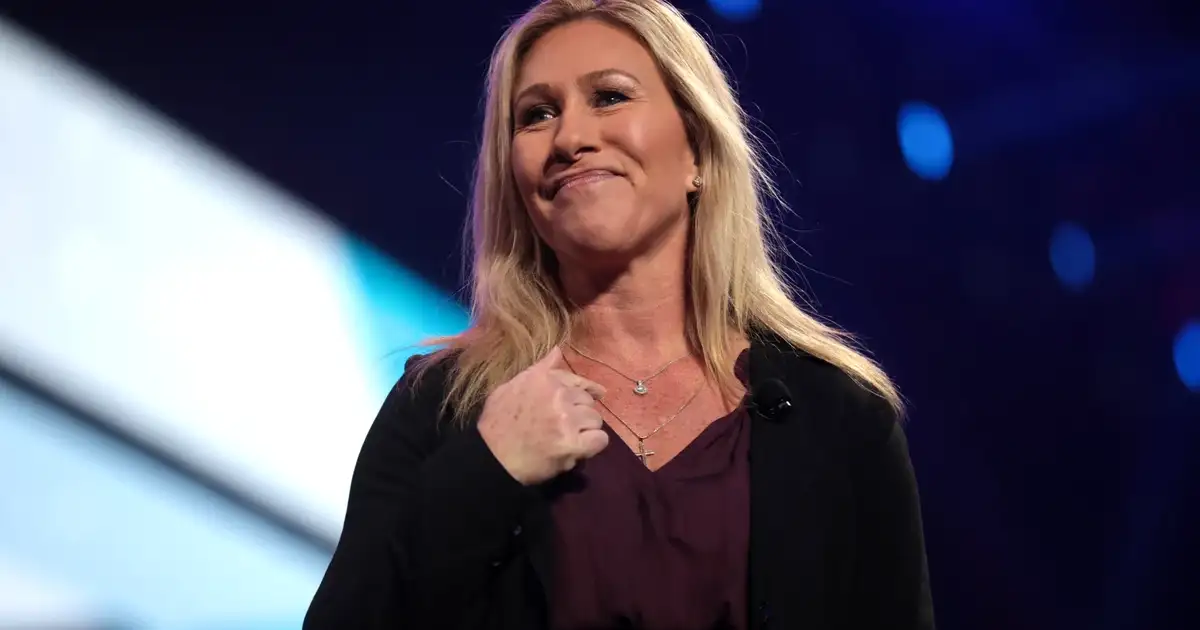

The political tremors emanating from Washington just intensified, courtesy of Representative Marjorie Taylor Greene (R-GA), who has unleashed a claim that could rattle President Donald Trump’s inner sanctum to its core. Greene asserts, with uncharacteristic bluntness, that Trump himself confided in her, admitting his “friends would get hurt” if the full, unredacted Jeffrey Epstein files ever truly saw the light of day.
This is no mere political whisper; it’s a direct challenge, a gauntlet thrown down by an influential Republican. Greene didn’t mince words, declaring Trump’s direct confession to her. Such an admission, if true, doesn’t just hint at a casual acquaintance with Epstein’s sordid affairs; it points to a deep, personal, and potentially incriminating understanding of the explosive contents still hidden within those sealed documents. It suggests the unredacted files harbor secrets capable of not merely damaging, but utterly shattering, reputations, careers, and even political legacies across the American elite.

The Ghosts of Mar-a-Lago: Who Are These “Friends”?
The immediate, chilling question reverberating through the corridors of power is stark: who, precisely, are these “friends” President Trump ostensibly sought to protect? The Epstein saga has always been a grotesque tableau of power, privilege, and the insidious mechanisms of protection afforded to the elite. Greene’s new revelation doesn’t just pull back the curtain; it rips it down, exposing the raw nerve of that dynamic.
It is well-documented that Trump and Epstein moved within the same rarefied social circles throughout the 1990s and early 2000s. Epstein was not merely an acquaintance but a frequent, indeed, a welcomed guest at Trump’s opulent Mar-a-Lago estate in Palm Beach. This shared social orbit, a nexus of wealth and influence, forms the most obvious, and chilling, starting point for speculation. Many of those old connections, once considered harmless networking, could now be feeling the intense, suffocating heat of impending exposure.
While court documents and Epstein’s infamous flight logs have, over the years, slowly peeled back layers of secrecy, revealing a constellation of prominent names, countless individuals remain stubbornly under redaction. Trump’s alleged comment implies not just a passing familiarity, but an intimate knowledge of precisely who these shielded figures are, what they did, or what they witnessed. It’s a stark, unsettling reminder that the full, unvarnished truth about Epstein’s sprawling, depraved network remains largely hidden from public view.
But to confine the speculation merely to Mar-a-Lago’s gilded ballrooms would be a grave miscalculation. Epstein’s insidious web stretched far beyond the social scene, ensnaring powerful figures in business, finance, and political spheres across continents. The “friends” Trump referenced could easily encompass individuals with whom he has past or current professional relationships, extending into the highest echelons of corporate America and the political establishment. This isn’t just about party guests; it’s about the intricate, often morally compromised, dance of power brokers, the quid pro quo that underpins Washington and Wall Street, and the true cost of admission to that exclusive club.
Epstein’s infamous “black book” is rumored to list hundreds of contacts – a veritable who’s who of the global elite. Yet, shockingly, many of those names have never faced genuine public scrutiny regarding their interactions with the convicted sex offender. This alleged admission from Trump suggests those pages hold far more than just phone numbers; they hold potential career-ending truths, the kind that could unravel carefully constructed public personas and expose decades of complicity or willful ignorance.
The Price of Secrecy: Erosion of Trust
The “hurt” Trump alluded to isn’t merely about the fleeting sting of public embarrassment. It implies far more serious, indeed, catastrophic consequences. We’re talking about irreparable reputational damage, the kind that ends careers and shatters legacies. We’re talking about profound legal exposure, potentially implicating individuals in complicity, or at the very least, a disturbing knowledge of Epstein’s heinous activities.
For everyday Americans watching this sordid drama unfold, Greene’s revelation fuels a deep-seated, corrosive cynicism. It doesn’t just reinforce the idea; it screams that powerful elites operate with impunity, shielded by wealth and influence, perpetually above the law. It confirms their worst suspicions: that vital truths are routinely suppressed, justice is selectively applied, and accountability is a luxury reserved for the powerless. This erosion of trust in institutions, in the very fabric of governance, is not merely dangerous; it is an existential threat to public faith in democracy itself.
The ongoing, tenacious struggle to unseal these files is a stark, undeniable testament to this epic power struggle. The public, weary of obfuscation, demands transparency – a full accounting. Those implicated, however, fight with a ferocity born of desperation, clinging to the shadows of secrecy. Greene’s statement positions her firmly on the side of full disclosure, leveraging this incendiary narrative to expose what she unequivocally calls “the deep state’s corruption.”
“The fact that these files are still being fought over tells you everything,” Greene has often stated, as reported by CNN. “There are powerful people who do not want the full truth to come out.”
Her latest claim, delivered with characteristic defiance, adds serious, undeniable weight to that argument. It suggests that the highest echelons of power are not merely aware but directly complicit in this ongoing cover-up. The cost of continued secrecy is not abstract; it is paid by a public whose faith in justice dwindles daily. Justice for Epstein’s countless victims remains agonizingly elusive, and accountability for the powerful remains a cruel, distant dream.
Greene’s Political Playbook and Looming Fallout
Why, then, would Marjorie Taylor Greene choose this precise moment to unleash such a politically charged admission? This is no accidental slip of the tongue; it is pure, unadulterated political theater, executed with a strategist’s precision, and with stakes that could redefine political careers. Greene expertly positions herself as the ultimate insider, a confidante privy to the President’s most private concerns. This doesn’t just boost her relevance; it dramatically amplifies her influence within the often-fractious Republican Party, cementing her image as a truth-teller unafraid to challenge even her allies.
Her populist brand, built on a foundation of anti-establishment fervor, thrives on exposing perceived corruption wherever it festers – even, notably, if it implicates figures associated with her own political allies. Greene has been a consistent, vociferous proponent of releasing all Epstein-related documents, using the issue as a bludgeon against political opponents and a rallying cry against the amorphous “establishment” she so often decries.
Her strategy is transparently clear, yet brutally effective: she aims to be the singular, unyielding voice exposing the rot in the “swamp,” demonstrating a willingness to go where others fear to tread. This audacious move validates her long-held position, transforming her from a fringe provocateur into a central player in the fight for transparency. Crucially, it also places immense, uncomfortable pressure on those who might foreseeably be named, forcing them into a defensive posture and compelling them to consider their next, desperate steps. This is a calculated provocation, meticulously designed to ignite a political firestorm.
The timing of this revelation is, of course, exquisitely critical. With the political landscape already volatile, fractured by partisan divides and looming electoral battles, any new, verifiable information regarding Epstein’s network has the potential to unleash unprecedented chaos. This alleged admission from President Trump himself doesn’t merely amplify the potential fallout; it imbues the issue with a presidential imprimatur, making it utterly impossible for any serious political actor to ignore.
The implications for the current political cycle are not merely massive; they are potentially seismic. If Greene’s claim holds even a kernel of truth, the unreleased Epstein files are not just potent; they are a political weapon of mass destruction. They could contain information capable of not just “hurting” but utterly annihilating individuals within Trump’s social or political orbit. This would not just impact public perception; it could fundamentally shift allegiances, sway undecided voters, and irrevocably alter the course of future elections.
Further calls for transparency will not merely intensify; they will become an irresistible tide. The pressure on the courts, already considerable, to release every last redacted document will become immense, verging on unbearable. Every shielded name, every obscured detail, will now be scrutinized with renewed, almost obsessive vigor. The public’s unalienable right to know will clash directly, violently, with the powerful’s desperate desire for protection, setting the stage for a legal and political showdown unlike any seen in recent memory.
President Trump has, for years, consistently attempted to distance himself from Epstein, often with a casual dismissiveness that bordered on the glib. He famously claimed he “wasn’t a fan” and that Epstein “liked beautiful women, as I understand it,” attempting to relegate their association to a bygone era of New York social climbing. This alleged private admission to Greene, however, starkly contradicts his carefully curated public stance. It paints a picture of deeper knowledge, profound concern, and perhaps, a personal stake in the continued suppression of these files.
The “hurt” Trump alluded to could manifest in a terrifying spectrum of ways. It could be career-ending accusations of moral turpitude, the kind that forever tarnish a public image. It could be financial ruin for those whose illicit dealings are exposed. It could even be criminal legal charges for others, finally bringing long-overdue accountability for complicity in a monstrous enterprise. The full, unvarnished release of these files would send shockwaves not just through Washington, but through the global financial and social elite, exposing the true, horrifying cost of operating for decades in the morally bankrupt shadows of power.
This isn’t just a story about decades-old files or a disgraced financier; it’s a searing indictment of who holds power, who is afforded protection, and who ultimately pays the unbearable price for elite impunity. Marjorie Taylor Greene, with this single, audacious claim, has pulled a thread that threatens to unravel far more than just a few carefully constructed reputations. She has exposed a raw nerve in the American body politic, suggesting that the rot runs deeper than many dared imagine, and the truth, it seems, is still buried within its murky, privileged waters. The question, then, is no longer if more will come out, but when the dam will finally break. And when it does, who among the powerful will be left standing amidst the ruins?
Source: Google News