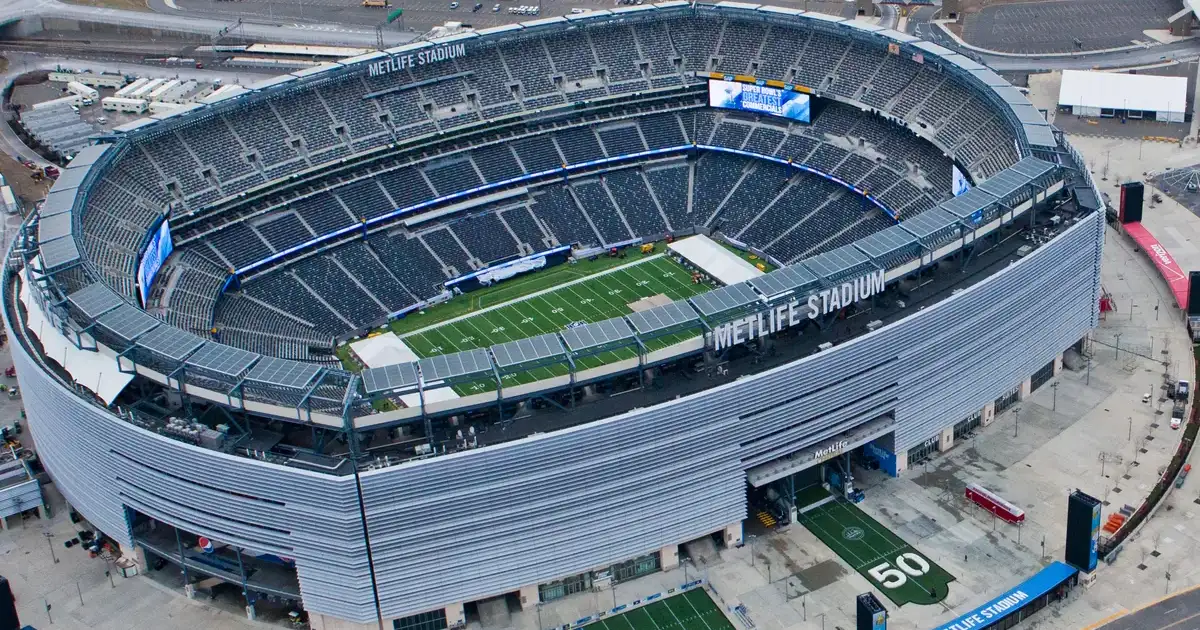

The roar of the crowd, the thrill of the final whistle—these are the hallmarks of a World Cup final. But in 2026, will the air itself be safe to breathe? This isn’t a hypothetical; it’s the stark reality FIFA confronted when urgent talks with White House officials put the fate of the World Cup final at MetLife Stadium in question due to Canada wildfire smoke concerns.
Despite the looming threat of severe wildfire seasons, the global football body has made its audacious decision: the 2026 World Cup final will remain at MetLife Stadium. This isn’t a gamble, FIFA insists, but a commitment backed by promises of unprecedented environmental contingency planning. High-level discussions, which intensified over two critical days on July 16th and 17th, have set the stage for a new era of event management in a warming world.

New long-range climate forecasts paint a grim picture, showing an alarmingly higher chance of severe wildfire seasons. This isn’t just an inconvenience; it’s a flashing red light for organizers. Public health and event continuity have rocketed to the top of the priority list for every stakeholder involved, from the athletes on the pitch to the fans in the stands.
Beyond the Smoke Screen: Real Protections for Real People
The real question isn’t where the final will be played, but how FIFA plans to protect the millions who will descend upon the New York/New Jersey region. Fans and athletes aren’t just demanding answers; they’re demanding action. And FIFA, alongside its host cities, is finally stepping up with tangible, concrete plans:
- Advanced Air Quality Monitoring: FIFA will collaborate closely with federal agencies, including the Environmental Protection Agency (EPA). Their joint effort will deploy real-time air quality sensors strategically placed around MetLife Stadium and other key venues. This isn’t just data collection; it’s a vital early warning system, providing immediate, precise information on particulate matter (PM2.5) levels.
- Tiered Response Protocols: A meticulously designed system will dictate specific actions based on air quality. This means clear directives: from advising mask usage and limiting outdoor activities to directing attendees to indoor filtered spaces. In the most extreme scenarios, matches could be postponed or even relocated, triggered by pre-defined Air Quality Index (AQI) thresholds.
- Enhanced Indoor Air Filtration: Significant investments are being made to upgrade HVAC systems across all critical infrastructure. Stadium suites, media centers, and all enclosed public areas will be outfitted with high-efficiency particulate air (HEPA) filters. These aren’t luxuries; they are being engineered as vital, life-saving “clean air” havens.
- Designated “Clean Air” Zones: The contingency planning extends beyond the stadium walls. Nearby indoor facilities—think convention centers or large arenas—are being prepared to serve as expansive, air-filtered public shelters. These zones will offer refuge for fans and staff should outdoor conditions become dangerously polluted.
- Pre-Approved Backup Venues: While MetLife remains the chosen site for the final, FIFA is pragmatically assessing alternatives. Other stadiums in regions less susceptible to wildfire smoke are being evaluated as emergency backup sites, ready to host critical matches if the air quality at MetLife proves untenable.
A White House spokesperson underscored the administration’s unwavering commitment. “The health and safety of attendees, athletes, and staff at the 2026 World Cup is a top priority for the administration,” an unnamed official told CNN on July 17th. “We are working closely with FIFA to ensure all necessary precautions and contingency plans are in place to safeguard this global event.”
More Than Just a Game: A Resounding Climate Wake-Up Call
Let’s be clear: this isn’t merely about football. This is a blaring alarm bell, a visceral reminder of how climate change is relentlessly infiltrating every aspect of our lives. It touches our health, our economies, and even our most cherished global celebrations.
The 2023 Canadian wildfire season wasn’t just “brutal”; it choked major cities like New York, turning the sky an apocalyptic orange and rendering the air “unhealthy” for days. We cannot, we must not, ignore these warnings any longer.
FIFA understands the immense stakes. An unnamed FIFA official articulated their resolve, stating, “While we remain fully committed to MetLife Stadium as our final venue, these discussions underscore our proactive approach to potential environmental challenges,” Reuters reported on July 16th. “Our goal is to ensure a safe and memorable experience for everyone, no matter the obstacles.” This isn’t just a goal; it’s a mandate.
The New York/New Jersey region stands to reap an estimated $5 billion in economic activity from this event. For that to happen, the World Cup must unfold flawlessly. This means absorbing the colossal logistical and financial costs associated with these new, essential environmental protocols. It is not merely an undertaking; it is a monumental, unprecedented commitment to resilience.
The True Cost of Spectacle in a Warming World
This raises uncomfortable, yet vital, questions: Who ultimately pays for these advanced systems? Who bears the financial burden of these critical climate resilience measures? These are not trivial expenses; they accumulate rapidly, forming a new line item in the budget of global events. This situation sets a crucial, unavoidable precedent for all future large-scale gatherings.
We’ve seen this script before. The Tokyo 2020 Olympics wrestled with extreme heat. Major League Baseball, the NFL, and MLS have all witnessed games disrupted, even canceled, by wildfire smoke. These are not isolated incidents; they are a disturbing, accelerating pattern. The world must adapt, and quickly.
This situation demands a completely new playbook for global events. It forces a hard, honest look at how we plan, how we insure, and how we execute international gatherings. The safety of the crowd—our families, our friends, women and children among them—is non-negotiable. It is reassuring, finally, to see FIFA and the White House taking this with the gravity it deserves.
The decision to hold the final at MetLife, coupled with these aggressive contingency plans, isn’t just a choice; it’s an acknowledgment of a new reality. We can no longer pretend climate change is a distant, abstract threat. It is here, now, impacting our biggest spectacles, our most cherished moments.
The question that lingers, a potent challenge to us all, is this: are these plans truly enough to face the future head-on?
Photo: Wikimedia Commons (query: World Cup feared)
Source: Google News