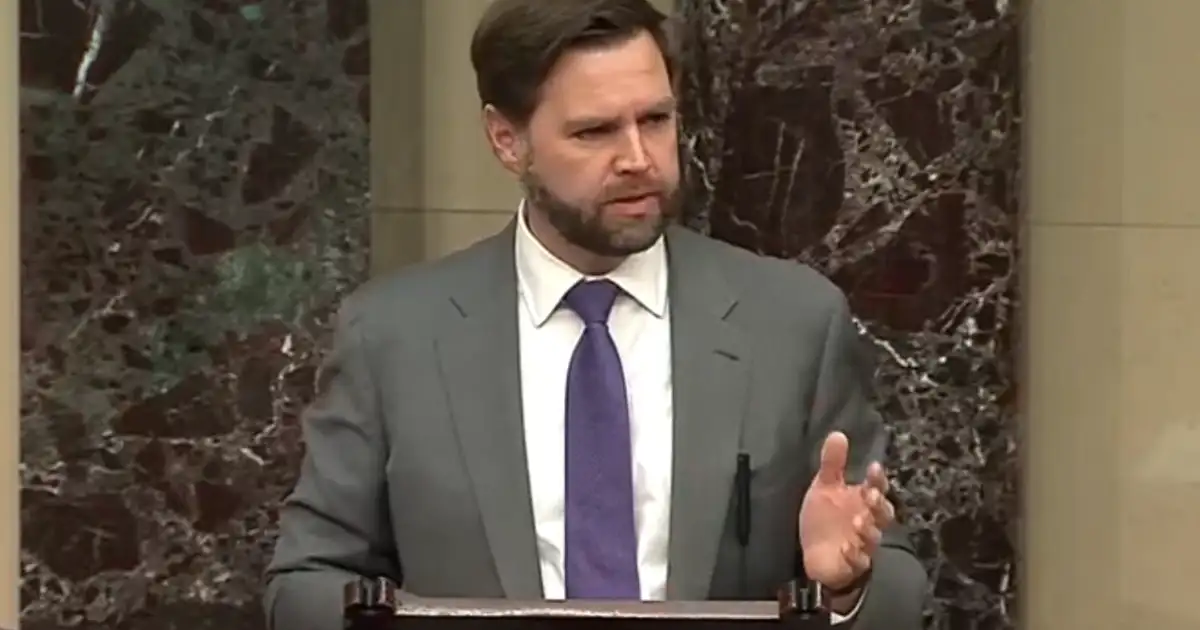

“Stand the pain.” Those three words, uttered by Senator J.D. Vance (R-OH), just landed like a blunt force trauma to the American wallet. As President Trump’s administration unleashes a strategic barrage on Iranian targets, Vance’s stark directive to absorb the economic fallout of surging gas prices has ignited a political firestorm, leaving everyday Americans to wonder if their pain is merely collateral damage in a high-stakes geopolitical game.
Vance’s incendiary comments, delivered on Fox News’ “Sunday Morning Futures” on Sunday, July 25, 2026, ripped through the news cycle. They followed a national gas price hike of roughly 15 cents per gallon, directly correlated with recent U.S. military strikes across Syria and Iraq.

These targeted strikes, aimed at Iranian-backed militia strongholds, were a swift, decisive response to a drone attack that wounded three American service members just last Friday. Now, the national average for gas isn’t just a number; it’s a gut punch at a staggering $4.10 per gallon, a sharp climb from $3.95 a mere week prior.
Vance’s “Kill a Few Chickens” Gambit: A Risky Play
When confronted with the very real economic strain on American households, Vance didn’t just stand his ground; he charged forward, articulating a foreign policy doctrine as unyielding as a goal-line stand.
Look, sometimes you gotta kill a few chickens to scare the monkey. We’re sending a clear message to Tehran and its proxies. If Americans have to stand the pain of a few extra dollars at the pump to ensure our national security and project strength, then that’s a price worth paying.
This quote wasn’t just a soundbite; it was a political Hail Mary pass, and it landed squarely in a hornet’s nest. The ensuing firestorm across every media platform was immediate and fierce.
Critics, spanning the political spectrum, wasted no time in labeling the remarks as tone-deaf, a callous dismissal of the profound financial struggles gripping millions of American families. Was this a calculated risk, or an unforced fumble?
Vance’s office, however, shows no signs of backing down from the line of scrimmage. They contend the Senator is merely emphasizing the brutal truth: a robust foreign policy, one capable of deterring hostile actors like Iran, often carries unavoidable domestic economic costs.
Supporters champion his words as a display of unwavering resolve, a commitment to national security that refuses to buckle under pressure. They argue that any perceived appeasement of Iran would only breed further instability, ultimately leading to even greater costs – both human and economic – down the line. It’s a strategic gamble, to be sure, but one Vance clearly believes is essential for long-term victory.
The Real Cost of Deterrence: Your Wallet on the Line
For countless Americans, this isn’t merely about a “few extra dollars.” This is about the razor-thin margin between making ends meet and falling behind.
Higher gas prices don’t just affect the commute; they ripple through every aspect of life, translating directly into less money for groceries, for rent, for medication, for the basic necessities that define a secure household. The notion of “standing the pain” for a foreign policy objective, however noble, is a brutally tough sell when household budgets are already stretched to breaking point. Is the average American family truly prepared to be a pawn in this geopolitical chess match?
Senate Majority Leader Chuck Schumer (D-NY) didn’t just criticize Vance’s remarks; he delivered a scathing indictment, branding them “callous” and “out of touch.”
Senator Vance’s comments are not only callous but dangerously out of touch. American families are struggling, and to tell them to simply ‘stand the pain’ while gas prices soar due to this administration’s reckless foreign policy is an insult. It demonstrates a profound lack of empathy for the very people he claims to represent.
Even within Republican ranks, a quiet discomfort is brewing. While many staunchly support a firm stance against Iran, they express concern that Vance’s blunt phrasing hands political opponents potent ammunition, alienating crucial swing voters. They advocate for a more nuanced, empathetic approach to communicating the economic hardships inherent in such a strategy, fearing that a perception of indifference could prove more damaging than any foreign policy gain.
Gearing Up for a Bigger Game with Iran? The Escalation Playbook
The critical question now facing Washington and the world is whether these recent strikes are mere skirmishes, or if they signal the Trump administration is preparing for a far larger conflict with Iran. These latest U.S. strikes represent the third retaliatory action in the past two months, a clear and chilling indicator of escalating tensions. This isn’t just a minor squabble; it’s a dangerous, high-stakes game of tit-for-tat, each move pushing the region closer to the brink.
The global market, a sensitive barometer of geopolitical risk, has already reacted with alarm. Brent crude futures surged by 3% in the past 72 hours, now trading at approximately $85 per barrel.
This jump is a direct consequence of heightened instability in the Middle East. More conflict means more uncertainty in vital oil shipping lanes; more uncertainty means higher prices at the pump for you. It’s a predictable, brutal equation.
The White House Press Secretary, in an attempt to calm the roiling waters, acknowledged the public’s concerns, emphasizing President Trump’s dual commitment to global security and domestic economic stability.
President Trump is committed to both protecting American interests abroad and ensuring economic stability at home. We understand the concerns about gas prices and are exploring all options to mitigate the impact on consumers while maintaining a strong stance against those who threaten our allies and personnel. This administration will not back down from defending our nation’s security.
However, the specifics of these “options to mitigate the impact” remain conspicuously absent, leaving many to wonder if the administration has a coherent plan B for the economic consequences of its aggressive foreign policy.
The Economic Ripple Effect: Beyond the Gas Tank
The impact of this energy price surge isn’t confined to your gas tank; it sends a devastating ripple effect across the entire economy. The most recent Consumer Price Index (CPI) report revealed a concerning 0.4% month-over-month increase, with energy costs identified as a primary driver.
This means the cost of transporting goods to your grocery store shelves rises, leading to higher food prices. Your utility bills climb. The cost of nearly everything you buy becomes more expensive when gas prices soar, effectively shrinking the purchasing power of every dollar in your pocket
Photo: Wikimedia Commons (query: J.D. Vance)
Source: Google News