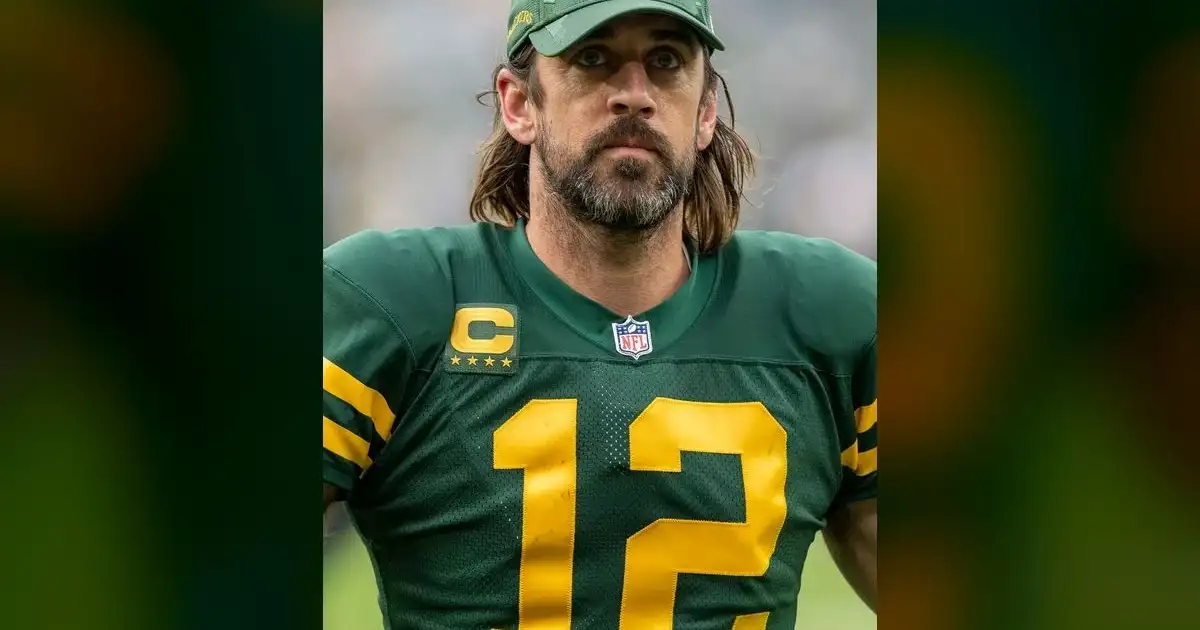

Aaron Rodgers didn’t just speak his mind on ESPN; he detonated a political bomb, branding Anthony Fauci an “absolute coward” and declaring the Covid virus was “obviously made in a lab.” This wasn’t merely a sports star’s off-the-cuff remark; it was a meticulously aimed shot across the bow of the establishment, reverberating far beyond the sports world and straight into the heart of America’s culture wars.
Rodgers delivered his blistering broadside during a live segment on the sports network, a stage typically reserved for game analysis, not geopolitical conspiracy. His direct challenge to the mainstream narrative surrounding the pandemic’s origins wasn’t just provocative; it was an act of calculated defiance that immediately ignited a firestorm across social media and cable news. The NFL quarterback’s remarks zeroed in on Dr. Fauci’s pivotal, and often polarizing, role throughout the pandemic, explicitly endorsing the controversial lab leak theory. For those who have followed Rodgers’ career, this public outburst wasn’t an anomaly but a predictable escalation in a long-established pattern.

This is the Aaron Rodgers playbook: identify a perceived orthodoxy, then dismantle it with rhetorical force. He has spent years cultivating an image as an independent thinker, a contrarian voice unafraid to challenge powerful institutions. His previous pronouncements on Covid-19 vaccines, for instance, didn’t just spark controversy; they cemented his status as a figurehead for a significant segment of the American populace deeply distrustful of official narratives.
Rodgers: The Anti-Establishment Provocateur
Aaron Rodgers has meticulously engineered a public persona built on defying the norm. He leverages his immense platform not just to comment, but to actively confront and destabilize what he views as entrenched power structures. His “scorched earth” approach to public discourse is now legendary. He has consistently lambasted what he labels “corporate propaganda,” perceiving a deliberate, orchestrated suppression of dissenting viewpoints. This stance doesn’t just resonate; it galvanizes millions of Americans who feel unheard and actively distrust mainstream media, government agencies, and even scientific consensus.
His latest offensive was a direct strike at the media’s coverage of public health, which he derided as “fear-mongering masquerading as journalism.” Rodgers didn’t merely suggest; he outright accused major news networks of acting as conduits for government and pharmaceutical interests, rather than impartial arbiters of truth. This isn’t just rhetoric; it’s a battle cry that deeply resonates with anti-establishment segments, fueling their conviction that a hidden agenda dictates public information. Why else, they ask, would a powerful athlete risk his reputation to speak such inconvenient truths?
Fauci: The Embodiment of Authority Under Siege
Dr. Anthony Fauci, for many, ceased being just a scientist and evolved into a symbol. He became the very embodiment of the scientific and governmental establishment, the face of restrictive public health measures that fundamentally altered daily life for millions. His image transformed into a lightning rod, attracting not just criticism but outright animosity from those who felt their freedoms curtailed and their livelihoods threatened. He was, in essence, the perfect target.
Rodgers’ attack on Fauci, therefore, was not random; it was a shrewd, calculated political maneuver. It tapped into a deep, volatile reservoir of public frustration aimed squarely at what is perceived as governmental overreach by health authorities and the media’s role in amplifying those messages. Rodgers, a master of public perception, understands precisely which buttons to push to maximize impact and rally his base. He knows that demonizing Fauci isn’t just about the man himself; it’s about systematically dismantling trust in government experts and the entire apparatus of public health messaging. This isn’t just giving voice to a powerful political current; it’s actively challenging the very foundation of institutional authority in America.
The implications extend far beyond a single doctor’s reputation. When a figure of Rodgers’ stature questions the integrity of public health leadership, it sows seeds of doubt that can cripple future efforts to address national crises. It transforms critical public discourse into a partisan skirmish, where loyalty to a celebrity trumps faith in established expertise. This erosion of trust, once initiated, is incredibly difficult to reverse, leaving the public vulnerable to misinformation and making collective action on pressing issues increasingly impossible.
ESPN’s Uncomfortable, Unwitting Stage
The sheer fact that this incendiary rant unfolded live on ESPN is not just crucial; it’s a seismic event in the ongoing blurring of sports and politics. ESPN is not a niche political podcast; it is a colossal platform, reaching tens of millions of viewers who may tune in for scores and highlights, not for a deep dive into virology or government conspiracies. This unparalleled reach imbues Rodgers’ message with an incredible, unfiltered amplification, pushing his narrative into homes and minds that might otherwise remain untouched by such politically charged discourse.
Was ESPN genuinely prepared for such a politically charged diatribe? Did they truly anticipate Rodgers’ “blistering” comments, or were they caught flat-footed by the sheer audacity of his pronouncements? Regardless, the network found itself an unwilling, perhaps even unwitting, stage for a full-blown political skirmish. This incident irrevocably blurs the already fading lines between sports entertainment and partisan warfare, raising profound questions about the responsibility of major media platforms in an era where celebrity voices can wield unprecedented influence. Networks often strive to maintain a veneer of political neutrality, but by offering a platform to a figure as outspoken and polarizing as Rodgers, they inevitably invite, and even amplify, controversy. His statements will not simply fade; they will be dissected, celebrated, and condemned across every conceivable media ecosystem, from politically charged podcasts to the most virulent corners of social media. ESPN’s decision to host him, whatever its initial intent, now carries substantial and unavoidable consequences for its brand and its role in public discourse.
The ‘Lab Leak’ and the Information War’s Front Lines
Rodgers’ assertion that the virus was “obviously made in a lab” is not just highly contentious; it’s a direct volley into one of the most fraught debates of the modern era. This theory, once relegated to the fringes, has gained significant traction, particularly among conservative circles and those skeptical of official narratives. It fundamentally challenges the widely accepted natural origin hypothesis, a challenge that has been amplified by intelligence reports and scientific discussions, moving the theory from fringe speculation to a legitimate, albeit still debated, line of inquiry. By endorsing it so emphatically, Rodgers lends it a powerful celebrity imprimatur.
Such claims are not isolated incidents; they are potent weapons in a larger, relentless information war. They are designed to foster deep-seated distrust in scientific consensus and to actively undermine official government reports and public health directives. Rodgers, framing this as a heroic fight against “coordinated efforts to control the narrative,” suggests these efforts are meticulously designed to “coerce public opinion” and suppress inconvenient truths. He positions himself as a truth-teller, pulling back the curtain on a vast, shadowy conspiracy.
“It’s about who you trust, not what the facts say.”
This rhetoric is undeniably powerful, resonating with those who feel systematically ignored, dismissed, or actively misled by mainstream voices. It provides a celebrity endorsement for alternative theories, transforming a complex scientific debate into a stark choice of allegiance. In this landscape, the discourse becomes less about verifiable scientific evidence and more about tribal loyalty. It’s no longer about what the facts dictate, but rather about who you trust, and critically, who you distrust.
The Steep Cost of Celebrity Outrage
Aaron Rodgers, with his unparalleled celebrity status, understands the mechanics of commanding attention. He wields his megaphone not just to speak, but to amplify anti-establishment sentiments with surgical precision. This tactic is undeniably effective in mobilizing a base, but it is also profoundly, perhaps irrevocably, polarizing. It doesn’t foster dialogue; it deepens division, carving out trenches in an already fractured society.
His supporters hail him as a brave truth-teller, a courageous figure willing to challenge a monolithic media establishment and a complacent scientific community. His critics, conversely, accuse him of irresponsible rhetoric, of recklessly promoting dangerous conspiracy theories that have real-world consequences for public health and social cohesion. This chasm, this unbridgeable divide, is the true, enduring cost of his celebrity outrage.
The average American, caught in the crossfire, struggles desperately to discern truth from the relentless torrent of spin. Rodgers’ rant, far from clarifying issues, further erodes public trust in vital institutions—institutions critical for navigating complex challenges from pandemics to economic crises. It makes it exponentially harder to address real public health challenges, to foster a sense of shared reality, or to engage in constructive civic discourse. In this hyper-politicized arena, the political game often overshadows, and ultimately jeopardizes, the actual well-being of the populace. This is not just a sports figure speaking his mind; it is a calculated political maneuver, exploiting existing societal divides for maximum attention and influence. Rodgers has, definitively and irrevocably, inserted himself into the American political landscape, emerging as a potent, if profoundly polarizing, voice. The question is not if his words will have an impact, but how deeply the tremors will shake the foundations of our collective trust.
Source: Google News