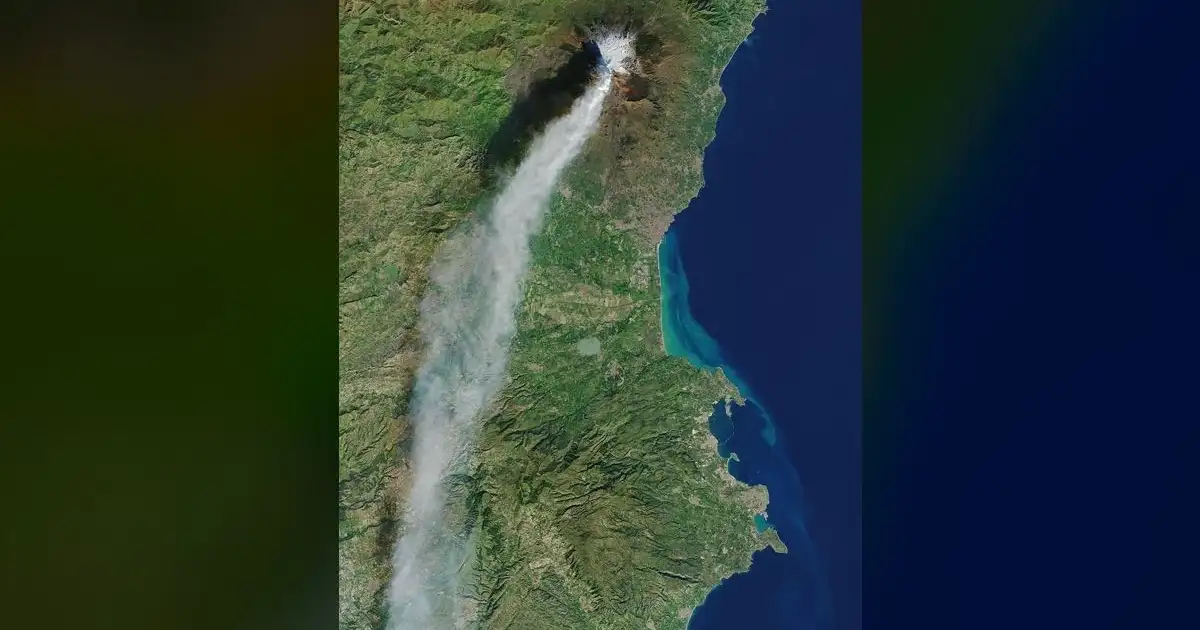

Mount Etna, Europe’s most relentlessly active volcano, has once again asserted its formidable power, challenging the meticulously planned logistics of modern Europe. In the past 48-72 hours, a fresh eruptive phase unleashed a substantial ash plume, reportedly reaching altitudes of up to 7 kilometers, drifting menacingly across eastern Sicily.
The consequence, as predictable as the changing seasons, has been the immediate cessation or severe curtailment of operations at Catania Fontanarossa Airport (CTA) as of the morning of August 15, 2026. With over 200 flights grounded and an estimated 30,000 passengers left stranded or rerouted, the convenient illusion of uninterrupted global mobility is exposed for the fragile construct it truly is.

This isn’t merely an inconvenience for holidaymakers; it’s a potent, undeniable demonstration of modern society’s delicate reliance on predictable systems. While the immediate focus remains on the visible disruptions – the canceled flights, the frustrated travelers, the logistical scramble – the deeper implications for Italy’s economy, regional supply chains, and Europe’s broader infrastructure resilience demand a far more rigorous and critical examination. How long can a continent that prides itself on seamless connectivity continue to operate with such inherent vulnerabilities?
The Economic Tremors Beyond the Ash Cloud
Sicily, a jewel in Italy’s tourism crown, relies heavily on air travel to bring in its lifeblood of visitors. Catania Airport is not just a regional hub; it’s a critical gateway for international arrivals, feeding the island’s hotels, restaurants, and local businesses.
The immediate closure means a direct, measurable hit to this vital sector, conservatively estimated at €5-10 million in lost revenue daily for the region. Airlines face immediate revenue losses, rebooking costs that can easily run into millions, and the operational nightmare of rerouting or holding aircraft.
For local Sicilian businesses, particularly those operating on thin margins, every day of airport closure translates into lost bookings, perishable goods unsellable, and a rapid erosion of cash flow. This isn’t theoretical; this is immediate financial hemorrhaging that disproportionately impacts small and medium-sized enterprises.
The impact extends far beyond tourism. Air freight, though less publicized, is crucial for high-value goods and time-sensitive deliveries like pharmaceuticals, high-tech electronics, and fresh produce.
A disruption at CTA, even for a few days, creates bottlenecks that ripple through supply chains, impacting importers and exporters across the Mediterranean and beyond. The hidden cost is not just the delay but contractual penalties, spoiled goods, and damaged reputations.
These accrue when global commerce grinds to an unexpected halt. Consider the delicate supply chain for fresh seafood or specialized medical components; their timely delivery is not a luxury, but a necessity.
“The true casualty count often goes unmeasured, hidden in the balance sheets of small businesses and the frustrated plans of international commerce.”
Europe’s Airspace: A House of Cards?
Etna’s eruption, while localized to Sicily, inevitably highlights the inherent fragility of Europe’s integrated air traffic management system. The continent’s airspace is among the busiest and most complex in the world.
When a significant regional airport like Catania, serving over 10 million passengers annually and a major tourist destination, goes offline, the ripple effect is substantial. Aircraft must be diverted, often to airports already operating at capacity, creating congestion and further delays.
This increases fuel consumption across the entire network. A problem in Sicily quickly becomes a problem for Frankfurt, London, and Paris, illustrating the interconnectedness that simultaneously empowers and imperils modern aviation.
This isn’t Europe’s first dance with volcanic ash. The infamous Eyjafjallajökull eruption in Iceland in 2010 brought much of European airspace to a standstill for nearly a week, costing the European economy an estimated €5 billion.
While Etna typically produces less widespread ash plumes, the principle remains: modern aviation, for all its technological prowess, remains fundamentally vulnerable to atmospheric conditions dictated by geological events.
The question isn’t if another such event will occur, but when. Have the lessons learned about contingency planning and coordinated response been truly embedded into systemic resilience, or merely recited during post-incident reviews? Are we simply waiting for the next major disruption?
The Red Marker Verdict: A Cycle of Reactive Mitigation
Let’s be unequivocally clear: Etna is not a new phenomenon. It is a constantly active volcano in a densely populated region.
The cycle of eruption, ash, airport closure, and subsequent scramble is a well-worn path. The “Red Marker” verdict here is that despite living with this geological reality for millennia, the approach to its inevitable disruptions remains largely reactive.
It is not proactively integrated into long-term infrastructure and economic planning. The narrative often focuses on the “unforeseen” nature of the event, when in reality, Etna’s activity is as foreseen as the changing seasons. These are not black swan events; they are geological clockwork.
The true cost is systematically externalized. Airlines absorb losses, passengers suffer delays, and local businesses bear the brunt of lost revenue.
Governments, particularly Rome and the regional Sicilian administration, are perpetually caught in a cycle of emergency response and appeals for aid. They fail to invest in fundamentally resilient systems that can better withstand these predictable disruptions. There’s little compelling evidence of a paradigm shift towards alternative transport infrastructure or substantial long-term economic diversification.
The hypocrisy lies in the expectation of seamless connectivity and robust economic growth, while simultaneously accepting a fundamentally reactive posture towards a known and constant geological threat. The financial motive isn’t necessarily a sinister plot, but rather the collective avoidance of the massive upfront investment required for true resilience, opting instead for the politically palatable, yet economically draining, strategy of crisis management after the fact. It is, in essence, deemed cheaper in the short term to clean up the mess than to redesign the entire system to be ash-proof, or at least ash-resistant.
The disruption at Catania Airport, therefore, serves as more than just a weather report or a localized inconvenience. It’s a stark, annual audit of Europe’s ability to truly live with its natural environment.
This means its consistent choice to prioritize immediate economic convenience over the costly, long-term investments that would genuinely insulate its vital arteries from the Earth’s enduring power. The flights will eventually resume, the ash will settle, but the underlying fragility and the reactive cycle will remain, awaiting Etna’s next inevitable assertion.
The question is not if Etna will erupt again, but whether Europe will continue to merely react, or finally commit to building genuinely resilient systems that honor the Earth’s formidable power rather than merely enduring its consequences.
Source: Google News