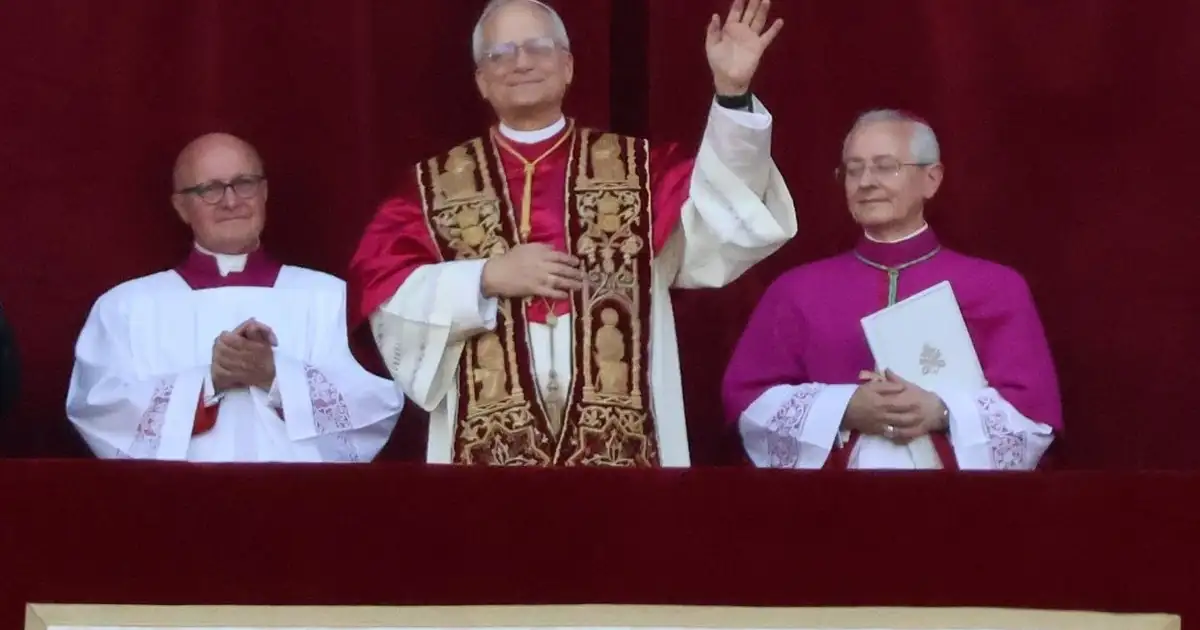

Forget the saccharine headlines suggesting Vice President JD Vance is extending an olive branch to Pope Leo XIV. That narrative misses the core truth entirely. Vance’s recent remarks were not a gesture of reconciliation, but a meticulously calculated political maneuver, a sharp elbow thrown into the ongoing ideological wrestling match within the Republican Party. This wasn’t about bridging divides; it was about staking a definitive claim, using a high-profile papal disagreement as the proving ground for his own brand of conservative power and influence.
Vance’s Calculated Papal Play: A Theological Gauntlet Thrown
Vice President Vance, ever the provocateur, recently offered a public nod to Pope Leo XIV’s advocacy for peace during a high-profile Turning Point USA event. But let’s not be naive: this brief acknowledgment was merely the setup for the real show. Vance immediately pivoted, launching a direct and unambiguous challenge to the Pontiff’s theological stance on war and peace.

The Pope had declared, with unmistakable moral clarity, that
“God is never on the side of those who wield the sword.”A profound statement, certainly, and one that resonates deeply with many. Yet, Vance, with the precision of a seasoned debater, swiftly countered this. He invoked the historical crucible of the liberation of France from the Nazis, suggesting that divine support might, in fact, align with military action under certain, righteous circumstances. This wasn’t a subtle disagreement; it was a theological gauntlet thrown down in plain sight.
To call this an “olive branch” is to fundamentally misunderstand Vance’s political calculus. This was a clear, public pushback on a core theological point, designed not to conciliate, but to differentiate. While Vance did offer the perfunctory remark that he had
“a lot of respect for the Pope”and didn’t object to the Pontiff commenting on modern issues, the substance of his response was undeniably argumentative, even confrontational. He drew a line in the sand, daring others to cross it, and in doing so, he signaled his willingness to challenge even the most revered moral authorities when he believes it serves his political agenda. This move, far from seeking common ground, was about defining his own ideological territory and asserting intellectual leadership within a segment of the conservative movement that often views traditional institutions with skepticism.
Shaping the Republican Future: An Industrial Renaissance and Its Price
Vance’s actions are not isolated incidents; they are integral components of a larger, deliberate strategy to reshape the Republican Party’s future direction. This vision encompasses not just foreign relations but, crucially, a radical overhaul of economic policy. He is not merely navigating the various ideological currents within the conservative movement; he is actively attempting to redirect them, consolidating influence and meticulously defining the party’s platform for the coming decades.
His recent engagements offer a crystal-clear illustration of this ambition. Vance has been deeply immersed in influential think tank discussions, a regular fixture at conservative conferences, where he tirelessly presents his blueprint for an American industrial renaissance. This isn’t just rhetoric; it’s a strategic effort to integrate populist economic themes—like the aggressive promotion of domestic manufacturing and a robust strategic industrial policy—into the very core of the GOP platform. He advocates for a sweeping re-evaluation of global trade agreements, promising a return to an economic nationalism designed to prioritize American workers and industries above all else.
This approach has become his political identity, a cornerstone of his appeal. He aims to forge a new economic consensus, a framework designed to appeal to a broad spectrum of voters, from the struggling working class in the Rust Belt—a demographic he knows intimately—to traditional business interests wary of global supply chain vulnerabilities. It’s a masterful move to unify disparate wings of the GOP under a shared, compelling policy vision, promising a return to American economic might.
But let’s be blunt about the financial implications here, because this isn’t just about jobs and patriotism; it’s about power and dollars. A nationalist economic agenda means potentially billions in government contracts steered directly to domestic industries, bypassing global competition. It means the imposition of new tariffs that will undoubtedly hit importers hard, shifting market dynamics. For consumers, this translates to potentially higher prices on a range of goods, from electronics to clothing, as imported alternatives become more expensive. Yet, the political promise is alluring: more jobs in key swing states, a tangible shift of wealth and power from global corporations to domestic manufacturers and their workers. The question is, who ultimately bears the cost of this economic re-engineering? Inevitably, it is the consumer, while specific, politically connected industries and their lobbyists stand to profit handsomely.
This isn’t about theological purity or divine intervention. This is about raw power, economic re-alignment, and the strategic deployment of capital. Vance is not just playing the game; he’s attempting to redraw the entire economic chessboard, and he’s making his move with audacious confidence.
https://www.politico.com/news/2026/04/gop-economic-soul-searching-vance-influence
The “America First” Doctrine: A World Remade?
Beyond economics, Vance remains an unyielding and prominent voice in foreign policy debates, consistently championing a more restrained, unapologetically “America First” approach. This doctrine prioritizes domestic concerns over what he views as expensive, often counterproductive, international interventions. His public statements, delivered through numerous media appearances throughout late 2025 and early 2026, consistently reinforce these positions, painting a clear picture of a world where American resources are conserved for American needs.
This stance frequently places him at direct odds with more traditional, interventionist voices within the Republican Party, who still cling to notions of global leadership through military presence and extensive alliances. Vance’s consistent articulation of this position is deeply strategic, carefully framed around national interest and the prudent allocation of finite resources. He is not merely expressing an opinion; he is actively attempting to consolidate a specific foreign policy perspective, pushing it from the fringes to the mainstream within the GOP. He envisions a party that is less eager to police the world and more focused on securing its own borders and economic future.
This process of shaping the party’s foreign policy identity involves constant, often bruising, dialogue. It implicitly, and sometimes explicitly, tries to bring dissenting voices into alignment, building a broader coalition around a vision of American strength that doesn’t necessarily equate to global hegemony. But what are the real-world implications of such a seismic shift?
Consider the profound financial ramifications. A truly restrained foreign policy means significantly less money funneled into overseas wars and protracted nation-building efforts. It means fewer lucrative contracts for defense giants operating abroad, potentially redirecting military spending domestically. This could indeed free up substantial funds for vital infrastructure projects, bolster domestic social programs, or even contribute to deficit reduction. However, this reorientation also carries a heavy cost: potentially less influence on the global stage, a willingness to cede ground to rival powers, and almost certainly strained alliances with nations accustomed to American leadership and protection. It’s a stark trade-off, and Vance is unequivocally pushing the party to embrace it, consequences be damned.
https://www.breitbart.com/politics/2025/11/senator-vance-american-sovereignty-new-path-foreign-policy
The Trump Connection: Loyalty Forged in Fire
No analysis of Vance’s political ascent would be complete without acknowledging the absolutely crucial role of his relationship with President Donald Trump and his deep connection to the broader MAGA movement. Vance’s political journey—from vocal critic of Trump in 2016 to unwavering, steadfast ally—is not just well-documented; it’s central to understanding his current profile and influence. This transformation, often derided by his former ideological compatriots, has become a testament to his adaptability and, perhaps, his ruthless pragmatism.
His current role often positions him as a key interpreter and ardent advocate for Trump’s political philosophy. This isn’t a passive position; it requires continuous, visible effort to reinforce unity within the Trump-aligned wing of the party and to articulate its vision effectively to a wider audience. Any efforts by Vance to engage other segments of the GOP, or even challenge figures like the Pope, are viewed through this powerful lens. His proximity to Trump, his status as a trusted lieutenant, imbues his actions with inherent significance and amplifies his message.
He frequently appears on conservative media outlets, speaks at grassroots events, and tirelessly explains and defends positions associated with the Trump movement. This isn’t just about solidifying the base; it’s about potentially expanding its appeal, drawing in new converts to the “America First” banner. Make no mistake: Vance’s public sparring with the Pope isn’t about personal theological respect. It is a calculated exercise in political leverage, a strategic move designed to build his own power base, using the formidable Trump machine as his launchpad. He understands that in the current Republican Party, loyalty to Trump is not just a virtue; it’s currency, and Vance is spending it wisely.
https://www.foxnews.com/politics/2026/01/vance-reaffirms-commitment-trumps-america-first-vision
Beyond the Headlines: A Power Play Unveiled
The true nature of Vance’s engagement with Pope Leo XIV’s comments is far more complex and Machiavellian than any simplistic “olive branch” narrative suggests. While he offered a fleeting acknowledgment of the Pope’s call for peace, he immediately and directly challenged the Pontiff’s theological grounding, referencing the historically resonant liberation of France from the Nazis. This was not a nuanced discussion; it was a direct counter-argument, a public display of his willingness to disagree, even with a global religious leader, on matters of profound moral and strategic importance. This signals not just strength, but an unshakeable ideological conviction, carefully calibrated to resonate with a specific, often skeptical, segment of the conservative base.
Vance is not merely making nice; he is making decisive moves. He is relentlessly pushing for a distinct vision of America—one that is economically nationalist, militarily restrained, and culturally assertive. In doing so, he is meticulously solidifying his own influence within the fractured landscape of the Republican Party, all while operating under the formidable shadow of Donald Trump. His actions are strategic communication at its finest, a masterclass in coalition-building, and a crucial play for a political figure determined to ascend. They foster unity around particular ideas and aim to establish his leadership within a diverse, often fractious, political party.
This is not merely politics as usual; it is a high-stakes power play, a calculated gamble on the future direction of the American right. The only question that truly matters now is this: will Vance’s audacious vision, and his willingness to challenge even the most sacred cows, ultimately pay off for him and for the America he seeks to define?
Source: Google News