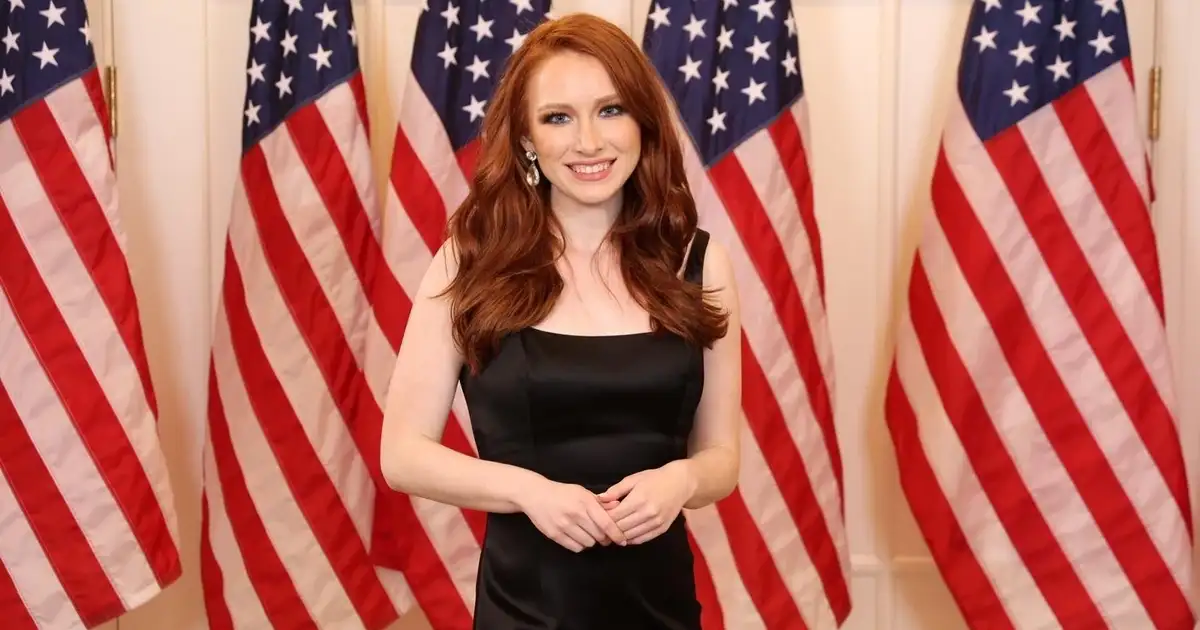

White House Deputy Press Secretary Anna Kelly is exceptionally qualified for her role. The persistent public debate surrounding her isn’t about her policy acumen or strategic communications skills. It’s about her beauty, her brains, and society’s uncomfortable struggle with a woman who dares to possess both.
The latest online firestorm erupted after Kelly’s April 30, 2026, press briefing. While she meticulously detailed crucial new economic development initiatives, the internet, predictably, pivoted. Within hours, the narrative wasn’t about the economy; it was, once again, about her past as a beauty queen, her singing talent, and the utterly irrelevant spectacle of her personal history.

This woman, a key communicator for the White House, holds a rigorous master’s degree in political management. Despite this unassailable academic and professional foundation, the digital echo chamber continues to question her credibility and intelligence. It’s a blatant dismissal of merit, fueled by something far more primitive than logical critique.
The Unrelenting Scrutiny: Why the Doubts Persist
If Anna Kelly’s qualifications are, as they clearly are, beyond reproach, then why do these tiresome doubts relentlessly resurface? This isn’t merely about her past. It’s a symptom of a far deeper, more toxic societal affliction: our collective discomfort with powerful women.
Persistent, deeply ingrained gender bias forms the bedrock of this scrutiny. Women in high-profile political roles endure an intensity of scrutiny their male counterparts simply do not. Their appearance, marital status, and personal choices are dissected, judged, and weaponized.
The media, particularly social media, is complicit. Algorithms amplify sensationalism and feed controversy. Narratives rooted in existing biases thrive in this environment.
Kelly’s journey from the pageant stage to a master’s degree and then to the West Wing is unconventional. This makes her an infuriatingly easy target in a world craving neat narratives. Her unique path directly challenges ingrained biases.
The public, often overwhelmed by a fast-paced news cycle, struggles with nuance. Simplicity sells. A dismissive label – “just a beauty queen” – is easier to digest than a complex assessment.
The White House, understandably, prioritizes policy over personal defense. Their focus is on the intricate machinery of governance, not on battling internet trolls. But this strategic silence inevitably leaves a gaping void in the public narrative.
Brains, Beauty, and the White House Grind
Let me be unequivocal: the facts are blindingly obvious. Anna Kelly is not “just a pretty face.” She possesses an unassailable arsenal of credentials that justify and elevate her role.
Let’s be precise about what that degree signifies. It’s a grueling program, demanding intensive research, critical analysis, and mastery of political theory. This isn’t a participation trophy; it represents countless hours spent in textbooks and debating complex issues.
Day in and day out, as Deputy Press Secretary, Kelly handles a relentless gauntlet of demanding tasks. She is the frontline conduit for crucial administration information, often under hostile fire. She manages intricate, often adversarial, media relations with precision.
Her past life as a beauty queen does not negate her current competence. It adds a fascinating, often underestimated, layer to her professional narrative. It speaks to a breadth of experience, public speaking comfort, and ability to connect with diverse audiences.
“My background has given me a unique perspective on connecting with people, but my education and work ethic are what drive my contributions here. I’m here to serve, not to entertain.”
That quote, delivered with characteristic poise, cuts directly to the heart of the matter. It’s a mic drop, a defiant assertion of self. Kelly isn’t denying her past; she’s owning it.
The Real Fear: A Woman Who Has It All
Let’s strip away the euphemisms and call it what it is: the relentless, obsessive focus on Anna Kelly’s beauty queen past is unadulterated sexism. It’s a visceral societal discomfort that surfaces when a woman dares to possess both formidable intelligence and conventional attractiveness. It’s as if the very existence of one must, by some twisted logic, negate or cancel out the other.
This double standard is a grotesque injustice. Male politicians with unconventional backgrounds often have their past avocations celebrated as ‘diverse experience.’ For a woman, her past involving beauty or performance is immediately weaponized.
This is not an isolated incident. Decades of research demonstrate female public figures face exponentially greater scrutiny. Their appearance, family life, and marital status are dissected, scrutinized, and often weaponized.
The insidious implication is clear, chilling, and utterly destructive: a woman cannot, must not, be both beautiful and brilliant. She cannot be both charming and profoundly capable. This isn’t just a casual judgment; it’s a systemic barrier that actively limits opportunities.
Beyond the Podium: Her Actual Work
What gets drowned out is the undeniable reality of Anna Kelly’s actual job. She isn’t on a stage, bathed in spotlights, or posing for a crown. She is in the White House, deep within the corridors of power, working relentlessly and with profound impact.
Her daily responsibilities are immense. She is the architect of clear, concise communication where every word is scrutinized. She expertly fields tough questions from a demanding press corps.
Her proven ability to consistently perform these demanding tasks is undeniable. It demonstrates her professional competence and unwavering commitment to public service. Yet, this irrefutable proof is constantly overshadowed by superficial discussions about her looks or past.
The debate, if there must be one, should be about policy and performance. It should be about the tangible impact of her work. It should never be about whether a woman’s looks ‘distract’ from her brain.
Photo: Wikimedia Commons (query: Anna Kelly)
Source: Google News