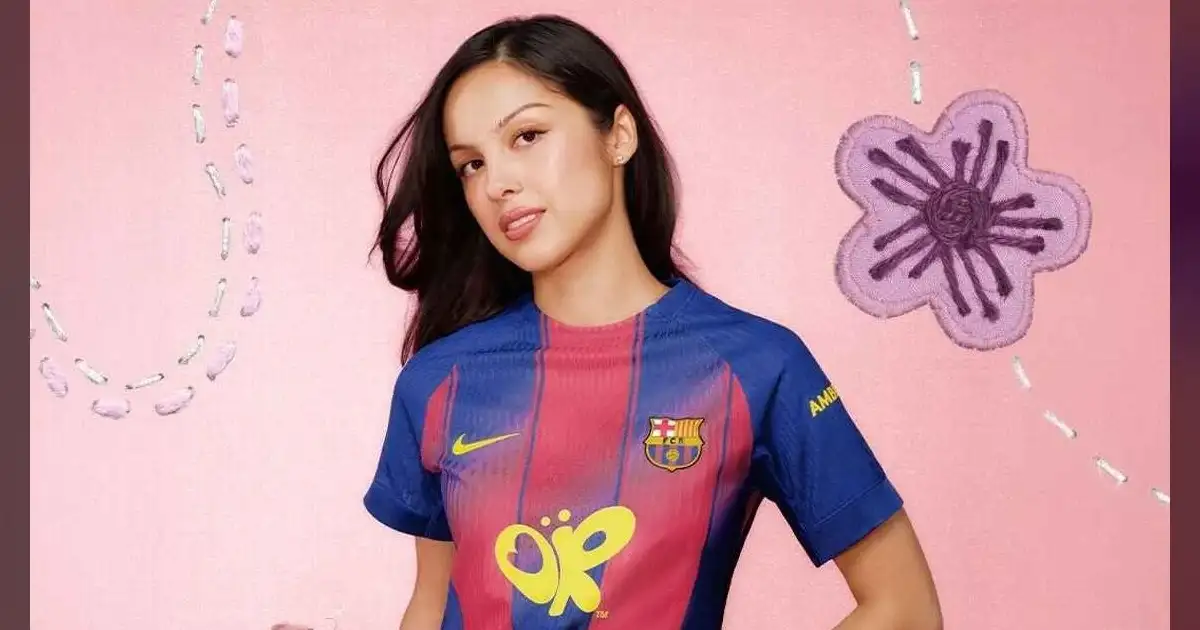

The sacred turf of the Bernabéu on May 4th, a stage usually reserved for footballing gods and gladiatorial clashes, will this year host a spectacle far removed from the beautiful game’s purest traditions. Forget Bellingham versus Lewandowski for a moment; the real headline is Olivia Rodrigo’s “GUTS” logo screaming from the chest of every FC Barcelona player. This isn’t just a jersey; it’s a stark, calculated declaration of where modern football’s soul, or lack thereof, truly lies.
For those still clinging to the romantic, perhaps naive, notion of football as a simple game, FC Barcelona, in lockstep with its main sponsor Spotify, just dropped the news. Rodrigo’s album art will grace the men’s team’s jersey for the biggest fixture in Spanish football.

This isn’t a surprise for anyone paying attention. It’s merely the latest, most audacious iteration of a meticulously engineered machine, following the likes of Drake, Rosalía, and The Rolling Stones.
Rodrigo herself already had a run on the women’s team’s shirt in November 2023. Now, she gets the main stage, a prime-time slot on one of the planet’s most hallowed sporting battlegrounds.
The Spotify Playbook: Not About the Music, It’s About the Millions
Let’s be brutally honest: this isn’t about celebrating musical artistry on the pitch. This is a masterclass in demographic targeting, a ruthless pursuit of market share.
Spotify isn’t just paying to have their name on the shirt; they’re leveraging Barcelona’s colossal global brand. Their goal is to penetrate new markets and capture eyeballs that might not typically tune into La Liga.
They’re buying cultural currency, meticulously curated for maximum impact. Drake brought hip-hop fans, Rosalía tapped into the exploding global Latin pop scene, The Rolling Stones pulled in the classic rock demographic.
Olivia Rodrigo? She brings Gen Z, a demographic notoriously difficult to pin down, engage, and monetize. This is about data points, streaming numbers, and subscription growth, all expertly disguised as a “unique cultural collaboration.” Don’t mistake it for anything less than a corporate power play.
Barcelona, for their part, is more than happy to play along. With financial fair play looming like a dark cloud and the bottom line dictating every strategic move, a sponsor willing to go beyond a static logo is a goldmine.
The limited edition jerseys – let’s not forget the “exclusive signed versions” that will undoubtedly fetch astronomical sums – will fly off the shelves faster than a Vinicius Jr. sprint.
It’s not just about selling tickets to the Camp Nou anymore. It’s about selling merchandise to a global audience, many of whom might only know Barcelona as “that team with the cool shirts.”
Is the erosion of identity worth the extra millions? For Barcelona, the answer is a resounding, financially-driven ‘yes’.
El Clásico: A Global Billboard, Not Just a Battleground
Think about it. El Clásico is one of the most-watched sporting events on the planet, a spectacle that transcends borders and languages.
Historically, it’s been a geopolitical, cultural, and sporting clash of titans, a visceral representation of Spain’s deepest rivalries. Now, it’s also a prime-time commercial slot, a global billboard for the highest bidder.
Does it dilute the rivalry? For anyone who still believes in the soul of the game, the answer is a resounding, tragic yes.
The purists will howl, lamenting the relentless commercialization, the loss of tradition. They hate the idea that a pop star’s album cover could overshadow the sacred crest. But the harsh reality is, those purists are a dwindling, albeit vocal, minority in the grand scheme of global sports marketing.
The players? They’ll wear whatever the club tells them to wear, their minds fixed on the tactical battle, the referee’s whistle, the three points. They are professionals, detached from the marketing circus.
But the club? Ah, the club is playing a different game entirely, a global chess match for brand dominance. Tradition is merely a pawn to be sacrificed.
They are expanding their brand beyond traditional football fans, reaching deep into the lucrative entertainment sphere. It’s a calculated gamble that, so far, has paid off handsomely for both Barcelona and Spotify, proving that today, brand equity often trumps legacy.
Let’s be unequivocally clear. This isn’t some spontaneous, feel-good moment of cultural fusion. This is a cold, hard business transaction.
Spotify, a company constantly battling for market share in the cutthroat streaming wars, is utilizing one of the biggest sporting stages on earth. Their goal is to directly connect with a massive, young, and impressionable audience. They know exactly what they’re doing.
And Barcelona, a club perpetually juggling monumental debt with an insatiable hunger for global dominance, is more than willing to turn its most iconic fixture into a walking, talking billboard for the right price.
The Red Marker Verdict: Chasing the Bag, Every Single Time
The “Red Marker” is simple, undeniable, and etched in the stark reality of modern sports. Anyone who thinks this is primarily about celebrating Olivia Rodrigo’s music or fostering some beautiful synergy between sports and art is missing the plot entirely.
This is about chasing the bag, expanding reach, and acquiring data. It’s a brilliant, ruthless marketing play by Spotify, and a financially savvy, tradition-be-damned decision by FC Barcelona.
This isn’t about ‘GUTS.’ It’s about gutsy business decisions in a cutthroat global market. Barcelona is a brand, El Clásico is a platform, and Spotify is the brilliant puppet master pulling the strings to reach millions of new consumers.
So, the next time you marvel at a dazzling goal in El Clásico, remember the ‘GUTS’ emblazoned on the chest. It’s not just a pop star’s album; it shows the beautiful game’s brutal evolution.
We can lament the loss of innocence, or we can accept the cold, hard truth: in modern football, every sacred space is for sale. The price of tradition is merely a line item on the balance sheet.
What’s next? A TikTok dance challenge at halftime of the Champions League final? Don’t bet against it.
Source: Google News