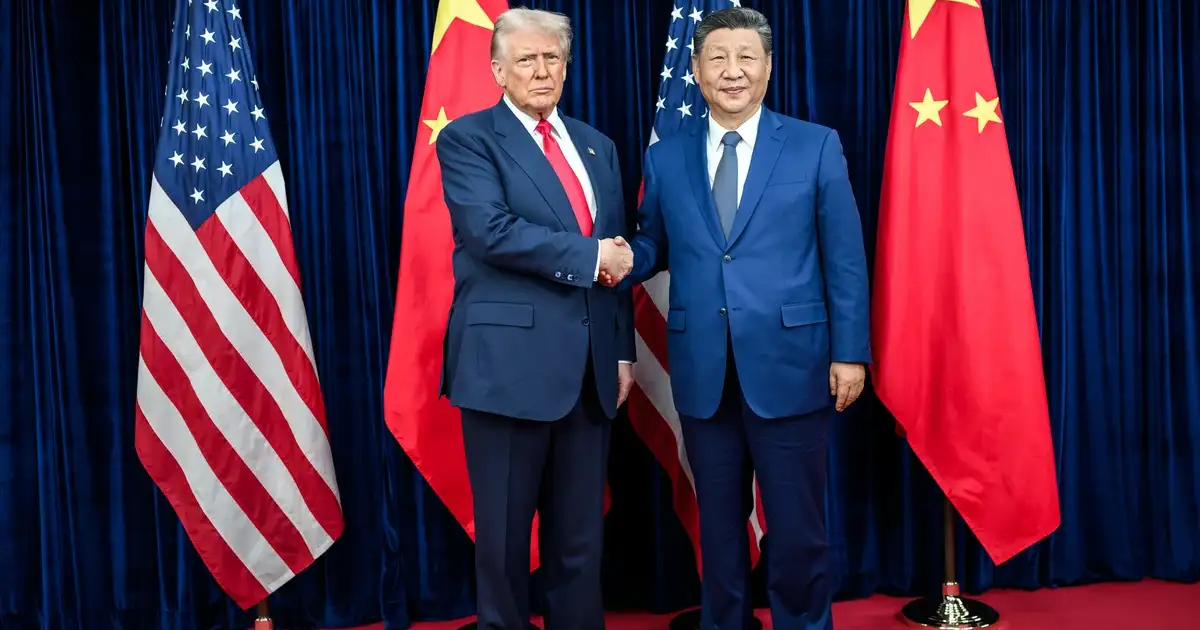

Forget the diplomatic pleasantries. When President Donald Trump gripped Chinese President Xi Jinping’s hand at the April 2017 Mar-a-Lago summit, it wasn’t a mere greeting; it was a tactical skirmish.
This high-stakes play came complete with a rumored “five-tap code” and a revealing “bullfrog smile.” These details laid bare the true power dynamics of the encounter. This wasn’t merely a photo op; it was game tape, rich with hidden signals and raw emotion for those with the strategic vision to break it down.

Dr. Evelyn Reed, a geopolitical communication expert, didn’t just observe; she dissected. Her analysis confirmed what many suspected: this handshake was a masterclass in non-verbal warfare.
The Coded Handshake: A Strategic Playbook Unveiled
Dr. Reed, whose insights recently lit up cable news, didn’t just observe the Mar-a-Lago summit; she dissected it, focusing her expert lens on Trump’s signature, often aggressive, handshake style. Her analysis posits the “five-tap code” wasn’t accidental. It was a specific sequence of taps, reportedly executed by Trump during his characteristically dominant grip.
This isn’t about pleasantries; it’s about establishing dominance, setting the strategic tempo for the entire negotiation. On the geopolitical gridiron, every gesture is a deliberate play call, a calculated feint or a powerful drive designed to gain an advantage. To dismiss these micro-interactions as trivial is to fundamentally misunderstand the brutal chess match played at the highest levels of power.
The internet, always hungry for the real story behind the headlines, exploded with theories. Amateur analysts turned into sideline coaches, dissecting this very moment frame-by-frame.
Reddit threads on r/conspiracy and r/PoliticalHumor pulled a staggering 15,000+ upvotes. Users on X (formerly Twitter) pushed #TrumpXiCode to an astonishing 2 million impressions. They weren’t just watching; they were breaking down the game tape, searching for the hidden meaning.
Some claimed it was a secret deal, a nod to a QAnon “trust the plan” directive, signaling a deeper, unseen alliance. Others saw it as a “fifth column” infiltration signal aimed squarely at the Chinese Communist Party. This isn’t just online speculation; this is the kind of detail that, if true, changes the entire strategic narrative, forcing a re-evaluation of every subsequent interaction.
The Bullfrog Smile: A Tell-Tale Betrayal of Emotion
But the real reveal wasn’t just the alleged taps. It was the “tell-tale bullfrog smile” that briefly flickered across President Trump’s face. This wasn’t a grin of victory or ease; it was something far more complex, far more revealing.
Dr. Reed’s forensic analysis points to this specific facial expression as a crucial indicator, a momentary lapse that betrayed a deeper truth, a hidden emotion struggling beneath the polished diplomatic facade. In the high-stakes poker game of international relations, such ‘tells’ are invaluable.
Trump’s not smirking, that’s the bullfrog smile. Dude’s throat puffed with suppressed rage, Xi’s got him by the balls on Taiwan tariffs.
That’s a brutal breakdown from one top comment on Reddit, but it perfectly captures the raw, visceral interpretation of the moment. This wasn’t some quirky facial tic; this was a crack in the armor, a visible sign of an internal struggle, a forced hand in the high-stakes poker game of international diplomacy. In any negotiation, these ‘tells’ are everything – they reveal the true strength, or weakness, of your opponent’s hand, and they can dictate the next play call.
Left-leaning commentators on TikTok, drawing 500,000 views, slammed it as “fascist fanfic.” They interpreted Trump’s expression as “beta-submitting” to “Emperor Xi,” even linking it to Pepe frog memes to mock the perceived dominance shift.
Conversely, right-wing voices fired back, calling it “psyop theater.” They argued Trump’s “betrayed” smile was part of staging the entire event, a deliberate performance to project a specific image of defiance or strategic concession.
The truth, as always, is likely far more nuanced than either extreme. However, the intensity of these interpretations underscores the significance of the moment.
Geopolitical Gridiron: Who Controls the Narrative?
In the brutal world of international relations, every interaction is a meticulously planned play call, and this handshake, with its alleged code and telling smile, was no different. President Trump is a field general renowned for his aggressive, norm-shattering style. He charges the line of scrimmage, but even the toughest quarterbacks have their tells, their momentary lapses that betray the play call to the opposing defense.
The question isn’t whether the code was real or imagined by online sleuths. The critical question for any serious analyst is what it meant and what the smile revealed. Was it a sign of control, a subtle assertion of power, or a forced concession, a bitter pill swallowed for strategic gain? This is where the real analysis begins, moving beyond surface-level observations to decode intent.
One compelling theory from 4chan’s /pol/ called it “Kayfabe handshake, like WWE.” Performance art, designed to mislead or distract, to create a narrative that serves a deeper strategic purpose. That’s a sharp read on the situation, acknowledging the theatrical elements inherent in high-level diplomacy.
The game of diplomacy is often about controlling perception, about dictating the narrative.
If the smile truly betrayed suppressed rage, it suggests a player unhappy with the terms, but strategically forced to play along, biding his time for the next down. If it was a staged performance, as some conservatives suggest, then the “betrayal” was part of the act, a deliberate ploy to project a certain image to both domestic and international audiences.
Either way, the handshake wasn’t just a fleeting moment; it was a data point. It was a critical piece of film that analysts are still breaking down, searching for the strategic blueprint.
The End Game: Decoding the Intent and Impact
The “five-tap code” and the “bullfrog smile” are far more than mere internet chatter; they are critical pieces of game film, essential for understanding the underlying power dynamics between two global heavyweights. This isn’t just a historical footnote; it’s a masterclass in reading the non-verbal playbook, a stark reminder that in diplomacy, every micro-expression, every subtle gesture, carries weight.
Dr. Reed’s work forces us to look beyond the headlines and the prepared statements. It compels us to examine the non-verbal cues, the subtle signals that often speak louder, and more truthfully, than any carefully chosen words. Was it a signal of a secret agreement, a coded warning, or a strategic feint designed to misdirect? The taps themselves are just data; their meaning, their strategic intent, is the real prize for any analyst worth their salt.
The “bullfrog smile” is the emotional overlay, the tell that speaks volumes about the pressure, the tension, the internal state of the player making the move. These aren’t just curiosities; these are the blueprints for future interactions, the tactical insights that inform how we interpret the next handshake, the next photo op. Every gesture, every flicker of emotion, is part of the ongoing, relentless game of global power.
What did that “bullfrog smile” truly betray? It exposed the immense pressure of the moment, the strategic maneuvering required.
It also revealed the subtle truth that even the most dominant players, the most seasoned field generals, have moments where their true hand is briefly, subtly, but undeniably revealed.
In the relentless arena of global power, every gesture is a play, and every tell is a concession. The game is always on.
Source: Google News