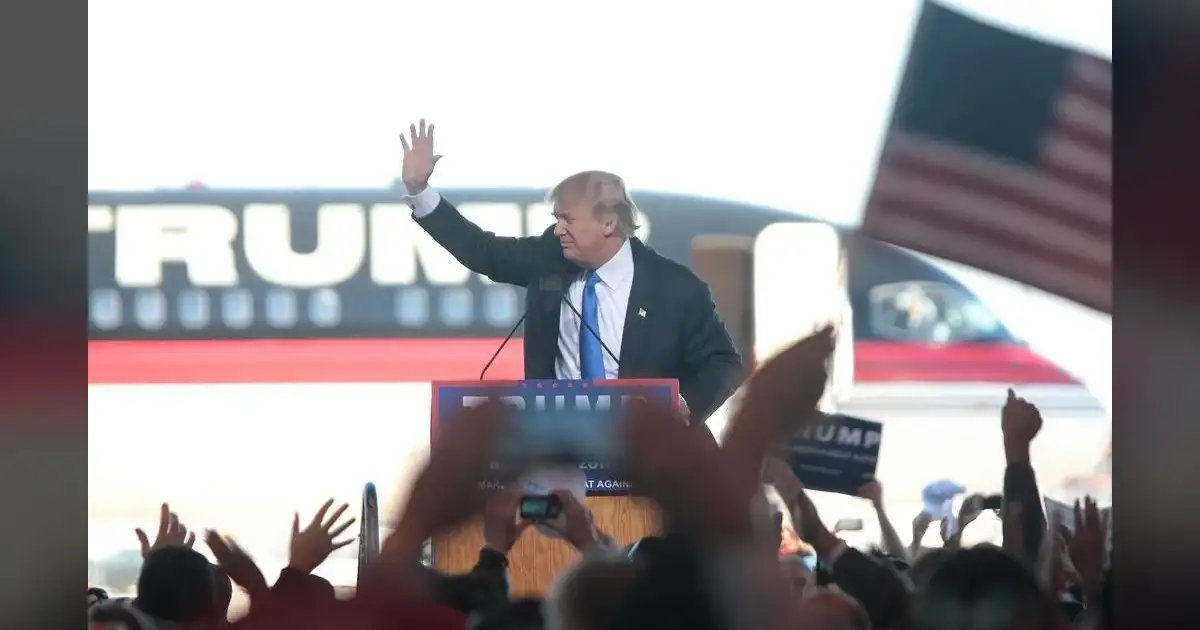

When President Donald Trump abruptly scraps a golf outing, citing vague ‘government circumstances’ while critical Iran talks implode, it’s not a mere schedule adjustment. It’s the klaxon blaring across Washington, a chilling signal that an already volatile global stage is teetering on the brink of outright catastrophe. Forget the polite diplomatic euphemisms; the war drum is beating louder, and the silence from the White House is deafening.
Sources embedded deep within the administration didn’t just ‘confirm’ the last-minute decision; they whispered of an Oval Office in lockdown, a frantic scramble behind the gilded doors. The official line remains “unspecified government circumstances,” a convenient smokescreen for what everyone knows is a crisis.

The President, a man whose routines are as predictable as the sunrise, was pulled from the brink of the green, not by choice, but by necessity. This wasn’t a casual change of plans; it was an emergency recall, a stark admission that the situation has reached a critical, unmanageable point.
This seismic shift occurred within a frantic 48-72 hour window, a period that saw diplomatic efforts with Iran not just falter, but utterly collapse. The official details, naturally, remain shrouded in the impenetrable fog of national security. But make no mistake: what’s clear is not just a ‘breakdown,’ but a catastrophic implosion of any pretense of peaceful resolution, leaving only the grim specter of military action.
The War Nobody Dares Name
Let’s cut through the officialese and be brutally frank: the United States and Israel aren’t merely ‘involved’ in a regional spat. They launched decisive military strikes against Iran on February 28, 2026, initiating an ongoing, undeclared armed conflict.
The Strait of Hormuz isn’t just a ‘major flashpoint’; it’s a powder keg, a choke point for global energy, and a constant stage for brinkmanship. When the White House murmurs that “Iran talks unravel,” understand this: it means the war talks are failing, the last threads of de-escalation snapping under immense pressure.
This isn’t some academic exercise in distant Geneva or Vienna. This is about a hot, active conflict, a war that has already drawn blood and rattled global markets.
The President of the United States, a man who famously prioritizes his leisure, doesn’t cancel golf for “government circumstances” during wartime unless the wolves are truly at the door. This isn’t just a ‘stark signal’; it’s a blaring siren, pointing unequivocally towards a significant, perhaps unavoidable, escalation. We are past mere routine diplomacy; we are at a critical juncture, a precipice from which there may be no return.
And who, precisely, is footing the bill for this increasingly costly venture? The average American taxpayer, of course.
Every F-35 sortie screaming across the Gulf, every carrier strike group deployment, every clandestine intelligence operation costs not just millions, but billions. When diplomatic channels fail, the meter doesn’t just tick up; it explodes.
The stakes aren’t merely ‘getting higher’; they are reaching existential levels, and yet, the public remains deliberately, shamefully, in the dark. It’s a national tragedy unfolding behind a veil of official secrecy.
Washington’s Shadow Play and Profiteers
Washington, the capital of coded language and hidden agendas, thrives on its secrets. The White House, predictably, offers its vague “circumstances,” a convenient linguistic fog designed to obscure, not clarify.
This deliberate ambiguity isn’t just about managing public perception; it’s a calculated move to allow powerful players – the deep state, the military-industrial complex, the unelected power brokers – to operate entirely without scrutiny, pulling strings from the shadows, shaping policy without accountability.
The cynical question, of course, is ‘Cui bono?’ Who truly benefits when these “unraveling” talks finally snap? The answer is as predictable as it is infuriating: the defense contractors, whose stock prices invariably surge with the scent of increased conflict.
The well-funded lobbyists for hawkish think tanks, those architects of perpetual war, are undoubtedly already clinking champagne glasses, celebrating their latest triumph over diplomacy. It’s a macabre dance of profit and power, played out on the global stage.
This is the grim, unvarnished truth of how the D.C. swamp operates. For the privileged few, crisis isn’t a threat; it’s an opportunity, a lucrative springboard for power and profit. For the vast majority of Americans, it simply breeds fear, uncertainty, and the gnawing dread of what fresh hell Washington will unleash next.
“The President’s abrupt change of plans signals that something truly urgent is happening behind closed doors,” a senior aide, speaking anonymously, reportedly stated. “This is not a minor diplomatic setback.”
This suffocating lack of transparency isn’t an oversight; it’s standard operating procedure for an administration that prefers its citizens remain docile and uninformed. It leaves ordinary Americans not just ‘wondering,’ but deeply suspicious of what their government is truly planning, what dark deals are being struck, and what the true, horrifying cost will be – not just in the untold billions of taxpayer dollars, but in the precious, irreplaceable lives of their sons and daughters.
“Unraveling” is a Euphemism for Catastrophe
When the State Department uses the delicate euphemism “unraveling” to describe the Iran talks, understand that it’s a polite, almost criminal, understatement for a complete collapse of negotiations. In the brutal reality of an ongoing war, this isn’t merely ‘dangerous’; it’s catastrophic.
It means the diplomatic off-ramp, however narrow, is not just closing, but slamming shut. It means the military option, once a last resort, is now the only visible, viable path being considered by the hawkish architects of this conflict.
The US-Iran War 2026, a conflict barely acknowledged by polite society, has already claimed an unconscionable toll in lives, both military and civilian. It has destabilized global energy markets, sending shockwaves through economies worldwide, and strained alliances to their breaking point. A complete, unequivocal breakdown in talks isn’t just a setback; it’s an explicit declaration that the administration is doubling down on military force, consequences be damned, and the world be warned.
A President’s personal schedule is typically the fodder of gossip columns, a minor detail in the grand scheme. But when that schedule is violently ripped apart for “government circumstances” during an active war, it transforms into a flashing red indicator, a definitive barometer of crisis.
It doesn’t just ‘tell us’ the situation is dire; it screams it from the rooftops. It reveals the immense, suffocating pressure cooker that is the White House, where decisions of war and peace are made under the heaviest of burdens.
The American public doesn’t just ‘deserve’ to know the specifics; they demand it. They have an inalienable right to understand the true nature of these “government circumstances,” the precise threats and strategic calculations that dictate their nation’s fate.
They are the ones who pay the taxes, the ones who send their sons and daughters to fight and die. Their right to full, unvarnished disclosure is not negotiable; it is a fundamental pillar of a functioning democracy, a pillar Washington is actively dismantling.
The Real Price of Washington’s Indecision
Every single decision, every whispered word,
Source: Google News