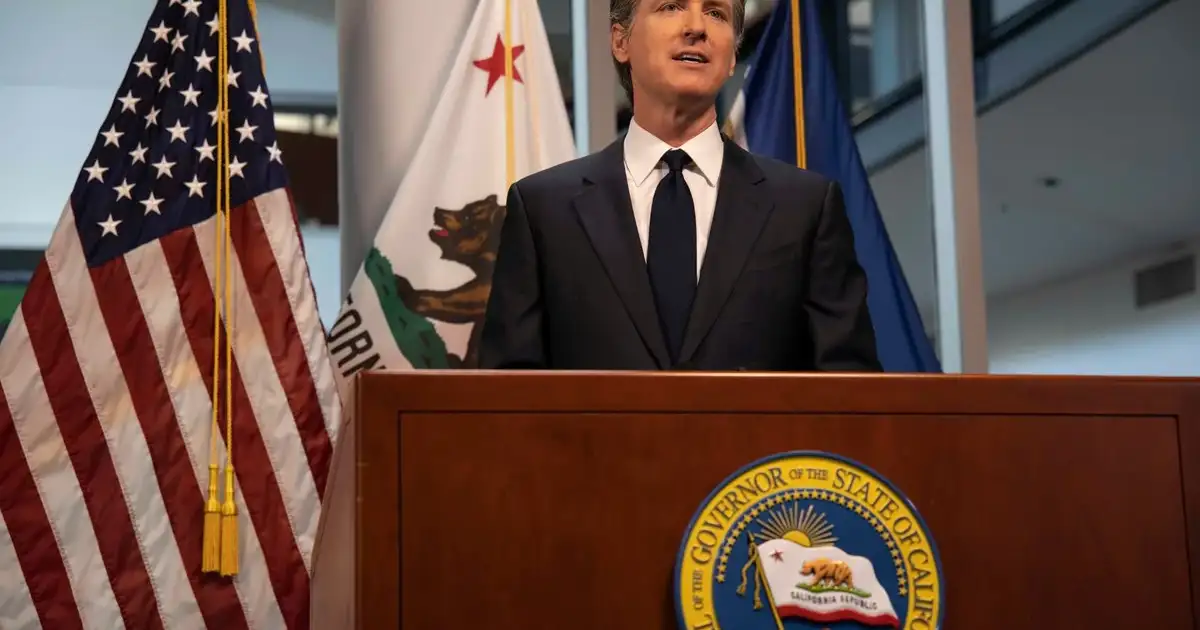

In a move that drips with unbridled hubris, California Governor Gavin Newsom has cemented his reputation for tone-deaf extravagance, confirming plans for a $33,000 taxpayer-funded portrait of himself. This isn’t merely an expense; it’s a stark, gilded monument to political vanity, paid for by a populace grappling with unprecedented economic anxieties.
The governor’s office, with characteristic political deftness, announced the costly commission on May 25, 2026. It is destined for the hallowed halls of the State Capitol building, a long-standing tradition for governors. Yet, in an era defined by fiscal strain and public skepticism, the sheer audacity of the price tag has ignited an inferno of outrage that even Sacramento’s seasoned spin doctors will struggle to extinguish.

The Price of Pomp: Newsom’s Self-Indulgence on Display
Thirty-three thousand dollars. This is the confirmed amount for Newsom’s official likeness, covering the artist’s fee, materials, elaborate framing, and installation. This isn’t a minor line item; it’s a significant outlay.
It stands against the daily grind of Californians struggling with soaring living costs, relentless inflation, and a state budget perpetually teetering on deficit. Is this truly the most pressing use of public funds?
The backlash from Republican lawmakers and frustrated taxpayer advocacy groups has been swift and brutal. They rightly condemn the expense as not just excessive, but as a glaring emblem of political vanity, a profound disconnect from the financial realities crushing ordinary citizens. For many, it’s less about art and more about arrogance.
“This is vanity unbound, pure and simple,” one exasperated critic, speaking to the Washington Post, sharply declared. “Our state is drowning in real problems – a housing crisis, rampant homelessness, a looming budget shortfall. To spend $33,000 on a painting of oneself, while people choose between groceries and rent, is not just an expense; it’s an outright insult to every hardworking Californian.”
Newsom’s administration, ever adept at political deflection, attempts to contextualize the cost by pointing to historical precedent. Governor Jerry Brown’s portrait, commissioned in 2017, cost $25,000.
Adjusted for inflation, that figure hovers around $31,000-$32,000 today. Newsom’s office argues this makes the current expenditure “consistent,” a quaint nod to preserving history and artistic legacy.
But consistency, especially in profligacy, does not equate to necessity. When the state faces a potential multi-billion-dollar budget deficit, every discretionary dollar becomes a moral question, not just an accounting entry.
The true scandal here extends beyond the mere dollar amount; it’s the utterly tone-deaf timing of the announcement. With California’s budget facing ongoing scrutiny and potential shortfalls, any spending perceived as non-essential instantly becomes a flashpoint.
This portrait isn’t just a piece of art. It’s a stark, infuriating reminder of where the priorities of the ruling elite truly lie, often miles removed from the bread-and-butter concerns of their constituents.
Newsom’s Thin Defense Crumbles Under Scrutiny
Newsom’s team trots out the familiar playbook: “standard practice,” an “investment in public art,” “historical documentation,” and the predictable accusation that critics are merely “politically motivated.” This is the well-worn political spin, designed to obscure rather than address the fundamental issue. It’s a rhetorical smokescreen that fails to engage with the public’s legitimate anger.
The core issue isn’t about art appreciation; it’s about leadership. It’s about a governor’s capacity to understand the public mood, to exercise fiscal prudence, and to allocate precious resources wisely.
A governor’s lasting legacy is forged in policy achievements, in tangible improvements to people’s lives, not in the brushstrokes of a commissioned portrait. It is built on solving systemic problems, on lifting up communities, not on the self-aggrandizement of a painted likeness.
While the art community might indeed advocate for fair compensation for artists and view such commissions as standard, the average Californian isn’t an art critic. They are taxpayers.
They are parents balancing household budgets, workers facing stagnant wages, and renters struggling with exorbitant housing costs. From their vantage point, this isn’t an artistic investment; it’s an unnecessary, even offensive, extravagance.
The chasm between the elite’s perception of “public art” and the public’s demand for basic services could not be wider.
The real motivation here is disarmingly simple: image, ego, and the relentless desire to solidify one’s place in history. Every politician yearns for remembrance, to leave an indelible mark.
But at what precise cost to the very people they swore an oath to serve? Is this the indelible mark Newsom truly wishes to leave?
Who Bears the Cost, Who Reaps the Reward?
The answer to this question is unequivocally clear: California taxpayers are footing the entire $33,000 bill. The still-unnamed artist will profit handsomely. The framing company will profit.
Most significantly, Newsom’s carefully curated image will profit, his legacy quite literally painted into the annals of history, all courtesy of the public dime. It’s a transaction where the public pays, and the political establishment benefits.
This scenario is a textbook example of the ingrained “Sacramento mentality,” a provincial echo of the infamous Washington D.C. elite. Here, the powerful few unilaterally decide what constitutes “important” public expenditure, often pouring public money into projects that primarily serve their own glorification or perpetuate their image. Meanwhile, ordinary citizens outside the Capitol’s gilded cage continue their daily struggle to keep a roof over their heads, to afford healthcare, or simply to fill their gas tanks.
Imagine the tangible good that $33,000 could accomplish. It could fund a vital small community program. It could provide temporary shelter and support for dozens of homeless individuals.
It could alleviate minor, yet critical, budget pressures in a struggling school district. Instead, it purchases a picture – a picture of the very man who authorized its purchase, a self-congratulatory gesture in a time of widespread need.
This isn’t about fostering culture or supporting the arts. It is, at its cynical core, about power. It is about perception.
It is about a leader who appears to have fundamentally forgotten the financial realities of his constituents, who has seemingly abandoned any pretense of fiscal responsibility in favor of personal pomp. It’s a stark reminder that some politicians, once
Source: Google News