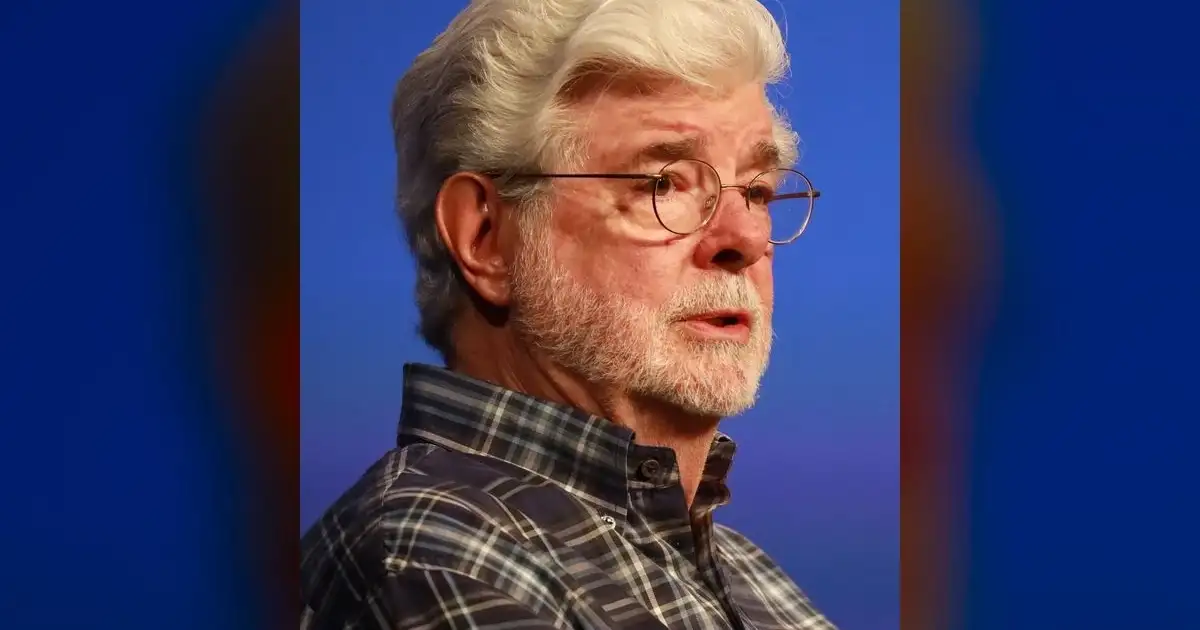

Forget the latest blockbuster; Hollywood just got hit with a seismic shift, and it wasn’t from a meteor shower. It was from George Lucas, the legendary architect of Star Wars, who just delivered a tactical masterclass on the future of film. His message? AI isn’t just a new tool; it’s a “paradigm shift far greater than the advent of CGI,” a direct challenge to an industry that, frankly, looks like it’s fumbling on the one-yard line.
Lucas addressed the Directors Guild of America (DGA) on , and his words weren’t a mere caution; they were a thunderclap. He didn’t mince words about AI’s double-edged nature: a powerful creative instrument capable of unlocking unimaginable frontiers, or a relentless destroyer of human artistry and livelihoods. “We stand at a precipice,” he declared, and the tremor of that statement should be rattling every studio executive and guild leader from Burbank to Beijing.

His stark warning hit with the force of a blindside tackle. Hollywood isn’t just wrestling with AI’s role; it’s grappling in the dark, trying to tackle a ghost that’s already sprinted past the goal line. Guilds and studios are locked in a desperate scramble to future-proof contracts, but the technology is evolving faster than anyone can keep up. It’s a game of catch-up where the rules are rewritten every quarter, and Hollywood is consistently behind the play.
The Lucas Playbook: A Digital Pioneer’s Urgent Warning
This isn’t Lucas’s first rodeo with technological disruption. This is the man who didn’t just witness the future; he built it. He revolutionized visual effects with CGI, transforming filmmaking forever through his pioneering company, Industrial Light & Magic (ILM). The Star Wars prequels, for all their divisive reception, were a raw demonstration of CGI’s power, pushing boundaries even as they drew criticism for their heavy reliance on digital sets.
So, when Lucas speaks about technology, the industry ought to listen with the intensity of a defensive coordinator studying game film. He has seen the future before, and he helped forge it. Now, he’s sounding a loud, unambiguous alarm. This isn’t a mere change of heart; it’s a deeper, more profound understanding of technology’s true cost and its potential to corrupt the very essence of storytelling.
He understands the intoxicating power of these tools. He also understands their insidious potential. Lucas warned that AI could become “the machine that tells the stories for us.” Such a future, he argued, would strip away “the very soul of our craft.” This isn’t just about efficiency or profit margins; it’s about the fundamental human connection that makes art, art. When a visionary like Lucas, a man who has always embraced innovation, issues such a dire warning, it’s time to stop admiring the technology and start fearing its unchecked trajectory.
Hollywood’s Fragmented Playbook: A Recipe for Disaster
Let’s cut to the chase: Is Hollywood truly ready for this disruption? The answer is a resounding, unequivocal “no.” The industry isn’t just playing catch-up; it’s actively losing ground, like a team running separate plays on every down, with no unified strategy and no clear leader calling the shots.
There is no cohesive plan for AI. Major studios are developing their own proprietary tools, their own isolated strategies, creating a patchwork of approaches that is more chaotic scramble than disciplined offensive drive. Does anyone seriously believe this scattershot approach will lead to victory? It’s a mess, a recipe for internal conflict and external vulnerability, not a cohesive, forward-thinking strategy.
The WGA and SAG-AFTRA are still locked in arduous negotiations over AI clauses, with many interim agreements set to expire soon. These aren’t just expiring contracts; they’re ticking time bombs, demanding immediate, aggressive re-evaluation to prevent a catastrophic breakdown. This protracted negotiation reveals a deep, systemic lack of long-term protections for the creative workforce. The game clock is running down, and Hollywood’s still huddling, seemingly unaware of the urgency.
The pace of AI development is relentless, a blitzkrieg of innovation that leaves legal frameworks and ethical guidelines choking in its dust. New capabilities emerge almost weekly, rendering yesterday’s protections obsolete. How can an industry build a robust defense when the offense keeps changing its formation mid-play?
Billions Invested, Ethics Ignored: A Dangerous Game
While the industry dithers on strategy, studios and tech companies are pouring money into AI with reckless abandon. A recent Motion Picture Association (MPA) report starkly illustrated this imbalance: investments in entertainment AI grew by a staggering 35% in 2025, reaching an estimated $2.8 billion globally. That’s a massive war chest, but where’s the corresponding investment in defense?
This massive spending isn’t matched by anything resembling robust ethical planning or comprehensive workforce development. There’s no comparable investment in robust frameworks to protect human creators. Job retraining programs for those displaced by automation are conspicuously absent. Compensation models for workers whose creative output might be used to train AI are nowhere in sight. It’s an aggressive offensive push with no thought given to the collateral damage.
Industry analysts project AI could automate up to 30% of routine post-production tasks within just five years. This isn’t a hypothetical threat; it’s a looming reality that threatens thousands of jobs. Editors, VFX artists, sound designers – entire creative departments face an uncertain future, their livelihoods potentially sacrificed at the altar of efficiency. This isn’t just about numbers; it’s about people, families, and the erosion of an entire creative class.
Unions, understandably, are sounding their own alarms. Sarah Jenkins, President of the Writers Guild of America (WGA), didn’t pull any punches:
Mr. Lucas’s words underscore what we’ve been saying for years. The creative spark is human, and we must ensure AI serves that spark, not extinguishes it. Our current negotiations prioritize robust protections for writers against AI exploitation. We are fighting to ensure that human creativity remains the foundation of all storytelling, not merely a data point for an algorithm.
Meanwhile, studio executives, ever focused on the bottom line, see nothing but opportunity. Michael Chen, CEO of OmniCorp Studios, offered a predictably different perspective:
We welcome George Lucas’s insights. AI is a tool, and like any tool, its impact depends on how it’s wielded. We believe in leveraging AI to empower our artists and streamline production, ultimately bringing more diverse stories to screens faster and more efficiently. We are committed to responsible innovation that enhances, rather than replaces, human talent.
This isn’t just a debate; it’s a clash of titans, a fundamental philosophical battle for the soul of an industry. One side sees progress and profit; the other sees peril and artistic extinction. Hollywood stands at a crossroads, and the path it chooses will define not just its future, but the very nature of human storytelling.
The Future of Storytelling: A Bellwether Moment for Humanity
Why should ordinary people care about this high-stakes drama unfolding in Hollywood? Because AI’s impact on this industry affects everyone, whether they realize it or not. It dictates the content we consume, shapes the quality and authenticity of our narratives, and ultimately defines the future of creative work across the globe. This isn’t merely an industry problem; it’s a societal one.
If AI leads to algorithm-driven narratives, churning out bland, focus-grouped content designed for maximum engagement rather than genuine artistic expression, then art will suffer immeasurably. The unique human perspective, with all its flaws, biases, and brilliance, is what makes stories compelling, resonant, and truly transformative. That irreplaceable element could be lost forever. Conversely, if harnessed ethically, AI could unlock new visual spectacles, offer fresh storytelling techniques, and democratize access to creation in ways we can only begin to imagine.
Hollywood often serves as the bellwether for tech adoption, and its struggles mirror broader concerns about AI’s role in the global workforce. This debate is a microcosm of a much larger challenge facing creative industries everywhere, from journalism to music, from fine art to architecture. The world is watching to see if Hollywood can navigate this treacherous terrain without losing its way.
Lucas has thrown down the gauntlet. The game is on, and Hollywood is staring down a fourth-and-long with the clock winding down. This isn’t just about protecting jobs; it’s about preserving the very essence of human creativity, the spark that ignites our imagination and connects us through shared narratives. The industry must huddle up, forge a unified, ethical strategy, and execute with precision and conviction. Fail to do so, and it won’t just lose its soul to the machine; it’ll lose the game entirely, forever. The time for indecision is over. The whistle has blown.
Source: Google News