
The gilded gates of Florida’s exclusive “Hamptons of the South” aren’t merely slamming shut on Russell Brand; they’re actively ejecting him from their polished, insular world. The wealthy, devout Christians who populate these opulent enclaves are not just turning on their new neighbor; they are actively disavowing him, finding his public beach baptisms and zealous embrace of MAGA ideology anathema to their carefully curated image and discreet faith.
Brand’s very public transformation from a rebellious, counter-cultural icon to a fervent evangelical Christian and unapologetic MAGA adherent has not just caused a stir; it has ignited a full-blown culture war within the most privileged echelons of conservative society. This isn’t merely a personal journey; it’s a spectacle, a challenge to the unspoken rules of decorum and the delicate social ecosystem that defines their world.
Once known for his provocative antics and anti-establishment rhetoric, Brand now preaches a gospel of redemption and political conviction, baptizing followers in the ocean with the fervor of a revivalist preacher. This is a far cry from the quiet, discreet, often transactional faith practiced by the wealthy elite, where spiritual belief is often a social accessory, not a public declaration.
The Unspoken Rules of Paradise: Faith and Status
The “Hamptons of the South” is a realm defined by old money, meticulously manicured lawns, and exclusive private clubs where social standing is paramount. Here, faith is typically a private affair, a heritage, or a quiet commitment, often intertwined with charitable giving and maintaining a respectable public profile. It’s a social tradition, not a theatrical performance for the masses.
Brand’s brand of Christianity, however, is anything but private. He broadcasts his baptisms across social media, openly discusses his newfound beliefs in unvarnished terms, and engages directly with a populist audience that the elite often view with disdain. This unfiltered, raw approach doesn’t just rattle the established order; it actively undermines the very notion of dignified, controlled piety they uphold. It’s a direct assault on their carefully constructed image of what a “respectable” Christian looks like.
These affluent Christians aren’t just wealthy; they often represent a specific, traditional strain of conservatism. This strain values order, tradition, and a certain intellectual distance from the more fervent, populist elements of the MAGA movement. Their faith is intrinsically intertwined with their social standing and their perception of themselves as custodians of a refined cultural ideal.
Russell Brand, with his boisterous enthusiasm and unpolished delivery, challenges that unspoken decorum at every turn. He is, to put it bluntly, too loud, too direct, and far too authentic for their comfort.
Brand’s well-documented past—a history replete with controversy, addiction, and hedonistic exploits—casts a long shadow. His transformation, while perhaps genuine, is viewed with profound skepticism. Many within these circles find it nearly impossible to reconcile his former persona with his current evangelism.
The elite prefer their converts to arrive quietly, cleansed of their past, and ready to assimilate into a pre-defined mold of respectability. Brand, however, refuses to fit; he is loud, proud, and unapologetically himself, carrying his past as part of his narrative, not something to be hidden away.
MAGA’s Uncouth Ambassador: A Bridge Too Far for the Gilded Class
Brand’s alignment with the MAGA movement further complicates his acceptance, proving to be a bridge too far for many in the “Hamptons of the South.” Donald Trump’s base is undeniably diverse, encompassing a significant portion of working-class Americans and a robust segment of evangelical Christians. Yet, the affluent conservative establishment operates differently.
While they may support Trump politically, often for fiscal or judicial reasons, they typically do so from a calculated distance, preferring their politics sanitized, intellectualized, and devoid of overt populism.
Russell Brand, on the other hand, embodies a raw, populist energy that is anathema to their sensibilities. He speaks directly to the people, often in language considered vulgar or unsophisticated by those accustomed to more refined discourse. This directness, this unvarnished appeal, disrupts the delicate balance of their social ecosystem, exposing the uncomfortable truth that the MAGA movement, at its core, is not always perfectly polished or intellectually pristine. It is often rough around the edges, driven by emotion and a sense of shared grievance, qualities the elite prefer to keep at arm’s length.
The whispers among the wealthy are not subtle: Brand is a curiosity, perhaps even an interesting spectacle, but he is emphatically not “one of them.” His conversion may be seen as legitimate by some, but his style, his public persona, and his embrace of the more boisterous elements of the populist right are simply too much to handle.
They see his beach baptisms not as profound spiritual acts but as performance art, designed for maximum social media impact. His MAGA talks are dismissed as rabble-rousing, lacking the gravitas and intellectual rigor they expect from public figures. This is not the quiet, dignified path they envision for a truly reformed individual; it is a challenge to their control over what constitutes acceptable public discourse and spiritual expression.
As one prominent Republican donor, speaking anonymously to Reuters, quipped, “We appreciate the enthusiasm, but one prefers their spiritual awakenings to be less… televised. And perhaps a bit more private. It’s simply not how things are done in these circles.”
The Stiff Price of Disruption in Paradise
What does this “turning on” actually mean for Russell Brand in practical terms? It translates into a very specific form of social exclusion, a quiet but potent ostracism. It means being conspicuously uninvited to the exclusive charity galas and private dinner parties where real power is brokered and social bonds are forged.
It means quiet snubs at the country club, veiled disdain at the yacht club, and being subtly overlooked in their tightly knit, influential circles. For this demographic, social capital is currency, and Brand is being cut off from the bank.
These communities thrive on conformity, on a shared understanding of values, appearances, and an unspoken code of conduct. Brand, by his very nature and his chosen path, shatters that illusion of homogeneity. He introduces an element of unpredictability and a stark reminder of the cultural divisions that even wealth cannot fully erase. The consequences are not financial ruin, but social isolation within a world where social connections are paramount.
His financial motives are also a constant subject of whispered speculation. Critics, particularly those from the established media, openly question his true intentions. Is this a genuine spiritual awakening, a profound personal transformation?
Or is it a savvy pivot for a new audience, a calculated move to rebuild a career tarnished by past controversies and accusations, leveraging the burgeoning market of conservative media and evangelical outreach? For the cynical, politically astute insiders, the latter is often the default assumption, reflecting the transactional nature they often perceive in public figures.
The established figures in these communities guard their influence and social capital fiercely. Brand’s arrival, with his disruptive energy and unconventional appeal, is not merely seen as an inconvenience; it’s perceived as an invasion, a threat to their carefully constructed world of order and control. This isn’t about deep theological debate or philosophical differences. It’s fundamentally about social hierarchy, about who gets to be “in” and who remains “out.” Russell Brand, despite his newfound faith and political alignment, remains very much “out” of their inner sanctum.
He is a new neighbor who simply doesn’t understand, or perhaps deliberately disregards, his place. He doesn’t play by their unspoken rules, and this makes him a pariah in paradise, an outsider looking into a world that values tradition and discretion above all else. His very presence forces them to confront the uncomfortable reality that their carefully constructed world is not impervious to the raw, populist forces reshaping modern conservatism.
Brand’s Unconventional Path: A Mirror to Modern Conservatism
Russell Brand will undoubtedly continue his current trajectory, leaning into his populist appeal and embracing his role as an outsider. This very rejection from the gilded elite only serves to strengthen his narrative, reinforcing his image as a champion of the common person against the entrenched establishment. It’s a potent political tool, and Brand, ever the showman, understands how to wield it.
His primary audience is decidedly not the “Hamptons of the South” elite. His true base lies within the broader MAGA movement and the evangelical community, groups that actively welcome his raw authenticity, his passionate declarations, and his willingness to challenge perceived orthodoxies. They see in him a relatable figure, a prodigal son who has found faith and a cause, and they embrace him precisely for the qualities that alienate the coastal elites.
The rich Christians, for their part, will maintain their quiet disapproval, their polite distance, and their social exclusion. This is how the establishment has always dealt with threats to its equilibrium: by pretending they don’t exist, by rendering them invisible within their carefully curated social sphere. It’s a powerful, if subtle, form of social control.
Brand’s transformation, therefore, serves as a powerful mirror, reflecting the profound, often uncomfortable divisions within conservatism itself. It highlights the chasm between the old guard—the traditional, often aristocratic, conservative establishment—and the new populism, with its fervent, often unpolished, grassroots energy. It’s a clash between quiet faith and public spectacle, between intellectualized policy and visceral emotion.
The real question is not whether Brand fits into their world, but whether he cares to. His path seems to be forging a new, independent way, one that deliberately embraces the very people and principles that unnerve and scare the traditional elite. This is the inherent price of being truly unconventional, the cost of disrupting the comfortable, predictable narratives of power.
Russell Brand may have found God and MAGA, but he will never find true acceptance in their gilded cages. And perhaps, for a man who built a career on rebellion, that’s precisely the point.
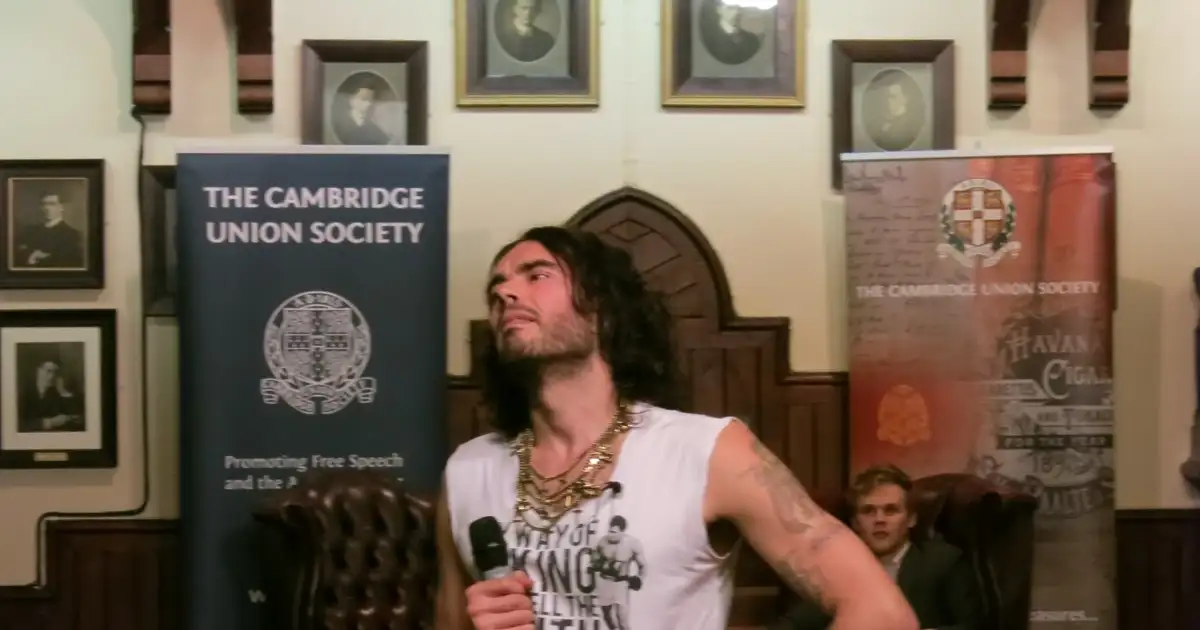
Photo: Wikimedia Commons (query: Russell Brand)
Source: Google News