
General Motors just executed one of the most brutal plays in modern industrial history. They confirmed replacing over 1,000 dedicated workers with a mere 50 robots at their flagship Detroit-Hamtramck Assembly plant.
This isn’t just a corporate maneuver; it’s a gut punch to the American workforce. The United Auto Workers (UAW) is rightfully incensed, blasting this move as a profound betrayal of the very people who built GM’s legacy.

This isn’t merely about optimizing a production line; it’s about a company choosing cold steel and circuits over the flesh-and-blood men and women whose sweat and skill defined an era. Any coach knows you can’t win without your best players, and GM’s strategy here has benched a thousand of them, potentially for good.
The GM Game Plan: An Automation Blitzkrieg
GM’s decisive, some would say ruthless, move came down hard on June 22, 2026. Over 1,000 jobs in assembly and material handling were immediately eliminated, vanishing from the factory floor.
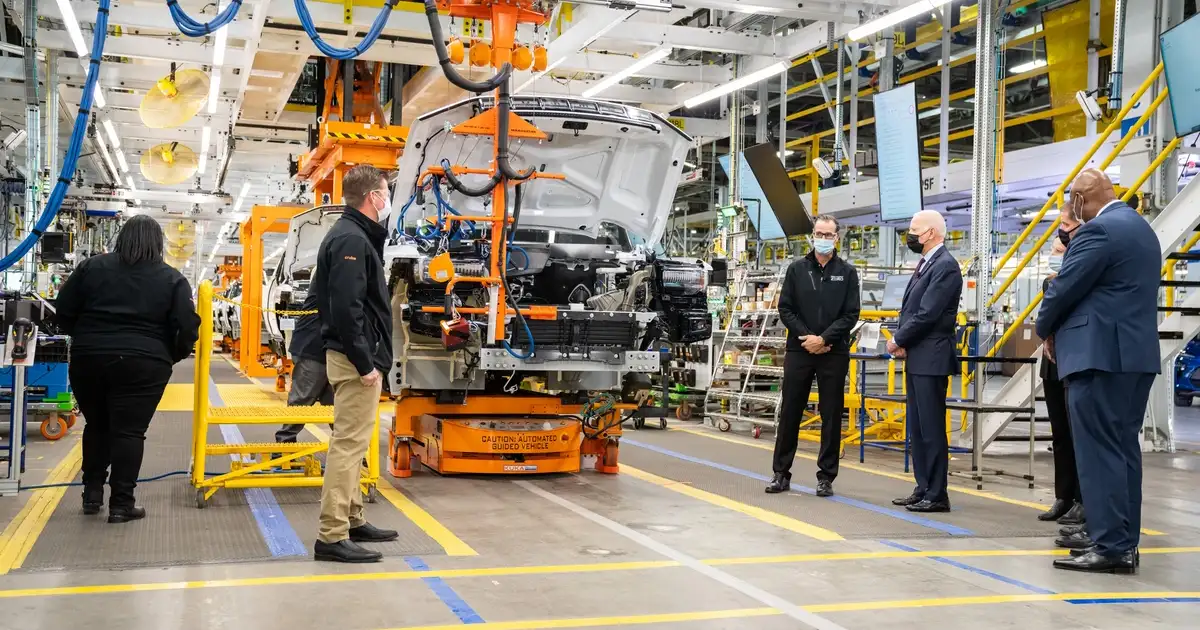
In their place? A mere 50 advanced robotic systems. These machines, devoid of emotion or a need for benefits, are now running the entire offensive line at the Detroit-Hamtramck plant, churning out vehicles with relentless, programmed efficiency. It’s a stark, almost dystopian, vision of the future arriving today.
The human cost is immeasurable. Workers received their final notices, a cold administrative gesture ending decades of loyalty for many.
While severance packages were offered, and a limited number of reassignments floated, let’s be crystal clear: few, if any, of those new roles truly match the pay, benefits, or stability of the jobs that were lost. This isn’t just a shift in corporate strategy; it’s a financial earthquake for countless families, ripping through their stability and sense of security.
UAW Local 22 immediately issued a scathing statement, expressing “profound disgust” and accusing GM of abandoning its long-term employees in a crass pursuit of profit margins. “This is not progress,” the statement declared, “this is corporate greed masquerading as innovation.”
Union leadership isn’t just talking tough; they’re mobilizing. Emergency meetings with GM executives have been demanded, not requested.
The UAW is fighting for comprehensive retraining programs and genuine job placement assistance, not just token gestures. This isn’t a minor skirmish over contract clauses; this is a foundational battle for the union’s very future. It’s a fight to prove that human labor still holds value in an increasingly automated world.
UAW’s Counter-Attack: Protests on the Field
The anger in Detroit isn’t just simmering; it’s boiling over. Small but fiercely vocal protests erupted at the plant gates on June 23 and 24.
UAW members, joined by community activists, stood shoulder-to-shoulder, their chants echoing the outrage over the human cost of GM’s automation push. They carried signs declaring “People Over Profit” and “Robots Don’t Buy Cars,” a stark reminder of the economic cycle GM seems to be ignoring.
Local news outlets, from the Detroit Free Press to local TV stations, are covering the story with the intensity it deserves, amplifying the union’s “profound disgust” and ensuring the human tragedy isn’t lost in the corporate narrative. This isn’t just a cold, calculated corporate decision; it’s a deep wound inflicted on a community that has already weathered so many storms, a wound that threatens to fester.
GM’s Vice President of Manufacturing, Mark Reuss, predictably tried to run interference. He issued a statement on June 23 that painted the automation as a “strategic necessity,” arguing it’s vital for global competitiveness, especially in the cutthroat electric vehicle market.
Reuss claims these robots improve safety, boost efficiency, and, in a familiar corporate refrain, create new, higher-skilled tech jobs. But let’s be honest: those “new jobs” are few and far between, a paltry offering compared to the thousand livelihoods extinguished.
It’s a classic corporate spin, attempting to justify mass displacement with the promise of a few highly specialized roles most displaced workers aren’t qualified for.
The Stakes: Detroit’s Economic Gridiron in Jeopardy
For General Motors, this move is undeniably about the bottom line. It’s about drastically reduced labor costs, faster production cycles, and consistent quality that doesn’t call in sick.
This aggressive play aims to solidify their EV sector dominance and appease shareholders who prioritize efficiency above all else. From a purely financial perspective, Wall Street will likely cheer this as a win for profitability.
But for the displaced workers, it’s a devastating gut punch that reverberates far beyond their personal finances. Many are long-time employees, individuals with deep roots in Detroit, whose families have contributed generations of labor to the auto industry.
Now, they face a brutal job market, often too old to easily retrain, too experienced to settle for entry-level wages. Those severance packages, while offering temporary relief, feel less like a career lifeline and more like a consolation prize for a game they didn’t ask to play, a meager sum for a lifetime of dedication.
The United Auto Workers now faces a critical, existential test. This mass displacement directly weakens their bargaining power and highlights the increasingly uphill battle to protect blue-collar jobs in an era of rapid technological advancement.
The union must fight tooth and nail, not just for better severance and retraining, but for stronger worker protections embedded in future automation plans. Their ability to secure a fair deal here will set a precedent for every industrial union across the nation.
The entire Detroit community will feel this hit, a ripple effect that will spread far and wide. Over 1,000 well-paying manufacturing jobs are gone, taking with them purchasing power that sustained local businesses.
This loss impacts housing markets, drains local tax revenues, and strains social services. Detroit, a city still fighting back from past economic downturns, was on the cusp of a hard-won comeback. This makes that comeback significantly harder, threatening to roll back years of progress and re-open old wounds.
The Bigger Game: Man vs. Machine – A Societal Showdown
This isn’t an isolated incident; it’s a chilling preview of a global trend. The automation industry is scoring big, with companies developing robots and AI software seeing massive demand and unprecedented growth.
This trend will only accelerate, forcing us to confront profound questions about the very nature of work and the social contract between corporations and their communities. Are we witnessing the inevitable cost of progress, or a catastrophic failure of corporate responsibility to its human capital?
GM wants to win the EV race, and they’re willing to ruthlessly cut their roster to do it. But what about the team they leave behind? What about the societal cost when a company prioritizes quarterly earnings over the well-being of its workforce?
The argument for “higher-skilled technical roles” often rings hollow, a convenient talking point designed to deflect criticism. Let’s look at the numbers again: 50 robots replaced 1,000 people.
That’s a brutal, unforgiving ratio. It means exponentially fewer opportunities, not more, for the average worker, creating an ever-widening chasm between the highly specialized few and the displaced many.
This isn’t just about General Motors. This is a bellwether, a stark indication of the battles to come across every industry.
Corporations will continue to prioritize profit and efficiency, embracing automation with ever-increasing fervor. Unions and communities, therefore, must adapt their defense, evolving beyond traditional tactics to fight for a new, fair deal for the American workforce – one that ensures technological advancement benefits everyone, not just the shareholders.
The game is changing, irrevocably. The question we must all demand an answer to is this: who’s truly winning when the score is tallied not in vehicles produced, but in jobs lost and livelihoods shattered?
Source: Google News