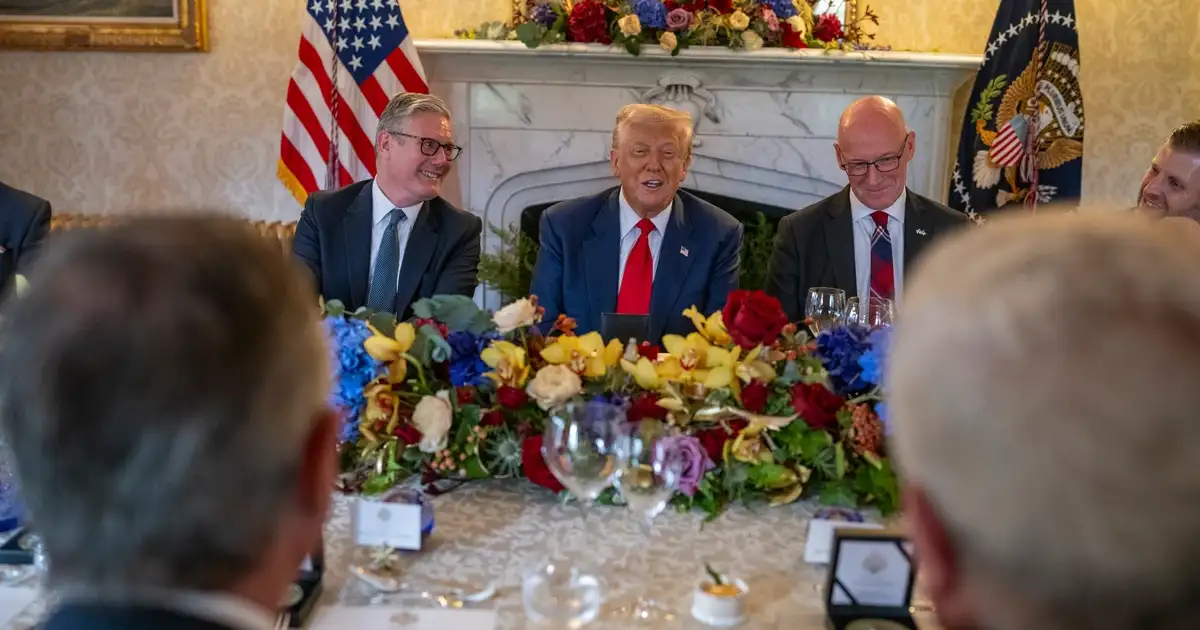

President Donald Trump didn’t just speak; he delivered a brutal, public takedown, declaring Keir Starmer “failed badly” as UK’s Prime Minister. The image of a reportedly weeping Starmer resigning isn’t just a political footnote; it’s a stark, visceral demonstration of the consequences when a leader fails to meet Trump’s demands on the global stage. This wasn’t a mere jab; it was a full-contact political blitz, a clear message sent across the Atlantic.
The UK leader’s dramatic exit, reportedly in tears, unfolded under the relentless glare of Trump’s criticism. Trump, a consistent and unwavering critic of what he perceives as allied freeloading, clearly views this as the inevitable outcome of weak leadership and strategic missteps. His pronouncements didn’t just hit; they landed like a bone-jarring tackle on a fumbled ball, right in the heart of the international arena, leaving no doubt about who dictated the terms of engagement.

Trump’s “America First” Playbook: The Fair Share Ultimatum
Trump’s recent campaign-style rally in Scranton, Pennsylvania, wasn’t just a political speech; it was a strategic blueprint, laying the groundwork for this kind of international takedown. He hammered home his long-standing demand for NATO members to finally pay their “fair share,” a non-negotiable term in his “America First” playbook. This wasn’t new rhetoric, but it served as a crystal-clear warning shot, setting an unambiguous expectation for allies. The UK, a major NATO player and historically a close partner, was always squarely in his crosshairs.
During that June 20, 2026, address, Trump held nothing back, pulling no punches. He lambasted countries with “endless money” for consistently failing to meet their defense commitments. He made his position unequivocally plain: the United States has shouldered too much of the burden for too long. He even escalated his threat, suggesting he would reconsider the sacred Article 5 protection – the collective defense clause that is the very bedrock of the NATO alliance. This wasn’t a suggestion; it was an ultimatum, delivered with the force of a head coach demanding results.
“We’re protecting countries that have endless money, and they’re not paying their fair share. It’s a disgrace. The United States is carrying the burden, and it’s time for that to change, dramatically.”
— President Donald Trump, Scranton, PA, June 20, 2026
Starmer’s reported resignation, complete with the emotionally charged image of tears, now appears less like a political accident and more like a direct casualty of this relentless pressure. It stands as a brutal, unvarnished demonstration of the “America First” doctrine in full effect. When Trump draws a line in the sand, he doesn’t expect polite discussion or diplomatic maneuvering; he demands action, and he demands it now. Failure to deliver, as Starmer learned, comes with a steep, public price.
The UK’s Strategic Fumble: Caught in the Crosshairs
The United Kingdom, under Starmer’s leadership, had been scrambling, desperately trying to adapt to the shifting geopolitical landscape Trump had engineered. They publicly affirmed their unwavering commitment to NATO. They made concerted efforts to bolster defense spending. They even pushed for greater European contributions, attempting to meet Washington’s increasingly stringent expectations. But, as Starmer’s dramatic exit proved, it simply wasn’t enough to satisfy the man in the Oval Office.
Starmer’s government found itself in an impossible bind, caught between the proverbial rock and a hard place. They faced escalating global security tensions, from Eastern Europe to the South China Sea, and understood that robust alliances were not just beneficial, but absolutely crucial for national security. Yet, Trump’s deep-seated skepticism regarding NATO’s foundational principles created immense, destabilizing diplomatic ripples. His words weren’t just pronouncements; they forced a constant, exhausting re-evaluation of UK foreign policy, akin to constantly changing the game plan under relentless defensive pressure.
This isn’t merely about budgetary allocations; it’s fundamentally about perceived strength and decisive leadership. Trump saw a leader who, despite efforts, ultimately couldn’t deliver on the critical defense spending demands. He saw a prime minister who, in his view, buckled under the immense weight of international pressure. The indelible image of Starmer reportedly crying while resigning plays directly into that narrative, painting a vivid picture of weakness, not the resolute leadership demanded in a volatile world. It’s a visual defeat, broadcast for all to see.
The Domino Effect: NATO on Edge
Starmer’s resignation sends shockwaves far beyond the UK’s borders. It directly impacts the already complex UK-US “special relationship,” potentially reconfiguring diplomatic priorities and trust. More critically, it creates a massive vacuum within NATO, an alliance that desperately needs strong, unwavering leadership from its key members, especially in an era of heightened global instability. A public display of such a “failure” doesn’t just weaken one nation; it weakens the entire team, exposing vulnerabilities that adversaries are all too eager to exploit.
Critics of Trump, often found in the more traditional diplomatic circles, argue vehemently that his confrontational statements undermine global stability and embolden adversaries like Russia and China. They claim his tactics fracture alliances and create dangerous precedents. But from Trump’s uncompromising perspective, this isn’t about fostering a cozy consensus; it’s about raw accountability. He’s not shying away from calling out what he perceives as freeloaders, demanding allies step up to the plate and meet their commitments, or face the very real, very public consequences.
This seismic event will undoubtedly dominate upcoming high-level diplomatic meetings, particularly within NATO and the G7. Alliance cohesion and burden-sharing were already red-hot topics, debated with increasing urgency. Now, Starmer’s dramatic exit adds a raw, human, and deeply personal element to the debate, intensifying the stakes exponentially. Every other NATO leader is watching, analyzing, and wondering: if Starmer can fall so dramatically, who is next on Trump’s chopping block? The pressure is palpable, and the game has fundamentally changed.
The Starmer Legacy: A Cautionary Tale for European Leadership
Keir Starmer’s tenure as Prime Minister, now ended with such a public display of emotion, will be etched into history as a cautionary tale. It vividly illustrates the immense, often unbearable, pressure facing European leaders in the current geopolitical climate. They are forced to manage complex domestic demands, from economic woes to social divisions, while simultaneously striving to meet increasingly stringent international expectations, particularly those emanating directly from Washington.
Trump’s influence on US foreign policy, even outside a presidential term, remains undeniably potent and far-reaching. His perspective doesn’t just shape policy; it actively molds global discourse, setting new terms of engagement for allies and rivals alike. His words carry immense weight, and as Starmer’s downfall demonstrates, they carry very real, very painful consequences. Starmer’s resignation under such circumstances doesn’t just underscore this reality; it screams it from the headlines.
What does this mean for the United Kingdom? A leadership vacuum at a critical, uncertain time, forcing a scramble for stability. What does it mean for NATO? More uncertainty, heightened anxieties, and a renewed, desperate scramble to meet defense targets that now feel less like goals and more like survival mandates. Trump’s declaration about Starmer isn’t just an opinion or a political soundbite; it’s a political earthquake, a tectonic shift that has rearranged the global playing field. It’s a clear, unmistakable message to every ally: pay up, or prepare to pay the ultimate price.
Source: Google News