
For nearly a decade, an Arizona man existed in the shadows, his life reduced to a garbage-filled campsite on national forest grounds. His recent arrest isn’t just a police report; it’s a brutal indictment, ripping the lid off Arizona’s profoundly failed approach to homelessness and the very concept of public space. This isn’t merely about one individual’s struggle; it’s about a society that has chosen neglect over humanity, enforcement over solutions.
The incident lays bare a stark, uncomfortable truth: cities across Arizona are locked in a desperate, often cruel, battle over basic human rights. They are struggling—or perhaps, refusing—to balance public order with even a shred of compassion. The problem extends far beyond the perimeter of a single, makeshift encampment; it’s a systemic crisis of conscience and policy.
Arizona’s War on the Unsheltered
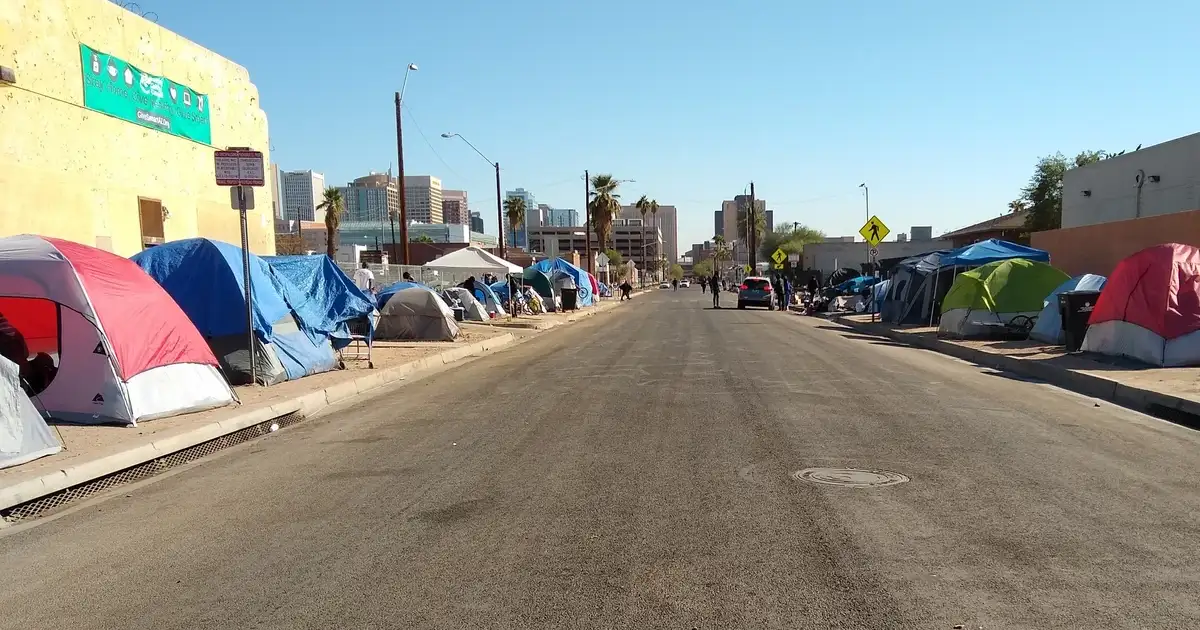
Nowhere is this battle more fiercely waged than in Phoenix, Arizona’s sprawling capital. Its infamous “public camping” ordinance is a legal and moral quagmire.
This law faces relentless challenges from advocates who rightly decry it as a direct criminalization of existence for those without a home. It makes the simple acts of sleeping or resting in public illegal, all while offering a woefully inadequate network of shelter alternatives. This policy is designed not to solve homelessness, but to sweep its visible symptoms under the rug, out of sight and out of mind.
Eleanor Vance, a columnist for The Arizona Republic, didn’t just comment on this; she delivered a scathing indictment. Her July 5, 2026, editorial, “Phoenix’s Public Spaces: A Battleground for Rights and Order,” didn’t merely expose hypocrisy; it tore it to shreds.
Vance argues with undeniable clarity that while cities certainly bear a duty to maintain public health and safety, their current enforcement strategies are not just ineffective. They are actively punitive, consistently harming the most vulnerable among us. These policies lead to arrests for the most basic, desperate acts of survival.
“Individuals are cited for ‘living’ in public when they have no other viable option,” Vance wrote, her words echoing with the frustration of countless advocates. “This prompts questions about the compassion and efficacy of such policies, questions that our city leaders seem determined to ignore.”
Vance brilliantly illuminates the cruel paradox at the heart of these policies. People are cited, fined, and arrested for “living” in public spaces precisely because they have no other choice.
This isn’t a solution; it’s a trap. It ensnares them in an inescapable cycle of fines, court dates, and criminal records. This makes the already monumental task of escaping homelessness an almost impossible ordeal. It’s a bureaucratic nightmare designed to perpetuate misery, not alleviate it.
The Crushing Cost of Inaction
The recent arrest of the Arizona man in the national forest isn’t an isolated incident. It’s a direct, predictable consequence of this systemic failure. It’s what happens when we prioritize draconian enforcement over genuine, humane solutions.
This man lived outside the system for almost ten years. Think about that: ten years of missed opportunities, ten years of public land degradation, ten years where a real, compassionate solution could have been found and implemented. Instead, we got a decade of neglect culminating in an arrest.
This isn’t just a humanitarian crisis; it’s an economic drain of staggering proportions. The endless cycle of arrests, court costs, incarceration, and emergency medical services piles up. This creates a financial burden that dwarfs the cost of actual, sustainable housing solutions.
We are, quite literally, paying more to keep people homeless than we would to house them. It’s a revolving door of misery, wasted taxpayer money, and bureaucratic absurdity that only a truly broken system could sustain.
The debate over homelessness has devolved into a political football, cynically tossed between factions. Some politicians, pandering to fear, push for ever-harsher measures, promising to “clean up” the streets with a heavy hand. Others, often drowned out by the noise, advocate for robust social services, mental healthcare, and proven housing-first initiatives.
The divide is not merely clear; it’s a chasm. With human lives hanging in the balance, the stakes could not be higher. To choose punitive measures over practical solutions is not just short-sighted; it is morally bankrupt.
A National Shame, Local Impact
Arizona, tragically, is not alone in this fight. Cities nationwide grapple with identical issues, facing the same moral quandaries and economic pressures. The defining difference, however, lies in how they choose to respond.
Some enlightened cities have found undeniable success by focusing on accessible shelter, comprehensive support services, and proactive outreach. These models are not just more humane; they are demonstrably more cost-effective, proving that compassion isn’t a luxury, but a pragmatic necessity. They break the cycle of homelessness, rather than perpetuating it through endless arrests and fines.
Vance’s editorial leaves no doubt about the path forward. She calls for an urgent, radical re-evaluation of current approaches, demanding that city leaders prioritize sustainable, evidence-based solutions.
They must address the root causes of homelessness—poverty, mental health crises, addiction, lack of affordable housing—instead of merely
Source: Google News