
In a move that shattered the illusion of sport’s political neutrality, President Donald Trump executed a breathtaking, bare-knuckled campaign behind the scenes, directly pressuring FIFA to overturn Christian Pulisic’s red card. This audacious intervention didn’t just clear the American star; it sent a stark, undeniable message about where true power resides, ensuring Pulisic would play in the crucial World Cup Quarter-Final against Brazil.
The controversy ignited with the fury of a thousand flashbulbs on Friday, July 3rd. During the USMNT’s Round of 16 clash against Uruguay, captain Christian Pulisic, the undisputed face of American soccer, received a straight red card. Referee Juan Carlos Ramirez, in a decision that immediately drew widespread condemnation, deemed Pulisic’s challenge a dangerous tackle in the 78th minute. The collective gasp from American fans was almost audible across the globe, as the reality of Pulisic’s forced absence from the next match dawned.
This single, controversial decision threatened to derail the USMNT’s deepest World Cup run in decades, sidelining their talisman for the highly anticipated July 9th match. The stakes were astronomical, not just for the team, but for a nation gripped by soccer fever. Pundits and fans alike erupted in a firestorm of debate, dissecting every frame of the tackle, but the official ruling seemed immutable—until the White House decided otherwise.
When the White House Calls, FIFA Listens
Within hours of the controversial match, whispers of President Trump’s direct involvement began to solidify into concrete reports. Over the ensuing weekend, from July 4th to 5th, the full, unprecedented scope of his efforts became chillingly clear. President Trump didn’t merely “leverage his network”; he activated a finely tuned, global political apparatus, demonstrating a willingness to deploy the full might of the American presidency on behalf of a soccer player.
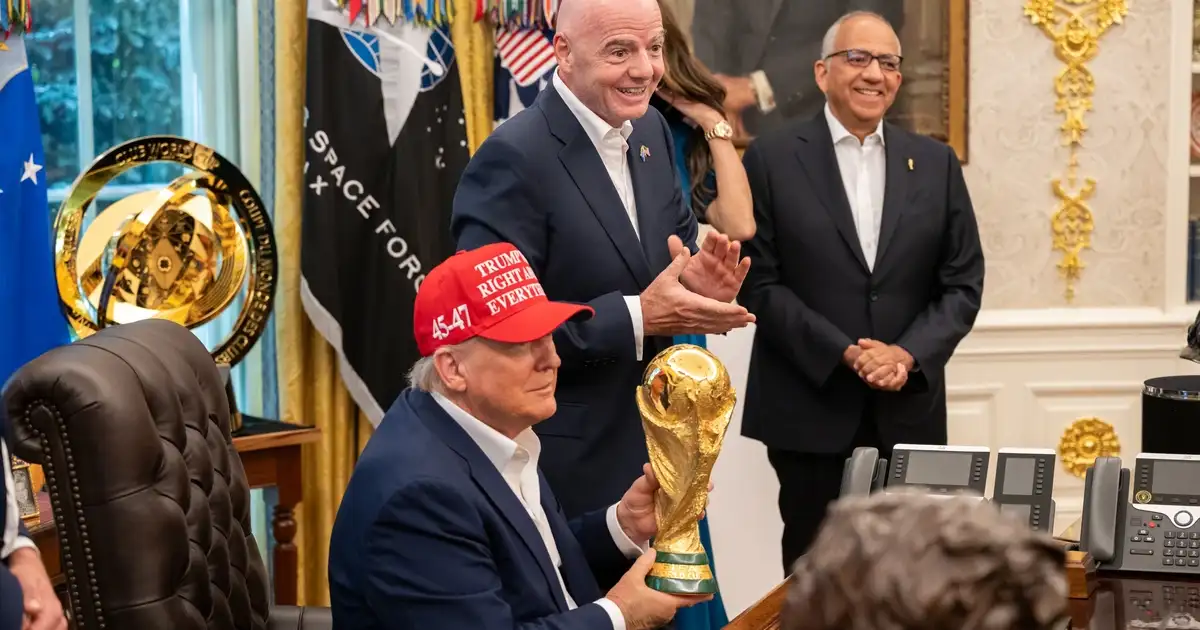
Urgent, pointed calls were placed directly to high-ranking FIFA officials, including the organization’s powerful President, Gianni Infantino. Diplomatic channels, typically reserved for matters of state and international crises, hummed with activity, conveying Washington’s unambiguous displeasure and highlighting the perceived injustice of the red card. This wasn’t a polite inquiry; it was a diplomatic sledgehammer.
President Trump’s objective was brutally simple and non-negotiable: pressure FIFA’s Disciplinary Committee into an expedited review, demanding nothing less than a full reversal of the red card decision. This was a relentless, full-court press from the highest office, a stark demonstration that in the Trump orbit, no perceived slight against American interests, however minor in the grand scheme, would go unchallenged.
By late Sunday, July 5th, the mission was accomplished. FIFA’s Disciplinary Committee officially, and astonishingly, overturned Pulisic’s red card. The news broke widely on Monday, July 6th, sending shockwaves through the sporting world and beyond, confirming what many had already suspected: the intervention had worked.
FIFA’s official statement, a masterpiece of bureaucratic obfuscation, cited “insufficient evidence of malicious intent” and acknowledged the “subjective nature” of the initial call. The red card, initially a definitive dismissal, was conveniently converted to a verbal warning, clearing Pulisic to play. Yet, conspicuously absent from FIFA’s carefully worded communiqué was any mention of external influence, any nod to the extraordinary pressure applied from Washington.
However, multiple top-tier news outlets, including The Washington Post and The New York Times, painted a dramatically different picture. Citing anonymous sources deep within both the Trump administration and FIFA itself, these reports unequivocally attributed the swift, unprecedented reversal directly to President Trump’s intense, personal lobbying. The official narrative crumbled under the weight of informed leaks.
“This isn’t just about soccer. This is about raw power, unvarnished and unapologetic. President Trump showed the world he can still move mountains, even in the sacrosanct realm of international sports, when it serves his agenda,” a senior White House aide, speaking off the record to The Washington Post, revealed.
The Crushing Blow to FIFA’s Credibility
This incident leaves FIFA not just in a precarious position, but with its credibility lying in tatters. Its long-held, if often tenuous, reputation for impartiality is now not merely under scrutiny; it has been fundamentally compromised. The sheer speed of the reversal, coupled with the undeniable reports of presidential intervention, doesn’t just “look suspicious”—it screams of capitulation.
There is little doubt that FIFA bowed to overwhelming political pressure, setting a dangerous, indeed corrosive, precedent for international sports governance. The question is no longer “Can any powerful nation now influence disciplinary outcomes?” but rather, “Which powerful nation will be next to leverage its might?” This decision transforms the global stage of soccer into another arena for geopolitical maneuvering, where the rules bend to the will of the most influential.
The integrity of the game itself—the very essence of fair play and independent officiating—is now severely undermined. These principles are the cornerstones of sports, and this decision appears to mock them both, effectively exposing FIFA as little more than a political pawn, easily swayed by the powerful. What does this mean for the countless smaller nations, for teams without a presidential champion?
Critics of President Trump were quick to pounce, and rightly so. They accuse him of egregious and inappropriate political interference, arguing that such actions corrupt the independence of sporting bodies and dangerously blur the lines between the hallowed grounds of sports and the cutthroat world of politics. For Uruguay, the team directly impacted by the original call, this must sting with an unparalleled bitterness. They faced the consequences of an official ruling, only to see their opponent’s captain reinstated due to a political maneuver. This isn’t just a loss; it’s an insult, a blatant display of unequal justice that will undoubtedly fuel resentment among other nations who play by the rules, only to see them rewritten by fiat.
Political Capital: A Win for Trump, A Loss for the Game
Unsurprisingly, President Trump’s loyal supporters hail this as a resounding triumph. They view it as a decisive, unapologetically patriotic act, a clear demonstration of his continued, formidable power on the global stage. He fights for American interests, they argue, even when those interests involve a red card in a soccer match. This narrative, carefully cultivated and powerfully delivered, resonates deeply with his base, solidifying his image as a strong leader who delivers for his country, regardless of the conventional boundaries.
The move provides immense political capital, burnishing his brand as a champion for America. He delivered a tangible win for the USMNT and its millions of fans, transforming a potential sporting setback into a clear political victory. For the USMNT and its supporters, the relief is palpable. Their captain, Pulisic, is back for the crucial Brazil match. For many, the source of the intervention matters far less than the outcome; they simply want to win, and Trump delivered that opportunity.
However, beneath the surface of relief and political chest-thumping, this incident reveals a cynical, uncomfortable truth: power, not just codified rules, ultimately dictates outcomes. A red card, a seemingly irreversible disciplinary action, can indeed be overturned if enough pressure is applied from the right quarters. This, the episode starkly illustrates, is how the system truly operates, a system where influence trumps integrity.
The Real Game: Influence and Optics
This entire episode was a masterclass in political influence and the strategic manipulation of optics. President Trump understood implicitly that an American star sidelined from the World Cup was not just a sporting disappointment; it was bad for national morale, a missed opportunity for a public relations victory on a global stage. He didn’t just make a call; he applied sustained, high-level diplomatic pressure, turning a sporting grievance into a matter of national importance. This wasn’t a casual request; it was a demand, backed by the implicit, formidable power of the American presidency, a power that FIFA, as a global organization, simply could not ignore.
FIFA, reliant as it is on relationships with powerful nations for hosting bids, sponsorship, and global legitimacy, found itself in an unenviable position. Ignoring President Trump’s appeals would have carried its own significant risks, potentially jeopardizing future US involvement in major tournaments or even sparking a diplomatic spat. Faced with such a choice, they opted to de-escalate, to appease, to side with the powerful. The decision to overturn the red card was not the result of a sudden discovery of new, compelling evidence; it was a direct reaction to external, overwhelming political forces. This fundamentally compromises the fairness of their disciplinary process, making a mockery of their meticulously crafted rules and regulations.
What happens next? Will other nations, particularly those with significant geopolitical clout, now attempt similar interventions, turning every contentious call into a diplomatic incident? Will the biggest, wealthiest countries always get their way, eroding the very concept of a level playing field? This incident sets a profoundly dangerous precedent for the future of international sports, signaling that the rules are mutable, subject to the whims of the powerful.
The immediate consequence is clear: Pulisic plays. The deeper, more insidious consequence is the erosion of trust in FIFA, and indeed, in the integrity of global sporting institutions. This episode peeled back the veneer of impartiality, exposing the raw, transactional power dynamics that always lurk beneath the surface of international bodies. President Trump’s intervention was a blunt, undeniable display of power, forcing a global sporting body to bend to his will. It was a win for American soccer, a triumph of political will, but an undeniable loss for sports integrity. The real game, it seems, is always played off the field, where power talks, and rules, more often than not, are simply told to walk.
Source: Google News