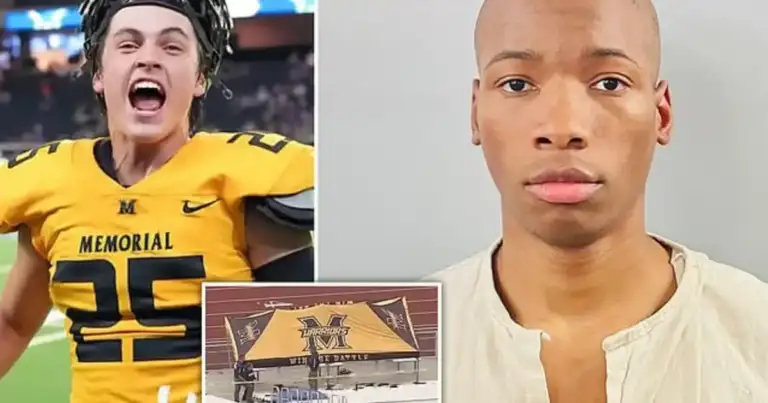

The hallowed halls of justice rarely witness such raw, unvarnished contempt. This week, in a chilling tableau that will undoubtedly haunt the national consciousness, Tyler Robinson—the man accused of brutally murdering conservative titan Charlie Kirk—was captured on camera laughing, mere feet from Kirk’s visibly distraught widow, Erika Kirk.
The date was Monday, July 5, 2026, a routine procedural hearing in the Superior Court. Yet, there was nothing routine about the chilling spectacle that unfolded. Robinson’s smirk, a grotesque act of defiance, carved a stark line through the courtroom’s somber decorum.

It was a direct affront to Erika Kirk, whose profound grief in the front row was agonizingly palpable. Her sobs, barely audible, were nonetheless a powerful counterpoint to Robinson’s callous disregard.
The presiding judge, visibly perturbed, was compelled to issue a stern warning to Robinson. While formal contempt charges were not immediately levied, the damage was already irreparable.
This wasn’t merely a courtroom procedural; it was a brazen, public declaration of raw, ugly disrespect. It was a deliberate provocation that cut far deeper than any legal maneuver. This moment stripped away the veneer of judicial impartiality, revealing the raw, human emotion simmering beneath.
The Unfolding Tragedy and Unfathomable Disregard
Charlie Kirk, the dynamic founder of Turning Point USA, was brutally murdered on April 12, 2026, in what authorities quickly labeled a targeted attack. Robinson was swiftly apprehended and charged with first-degree murder. Kirk’s death sent shockwaves through the conservative movement, robbing it of one of its most influential and vocal young leaders.
Kirk’s political stature was immense; his rallies drew thousands, his podcasts reached millions. His organization, Turning Point USA, became a formidable force in shaping the conservative youth movement.
His influence transcended mere punditry, making his murder a national story of profound political and cultural significance. Now, his widow endures not only the agonizing void left by his absence but also the public spectacle of her husband’s alleged killer mocking her pain.
Robinson’s actions poured salt into an already gaping wound, deepening the collective grief and outrage.
“Today was another agonizing reminder of the evil that took Charlie from us. To see such a display of disrespect, a smirk, a laugh, while I am still grieving… it’s beyond comprehension. It’s a wound reopened with salt.”
— Erika Kirk (via family spokesperson, reported by Fox News)
Erika Kirk’s raw anguish, articulated through a family spokesperson, perfectly encapsulates the profound violation felt not just by her, but by countless Americans. They see such contempt as an affront to basic human decency and the solemnity of justice. The prosecution will undoubtedly seize upon this as a damning indictment of Robinson’s character, a stark demonstration of his utter lack of remorse and disregard for the victim and his family.
Can a Smirk Truly Sway a Verdict?
The immediate, visceral question on everyone’s mind is stark: Can a defendant’s brazen courtroom antics truly sway a murder trial? While the legal framework demands adherence to evidence, make no mistake—this kind of behavior matters profoundly, shaping perceptions, influencing narratives, and potentially sealing fates.
First, consider the immediate legal ramifications: contempt of court. The judge’s warning to Robinson was not a mere suggestion; it was a direct order.
Continued defiance risks not just fines but jail time, entirely separate from the murder charges. Such behavior signals a deep-seated disrespect for the entire judicial system. It poses a direct challenge to the very authority of the court, with tangible consequences for the defendant.
Second, and far more critical in the grand scheme of a murder trial, is jury perception. If this case proceeds to trial, jurors will be the ultimate arbiters of Robinson’s fate.
In the theater of the courtroom, every gesture, every expression, every flicker of emotion—or lack thereof—is amplified. A jury, tasked with discerning truth from testimony, inevitably forms an impression of the accused.
Jurors, for all their sworn impartiality, are undeniably human. They don’t merely weigh evidence and legal arguments; they assess character, they seek empathy, and they register defiance.
Robinson’s laughter, broadcast to those who will ultimately decide his fate, paints a vivid, damning portrait of a man devoid of remorse.
The defense, now facing an Everest of public and judicial disdain, will undoubtedly scramble to mitigate the damage. They’ll argue nervousness, misinterpretation, perhaps even a psychological coping mechanism.
But how does one rationalize away a guffaw in the face of a widow’s tears? It is a narrative challenge of monumental proportions. This effectively poisons the well of potential sympathy, making their already arduous task immeasurably harder.
Prosecutor Jane Doe, a seasoned legal veteran, wasted no time in seizing the narrative. Her statement outside the court was not just a legal declaration; it was a political maneuver, framing Robinson’s conduct as a profound moral failing, leaving no room for doubt about the prosecution’s interpretation.
“The defendant
Photo: Wikimedia Commons (query: Tyler Robinson)
Source: Google News