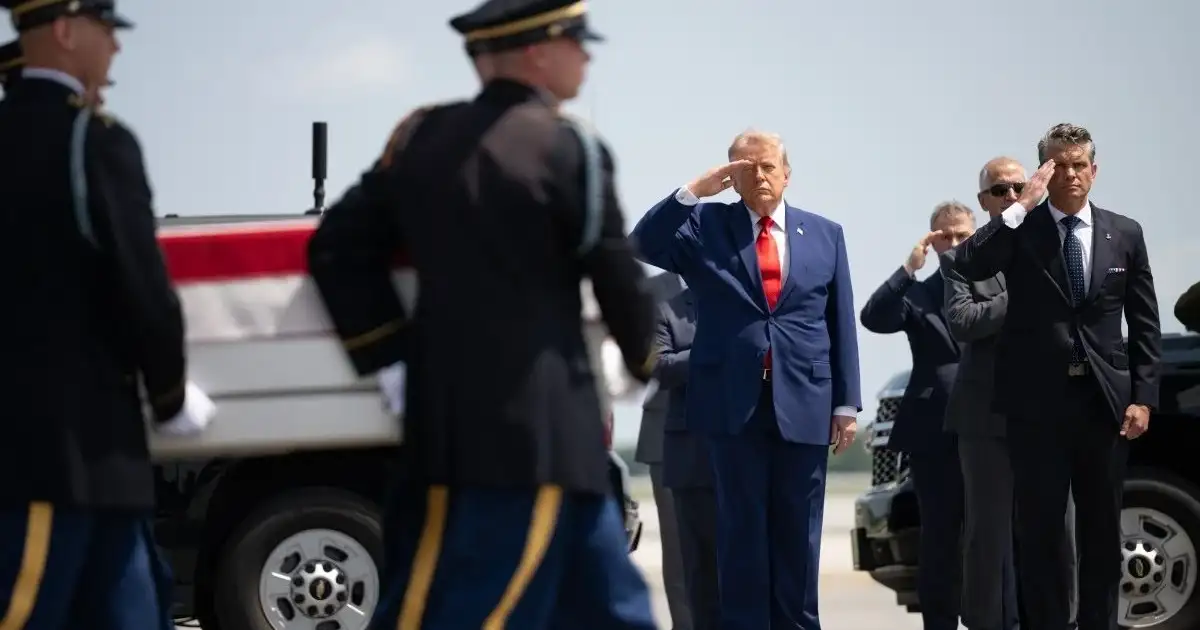

The grim reality hit home with brutal force at Dover Air Force Base this week. President Donald Trump stood witness to the ultimate cost of a widening air war against Iran, a conflict that has now claimed American lives. This isn’t just another skirmish in the shadows; it’s a tragic, undeniable escalation, bringing the true price of this proxy conflict directly to the American doorstep.
On Tuesday, July 20, 2026, the President met the flag-draped coffins of three U.S. service members: Captain Maria Rodriguez, Sergeant First Class David Chen, and Specialist Jamal Adebayo. Their reconnaissance drone, a critical eye in the sky, was shot down over southern Iraq just the day before, on July 19th. These are not merely statistics; they are names, faces, and families shattered by a war too many Americans barely knew was raging.

These three brave souls represent the first confirmed American combat fatalities in this intensifying conflict, a grim milestone that the Pentagon now euphemistically labels a “widening air campaign.” This war, largely unseen and unheard by the public, just crashed into center stage, demanding attention and accountability.
This Isn’t a Campaign; It’s a War
Let’s cut through the bureaucratic jargon. Is this a new war with Iran? The short, tactical answer is unequivocal: we are already in it, even without a formal declaration from Congress. The semantic gymnastics of calling it an “air campaign” or “retaliatory strikes” does not change the cold, hard fact that American lives are being lost in combat operations directly linked to Iranian aggression.
For months, Iranian-backed militias have relentlessly targeted U.S. bases in Iraq and Syria. The U.S. response has been a predictable, yet dangerously escalating, series of counter-strikes. This isn’t a direct ground invasion, no. It’s far more insidious: a perilous game of escalating proxy attacks. Iran, masterfully leveraging its network of Shiite militias, targets U.S. and allied interests, knowing full well the U.S. will respond. This creates a deadly, self-perpetuating cycle, a strategic quagmire where every move carries the risk of a full-blown regional conflagration.
The roots of this current conflict run deep, far beyond recent headlines. Tensions have not merely “simmered”; they have been a slow-burning fuse since the U.S. unilaterally pulled out of the JCPOA nuclear deal in 2018. The “maximum pressure” campaign that followed was less a deterrent and more a catalyst, fueling the very fires it sought to extinguish. This isn’t a sudden flare-up; it’s the inevitable consequence of a consistent state of low-level conflict, a strategic drift that has now cost American blood.
The Unacceptable Toll: Blood and Treasure
The ceremony at Dover was more than just a somber tradition; it was a raw, visceral display of national grief and an undeniable demand for answers. The families of Captain Rodriguez, Sergeant First Class Chen, and Specialist Adebayo are not asking for platitudes; they are demanding a clear, coherent strategy behind these sacrifices. They want to know the playbook, not just the highlights reel.
“Our hearts are broken, but our resolve is stronger than ever. Maria believed in protecting freedom, and we will honor her sacrifice by demanding accountability and a clear path forward.”
– Statement from the Rodriguez family, as reported by CNN.
President Trump, upholding a solemn presidential duty, offered condolences and vowed swift justice. His presence at Dover, while a powerful statement of commitment, also underscored the gravity of the situation. But is a presidential presence enough to quell the rising tide of questions about the mission itself?
The cost, however, extends far beyond the immeasurable value of human lives. Defense analysts now estimate that the increased operations are adding a staggering tens of millions of dollars weekly to the existing military budget. This isn’t just “piling onto”; it’s an unsustainable drain on resources, a costly strategy both in blood and treasure that demands a clear return on investment – a return that, so far, remains elusive.
The Political Game Plan: High Stakes in Washington
President Trump’s appearance at Dover was undeniably a powerful political statement, meticulously designed to reinforce his image as a strong commander-in-chief and to project unwavering commitment to the military. It was a play to demonstrate resolve in the face of escalating conflict, a strategic move to rally support and project strength.
The White House swiftly followed with its own statement, expressing condolences and reaffirming its commitment to protecting U.S. personnel. These are standard plays in a crisis, but in the current climate, they ring hollow without a clear, articulated strategy for de-escalation or decisive victory.
“The United States mourns the loss of these courageous service members. We remain committed to ensuring the safety of our forces and will respond decisively to any threats to our personnel or interests.”
– White House Press Secretary, in a statement released Tuesday.
Yet, Washington remains deeply divided, a strategic liability in itself. Some lawmakers clamor for stronger military action, advocating for a more aggressive posture against Iran. Others, however, push for diplomatic solutions, warning against the perils of another protracted conflict in the Middle East. Congress, in a rare moment of introspection, is actively debating the legal authority for these actions, questioning whether the executive branch is exceeding its constitutional powers. This internal discord is a weakness Iran will undoubtedly exploit.
Compounding the complexity, Iraqi officials are vehemently condemning the U.S. strikes within their borders, warning of further destabilization. Iran, meanwhile, continues its well-worn playbook of denying direct involvement, instead claiming to merely support “resistance movements” against foreign presence. This diplomatic dance allows Iran to project deniability while its proxies sow chaos, a tactic that has proven devastatingly effective.
The Next Down: A Reckoning on the Horizon
These three American deaths are more than a turning point; they are a stark, undeniable reckoning. They transform the abstract concept of foreign policy into a tragically real, human cost. This moment forces every American to confront the grim calculus of our involvement in the Middle East.
The critical strategic questions are no longer hypothetical; they demand immediate, decisive answers. What is the true scope of U.S. military involvement? How far will this “widening air campaign” truly go before it becomes an all-out war? And, most importantly, will this dangerous escalation lead to a broader, more direct conflict with Iran, a scenario with catastrophic global repercussions?
A full-scale war with Iran would unleash a torrent of consequences: a spike in global oil prices that would cripple economies, a renewed and divisive debate about a military draft, and an unimaginable human toll. The stakes could not be higher; the margin for error is razor-thin.
The current strategy, a continuous, reactive cycle of retaliation, is not merely unsustainable; it is a dangerous game of chicken with global stability. The families of the fallen deserve clear answers, a definitive game plan, not just more improvisational calls from the sideline. America demands a coherent strategy, a clear objective, and a path to victory or withdrawal, before more lives are tragically wasted in a war that nobody formally declared but everyone is now fighting.
Source: Google News