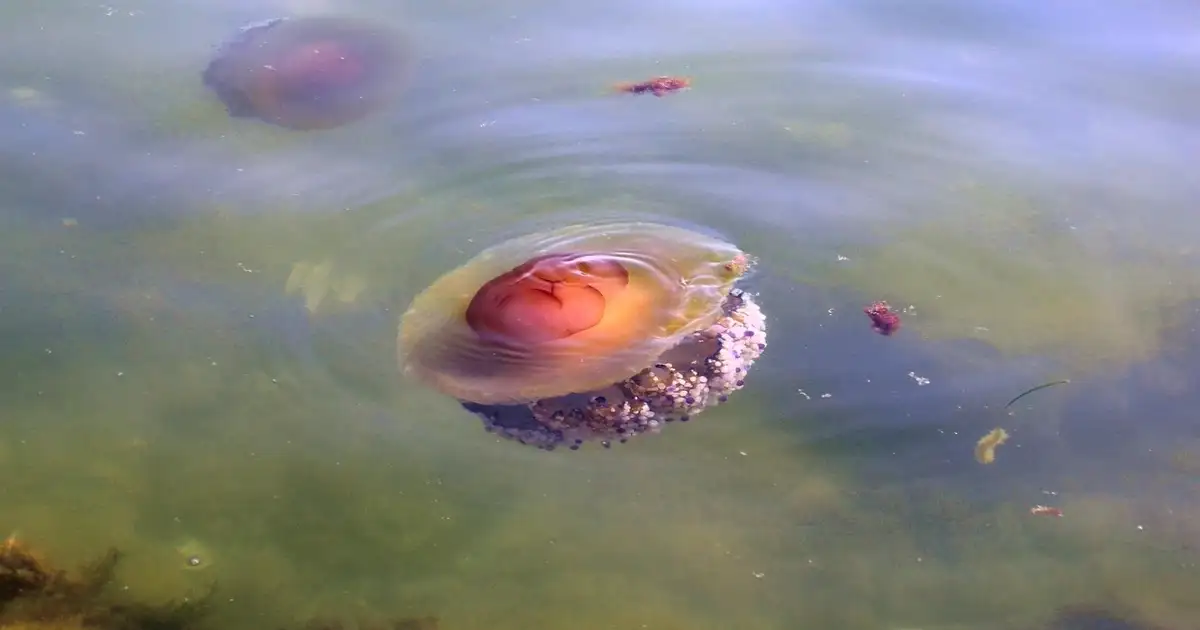

Another week, another cosmic Rorschach test delivered directly from Mars. This time, it’s a translucent ‘jellyfish’ clinging stubbornly to a Martian rock, and the internet, predictably, has lost its damn mind.
For the past 72 hours, an image captured by NASA’s Perseverance rover has dominated our feeds. It’s not for what it definitively proves, but for what it allows us to imagine.

This isn’t just a viral sensation; it’s a cultural phenomenon. It taps into humanity’s oldest, most persistent script: the desperate search for something, anything, else out there.
The image, originally snapped in late 2025 deep within the Jezero Crater, recently exploded online. A few influential science communicators amplified its peculiar contours, and a digital maelstrom followed.
Enthusiasts, armchair astrophysicists, and anyone with even a fleeting interest in the otherworldly began dissecting the anomaly. This 5-7 centimeter formation, to the untrained eye, looks suspiciously like an aquatic creature fossilized in Martian stone.
The uncanny symmetry, ethereal translucence, and almost-tentacles are all there. You just need to squint hard enough and, more importantly, truly want to believe. And let’s be honest, who doesn’t want to?
The Martian Menagerie: Why We See What We Want
The public reaction has been a familiar cocktail of awe, hope, and internet-fueled hyperbole. Forget dry statistics; the sheer volume of posts featuring this ‘jellyfish’ — millions of views, hundreds of thousands of shares — speaks volumes.
It’s a fleeting cultural touchstone, a moment that briefly unifies us in wonder. Or at least, in the shared experience of tapping ‘like’.
This isn’t about hard science for the masses. It’s about the thrilling possibility, the sci-fi fantasy bleeding into our dreary reality. It’s a collective act of imaginative projection, a cosmic game of ‘spot the alien’ that everyone gets to play, and frankly, we’re all winning by participating.
Meanwhile, the actual scientists at NASA and JPL are maintaining their cool, infuriatingly rational composure. Their explanation? Pareidolia.
That’s the endearing human quirk where we see faces in clouds, animals in burnt toast, and now, jellyfish in Martian rocks. They attribute it to a geological feature, a mineral deposit, or perhaps just a trick of light and shadow.
They’re not wrong, of course. Logic demands skepticism when dealing with data points millions of miles away.
But logic, as we all know, is often the most tedious part of the story. Especially when the alternative is so much more viscerally captivating. Who wants a rock when you can have a relic of an alien ocean?
NASA’s Accidental Blockbuster: The Power of Ambiguity
This isn’t NASA’s first rodeo with our collective imagination. Remember the “Face on Mars”?
That infamous geological formation from the Viking 1 mission launched a thousand conspiracy theories and cult followings. The ‘jellyfish’ is merely the latest, brilliantly cast installment in this long-running series.
It proves that the Red Planet remains our most fertile canvas for extraterrestrial speculation. Each new image, each tantalizing ambiguity, serves as a fresh prompt for our innate, almost desperate, desire to not be alone in the universe.
From a purely cultural perspective, these moments are pure gold. They ignite podcasts, inspire late-night monologues, and fuel endless TikTok debates.
They keep the public hooked on space exploration, even if that engagement is born more from fantasy than from peer-reviewed journals.
NASA might be focused on collecting data on past habitability, but for the average person, these viral images are the true prize. They transform abstract scientific missions into accessible, thrilling narratives.
They are the unplanned blockbusters of the cosmos. They are driven by our insatiable hunger for wonder and the profound allure of the unknown. Why settle for a scientific paper when you can have a cosmic mystery?
The Red Marker: Our Own Reflection on the Red Planet
Let’s be brutally honest. This isn’t about a jellyfish. It never was. It’s about us.
The ‘jellyfish’ in the Mars photo is less an alien organism and more a mirror. It reflects our own human anxieties, profound hopes, and undeniable need for a compelling narrative.
For NASA, these viral moments are an invaluable, organic marketing campaign. They guarantee public interest and, by extension, continued funding for their multi-billion-dollar endeavors.
Why spend a fortune on PR when a strangely shaped rock can do the job better, igniting millions of discussions for free?
And for us? It’s pure, unadulterated escapism. A momentary reprieve from the mundane, a thrilling whisper of ‘what if?’
It allows us to project our deepest sci-fi fantasies onto a distant, silent world. We don’t want a definitive scientific answer; we crave the lingering mystery.
We want the debate, the speculation, the chance to feel like we’re on the cusp of something monumental.
The ‘jellyfish’ isn’t evidence of life on Mars; it’s undeniable proof of life on Earth. Specifically, it shows the vibrant, restless life of our collective imagination, forever hungry for distraction and a good story.
NASA knows it, we know it, and the show, thank god, must go on.
Source: Google News