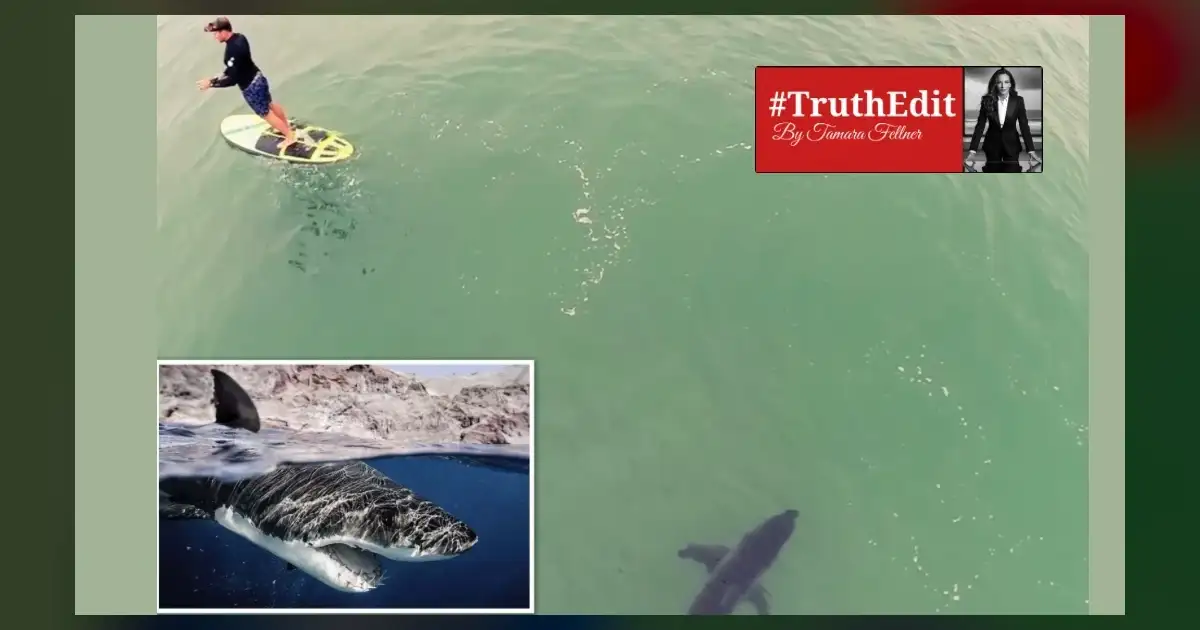

Let’s be brutally honest: the annual “shark panic” gripping California’s coasts isn’t actually about sharks at all. It’s about us – our anxieties, our thirst for drama, and the media’s relentless amplification of fear.
Despite the deafening drumbeat of alarmist headlines claiming sharks are “not scared” and pose an unprecedented danger to swimmers and surfers, this isn’t a new threat. It’s simply another summer of manufactured hysteria, and as a science communicator, I find it deeply frustrating.

The truth, grounded in evidence and marine biology, is far less dramatic than the sensational headlines suggest. Experts, local ocean users, and even casual observers are increasingly rolling their eyes at this predictable, seasonal hysteria.
The Hype Machine in Overdrive
Every year, it feels like we dust off the same old script. Social media feeds are awash with alarmist posts, often fueled by shaky drone footage and breathless commentary.
“Coastal Karens,” as some online communities affectionately (or exasperatedly) call them, clutch their pearls over dramatic “Shark Summer” headlines. This playbook feels straight out of a B-movie, meticulously designed to terrify and garner clicks rather than inform.
Consider the recent incident in Newport Beach. A surfer’s close encounter with an estimated 8-foot great white shark led to a multi-hour beach closure.
While a real event, it quickly spiraled, spawning “Sharkcarrion Summer” puns and generating disproportionate fear. Yet, for many locals who spend their lives by the ocean, the reaction was largely a shrug.
They understand that the ocean is a wild ecosystem, not a chlorinated swimming pool.
The public reaction online, particularly on platforms like Reddit and X (formerly Twitter), is often brutal in its common sense. Users savage the panic, pointing out the obvious with comments like, “Bro, it’s their ocean, you’re the intruder.”
This collective eye-roll is a powerful counter-narrative to the manufactured fear, suggesting that many people are far savvier than the sensationalist media gives them credit for.
The Cold, Hard Facts: What the Data Really Says
Let’s step away from the emotional appeals and look at the actual numbers. The data paints a remarkably clear picture.
Since 1950, California has recorded fewer than 250 shark incidents involving humans. Even more tellingly, fewer than 20 of these incidents have been fatal.
To put that into perspective, you have a significantly higher chance of being struck by lightning or dying from a bee sting than from a shark bite in California.
The vast majority of these incidents involve white sharks, and they largely occur during what’s known as “peak bite season”—typically late summer and fall, when water temperatures are warmer. Surfers are most often involved, primarily because their activities place them directly in these natural habitats, often mimicking the movements of seals or other prey animals.
Dr. Chris Lowe, a renowned marine biologist and director of the Shark Lab at CSULB, offers a clear, evidence-based explanation for recent observations:
“An unusually warm winter pushed juvenile great whites shoreward. These young sharks are essentially ‘clinging’ to Southern California, seeking comfortable waters and abundant food sources. They are not acting like some vengeful Jaws 2.0; they are simply following their natural instincts in a changing environment.”
This behavior is entirely normal for young, developing sharks. They are seeking areas with warmer water, which aids their metabolism and provides a safer environment away from larger, adult predators.
They are not suddenly more aggressive or “not scared”; they are simply being sharks in their natural environment.
Who Benefits from the Fear? The Economics of Panic
Who truly benefits when fear takes hold? The answer is often simple: anyone selling something.
Influencers hype drone videos of fins for clicks, driving engagement and ad revenue. Fear sells everything from specialized shark-repellent gear to simply more ad impressions for news outlets.
The reality, devoid of hyperbolic language, is far less exciting and therefore less profitable.
The USGS (U.S. Geological Survey) has noted a surge in sea otter “chum jobs”—instances of sharks feeding on sea otters. This isn’t a sign of sharks suddenly developing a taste for humans; it’s a clear indication of natural predator-prey dynamics at play within the marine ecosystem. Sharks are targeting their usual food sources, not suddenly seeking out human “Happy Meals.”
The people who truly understand the ocean—the surfers, the fishermen, the coastal residents who spend their lives immersed in it—get this. They understand the inherent risks and the profound beauty of a wild place.
Many locals simply state, with a wry smile, “They don’t want your vegan kale smoothie.” The ocean is their home, their hunting ground, their entire world.
We, as humans, are merely guests in their domain. This basic, ecological truth seems to be consistently lost in the manufactured panic.
The Real Danger: Misinformation and Ecological Illiteracy
The actual danger isn’t an unprecedented shark invasion or a sudden shift in marine behavior. It’s the insidious spread of misinformation, amplified by media outlets prioritizing sensation over science.
It’s the constant amplification of every ripple into a tidal wave of terror, fostering ecological illiteracy and an irrational fear of the natural world.
Despite the persistent “shark panic,” beaches across California remain packed. People still flock to the coast, eager to enjoy the sun and surf.
This inherent disconnect between the alarmist headlines and the public’s actual behavior demonstrates that many people see through the exaggerated claims. Sarcastic comments like “Stay out of the water if you’re scared, Darwin award pending” continue to abound online, highlighting a healthy skepticism.
As a society, we desperately need to focus on science, not sensation. We need clear, evidence-based reporting that educates rather than frightens.
This means fostering a deeper understanding of marine life, appreciating its complexity, and recognizing our place within the ecosystem, rather than demonizing creatures that are simply trying to survive.
The ocean is, and always has been, a wild and untamed place. The sharks are doing what sharks do.
Perhaps it’s time we stopped projecting our fears onto them and instead focused on our own behavior, our responsibility to the planet, and our capacity for rational thought.
The true threat isn’t a shark fin in the water; it’s the fear-mongering that keeps us from truly understanding the world around us.
Source: Google News