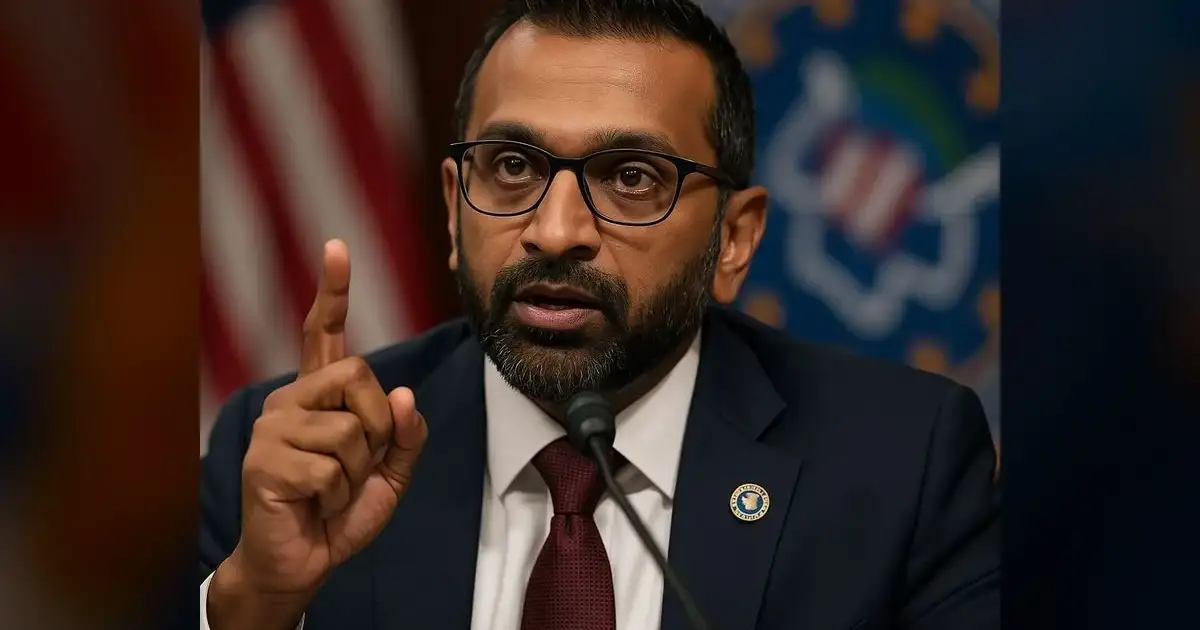

Kash Patel’s audacious $250 million defamation lawsuit against The Atlantic isn’t merely a legal maneuver; it’s a bare-knuckle political power grab, a cynical weaponization of the courts designed to silence critics and further energize the ever-present Trump machine. This isn’t about truth or reputation; it’s about control.
Patel, a figure whose proximity to power has only amplified his combative stance, and notably, Trump’s speculated pick for FBI director, unleashed this colossal suit on April 18, 2026. His claim centers on an article in The Atlantic that he alleges falsely reported him getting blackout drunk and screaming obscenities at staffers during a 2017 White House event. Patel dismisses the story as “reckless fiction” and demands a full retraction, yet the sheer scale of the damages sought suggests a motive far grander than simply clearing his name.

The Real Battle: A War for Narrative Supremacy
This lawsuit extends far beyond a simple drinking anecdote. It’s a calculated escalation in the relentless war for narrative control that defines modern Washington.
For years, Donald Trump and his loyalists have systematically branded mainstream media outlets as “enemies of the people,” launching an unprecedented assault on journalistic credibility. Patel, a key architect and enforcer within this ecosystem, is merely opening another front in this ongoing culture war.
His legal action sends an unmistakable signal: any reporting that dares to challenge the established, preferred narrative will be met with overwhelming force. This isn’t a novel strategy; it’s a well-worn playbook, refined over years, designed to sow chaos, cultivate doubt, and ultimately, benefit those who thrive on division and a fractured information landscape. The goal isn’t just to discredit a story; it’s to dismantle the very mechanisms of independent scrutiny.
The Internet Explodes: Mockery, Loyalty, and Digital Warfare
The online reaction to Patel’s lawsuit was not just immediate, but utterly predictable, mirroring the deep partisan chasm that cleaves American society. The internet, as always, swiftly devolved into a battleground of memes, accusations, and tribal loyalties.
On Reddit, left-leaning forums like r/politics erupted in savage mockery, a digital carnival of schadenfreude. Users gleefully questioned Patel’s liquor tolerance, Photoshopping him into absurd scenarios, from chugging vodka at J. Edgar Hoover’s desk to stumbling through the West Wing.
One top comment, dripping with sarcasm, quipped,
“Kash can’t handle his liquor or the truth.”These users, well-versed in Patel’s past controversial statements and his role in the Trump administration, viewed the lawsuit not as a quest for justice, but as an unhinged, desperate act.
Conversely, the right-wing subs, exemplified by r/Conservative, instantly rallied to Patel’s defense, framing the suit as a righteous counter-attack. They decried it as a “Deep State hit job,” blaming “Atlantic’s Soros-funded lies,” and claiming it was a cynical sabotage attempt against “Trump 2.0.”
The dark humor on this side was equally pointed, with one user suggesting,
“A real FBI boss would just spy on the journalists, not sue them.”This stark contrast in online sentiment underscores the profound distrust for institutions, including the media, on both sides of the political spectrum.
The firestorm inevitably spilled onto X/Twitter, where #KashPatelLawsuit generated a staggering 1.2 million posts within hours. Even Elon Musk, the platform’s owner and a vocal critic of mainstream media, weighed in, quote-tweeting the news with a terse, yet impactful endorsement:
“Media malpractice at its finest—good luck Kash 💥.”
This high-profile backing from Musk, with his vast following, undeniably fuels anti-media sentiment and lends a veneer of credibility to Patel’s claims for millions of followers.
On the opposing side, critics like the sharp-tongued analyst Mehdi Hasan piled on, snarking,
“Patel’s suing over drinks? Bro, we saw your Jan 6 fever dreams.”The online discourse isn’t just a reflection of American politics; it’s an active, performative extension of it, tailored for an audience already deeply entrenched in their respective camps.
The $250 Million Question: Intimidation or Justice?
Let’s not mince words about the money. $250 million is an astronomical, almost comical, figure for a defamation suit. This isn’t about meticulously calculated actual damages to a reputation; it’s about sending a message with the force of a wrecking ball.
This sum is designed not just to grab headlines, but to overwhelm the defendant, to drain their legal resources, and ultimately, to force a capitulation or a financially crippling settlement.
This is classic Washington hardball: the powerful leveraging the legal system as a blunt instrument against those who dare to challenge them.
The Atlantic, regardless of the merits of the case, will face monumental legal costs, a financial burden that can cripple even well-established publications.
This is precisely how the establishment operates: by making an example of someone, they ensure other journalists think twice, hesitate, and perhaps, self-censor before reporting critical stories about powerful figures. Who genuinely profits from this? Certainly not the average American taxpayer, who is subjected to more political theater and the erosion of journalistic independence.
Instead, it’s the powerful, consolidating their control over the flow of information, who emerge victorious.
The Chilling Effect: Muzzling Dissent and Undermining Accountability
The true, insidious goal here is to create a chilling effect across the journalistic landscape. This lawsuit aims to instill fear, to deter uncomfortable reporting, and to significantly limit critical analysis of political figures like Patel.
He and his allies aren’t just seeking to win a case; they seek to dictate what gets published, to control the terms of public discourse itself.
This is how power operates in D.C. – it’s rarely subtle, and often brutal.
This isn’t just about a single article; it’s about the future of independent journalism and its vital role in holding powerful figures accountable. It’s a dangerous game with profound implications for the health of our democracy.
If this tactic succeeds, other outlets will undoubtedly take notice. They might become risk-averse, opting for self-censorship, shying away from controversial topics, or pulling punches when reporting on those in power.
Such an outcome would make the already murky waters of the Washington swamp even more opaque, leaving the public less informed and more vulnerable to unchecked power.
What Happens Next: A Long, Dirty Fight with Political Payoffs
This lawsuit is destined to be a protracted, drawn-out battle, generating an endless stream of headlines and serving as prime fodder for cable news debates and political rallies.
For Patel and his allies, the actual legal outcome might well be secondary to the process itself. The process, in this context, becomes the punishment.
The incessant noise, the accusations, the narrative of victimhood – these are the real victories. It allows them to further entrench their narrative of a biased, hostile media, rallying their base around a perceived existential fight.
This is, unequivocally, another election-year tactic, plain and simple, designed to extract maximum political capital.
The legal system, sadly, has become yet another arena for political warfare in Washington. This is the cynical, calculated reality of our capital today, where lawsuits are wielded not as tools for justice, but as strategic weapons in a broader ideological conflict. Kash Patel’s $250 million lawsuit against The Atlantic isn’t just a legal filing; it’s a stark, unsettling reminder of how power operates in the nation’s capital, prioritizing intimidation and control over any genuine quest for truth.
Photo: Photo by exit78 on Openverse (flickr) (https://www.flickr.com/photos/28826830@N00/54604489737)
Source: Google News